
Where outdoor speakers belong on a property
The patio gets poured first. Then the beds get planted, the irrigation goes in, the walk gets set, the landscape lighting gets run. Sound comes up last, usually in a conversation that starts after everything outside is finished and somebody notices there is no music at the pool.
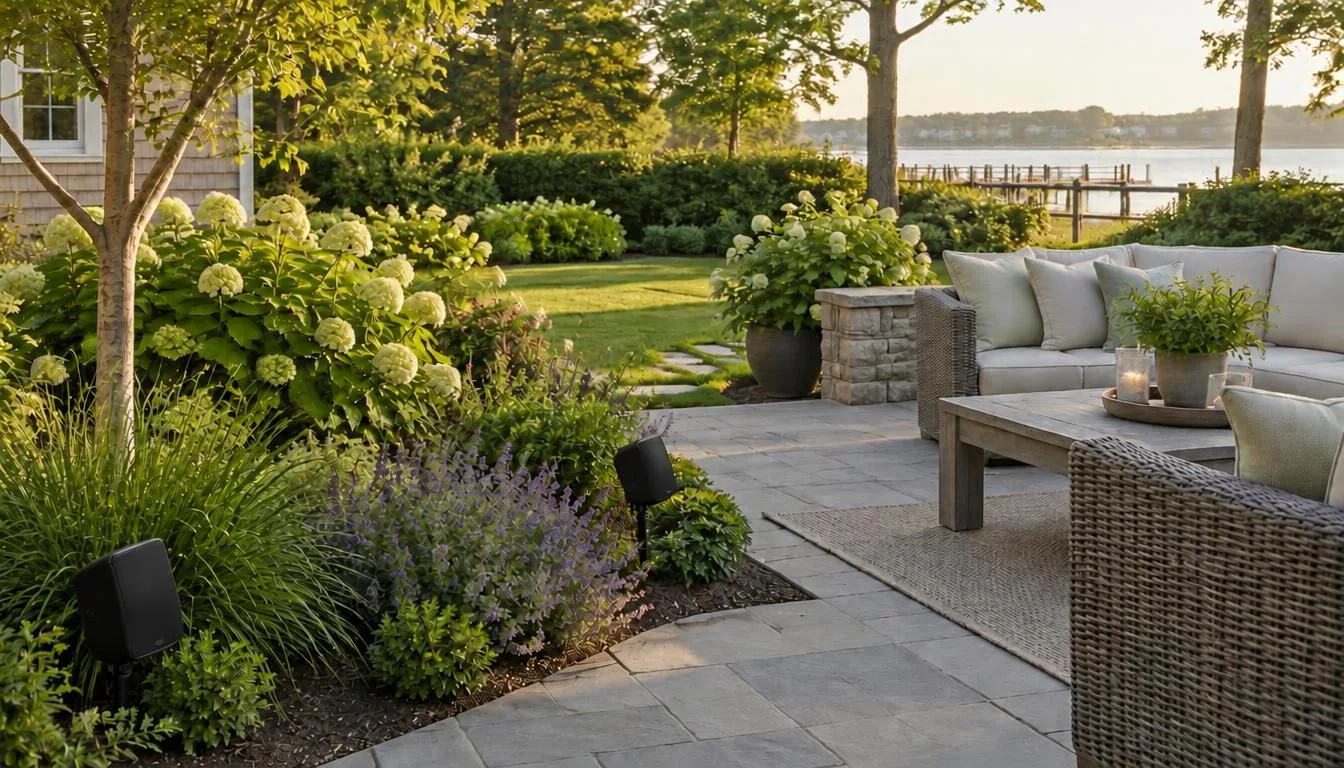
The order these systems get built in
By that point the easy locations are the back wall of the house, the underside of the eave, and whatever sits nearest to where power already reaches the outside of the house. The good locations are under mulch, behind plantings, or on the far side of a walk that is now stone.
That ordering explains most of what gets found in the field. A pair of speakers bolted to the back of a house is rarely the product of a siting decision. It is the product of being last in line.
Elevation, and what it does to aim
A speaker mounted high under an eave is a source pointed down and out. The people on the patio are below it and close, in the part of the pattern that is loudest and least even. The far end of the yard is in the tail of it. Outdoors there is nothing to help: no walls to reinforce anything, no ceiling, nothing returning any part of what leaves the speaker.
The usual response to a quiet far end is level, because level is the only adjustment available on a system that is already mounted. Level does not change direction. A high speaker aimed outward and turned up is a high speaker aimed outward, now reaching farther past the property line as well as farther into the yard. Elevation and aim determine where the sound goes; level determines only how far it gets.
There is a second effect that almost nobody looks for. Hard siding or stucco directly behind a mounted speaker returns part of what the speaker sends backward, which thickens and muddles the sound in the strip of ground closest to the house — which is where the seating usually is.
Wall mounting is not always wrong. A small covered porch, a narrow deck with one seating area and a long distance to the nearest neighbor: a pair under the eave can be entirely adequate there. "It still works" and "it would be useful" are two different standards, and a wall position passes the first one far more often than the second.
The planting bed as a location
A speaker sited low in a bed and aimed inward at a seating area is in an entirely different geometry. The listeners sit roughly on the axis of the pattern. The distance is short, so the level required is low. What gets past the property line is whatever clears the plantings and the fence at a level that started low to begin with.
Foliage and mulch take some of the high range out of anything that grazes them, which is why the same speaker sounds softer sited in a bed than it does on a bare wall. Softer in the high range is usually the direction an outdoor speaker needs to go anyway, since there is no room to warm it up.
Beds also stay workable. A bracket on a wall is a hole, a fastener and a bead of sealant in a facade, and changing it changes the facade. A unit sited in a bed can be shifted while the bed is being worked on, which matters in a yard that gets replanted over the years.
What salt air finds, in the order it finds it
Near the water, chloride in the air is the active ingredient, and it works from the outside in. In order of how often it turns up:
The grille goes first. Painted or anodized aluminum chalks, then pits, and the finish was the only thing standing between the air and the metal.
Hardware is second. Fasteners and brackets specified for general outdoor use show rust at the heads and seize at the pivot, so a speaker that was aimable the day it went in is no longer aimable by the time anyone wants to aim it.
Third, and the one nobody checks, is the connection. Copper strands wick moisture, go green from the cut end inward, and lose conductivity gradually rather than all at once. The symptom is a zone that got quieter without anyone being able to say when, and a speaker that goes unsuspected because the speaker is fine. The joint between cable and speaker is where outdoor audio fails most often, and it fails without looking like anything at all from the patio.
Coastal-rated hardware exists for this reason. What a manufacturer says about coastal use is a statement about specific materials and finishes, and it carries more weight than the general word "outdoor" on a carton. Sealing those joints is part of doing the work properly, and it belongs to the people doing the work. It is also the single detail most likely to be the reason a quiet zone shows up later. Smart Tek does not run a bench and does not take speakers in for repair; when a product fails on its own terms, what the manufacturer's warranty provides is what there is.
Why outdoor cable has a different jacket
Speaker cable sold for indoor use has a jacket formulated for a dry, dark, conditioned space. Outdoors it meets three conditions it was never compounded for. Ultraviolet light breaks down the plasticizers that keep the jacket flexible, so it stiffens and then splits. Water finds any opening and travels along the strands by capillary action, toward whichever end is warmer. Freeze cycles work at every kink and every staple until the jacket opens there.
Cable rated for wet locations and direct burial is a different product. The jacket is compounded for sunlight and moisture, and some versions carry a filled core so that water entering at one end cannot travel the length of the run. It is a different material doing a different job — the least visible part of an outdoor audio system, and the most common reason one ends up being done twice.
Where the electronics end up
The amplifier and whatever streams to it belong indoors in conditioned space, or in an enclosure built to keep weather and insects out. Heat, humidity and insects end outdoor electronics, roughly in that order, and an amplifier in a yard is also an amplifier nobody can reach. Only the speakers and the cable are outdoors by design.
That carries a siting consequence people do not anticipate. Every speaker location has to have a plausible cable path back to one interior point. The far corner of a yard can be an excellent place for sound and a difficult place to reach once a stone walk, a pool deck and a driveway sit between it and the house.
What the order of assembly costs later
The sequence tells the story. The patio was poured before anyone asked where the music needed to be. The irrigation and the lighting went in while the ground was open, and sound was not part of that conversation. By the time it was, the only remaining path ran up the wall of the house, and the only remaining location was wherever that path ended.
Cheapest, and first in any honest order of operations: knowing where people actually sit, while the ground is still open and before a single product is specified. Expensive and later: a cable path across a finished landscape, or a facade carrying brackets the household looks at every evening. Last and most expensive: doing the whole thing again because the joints were the wrong joints for air coming off the water.
FAQ
Frequently asked questions
A speaker high on the house is aimed down and out, so the patio sits in the loudest and least even part of its pattern while the far end of the yard gets the tail of it. Outdoors nothing returns any of it, since there are no walls and no ceiling to help. Raising the level does not change direction, so it travels farther into the yard and farther past the property line at the same time.
Sited low and aimed inward, they put the listeners roughly on the axis of the pattern over a short distance, so the level needed is low to begin with and less of it carries on. Foliage and mulch take some of the high range out of whatever grazes them, which is generally the direction an outdoor speaker needs to go. A bed also stays workable over the years in a way that a bracket set into a facade does not.
Chloride in the air works from the outside in. Finishes on grilles chalk and then pit, fasteners and brackets rust at the heads and seize at the pivot, and the joint between cable and speaker wicks moisture and loses conductivity gradually rather than failing outright. That last one is the most common and the least visible, which is why a zone that has gone quiet is more often a connection than a speaker.
Its jacket is formulated for a dry, dark, conditioned space. Sunlight breaks down the plasticizers that keep it flexible so it stiffens and splits, water travels along the strands by capillary action, and freeze cycles work at every kink until the jacket opens there. Cable rated for wet locations and direct burial uses a jacket compounded for those conditions, and some versions carry a filled core so water entering one end cannot travel the length of the run.
Plan the outdoor sound
For speaker layout, outdoor TVs and yard sound, see Outdoor Entertainment. For music that also plays inside the house, see Audio / Video Systems. Lights in the same beds are covered under Lighting & Shade Control.
Our town guides for Port Washington and Centerport cover outdoor sound near the water.
Talk through the problem
Call 631-656-9180, Mon–Fri 8 AM–6 PM and Sat 9 AM–1 PM, or tell us what is happening through the contact form. We serve Long Island, Manhattan and the Hamptons.