
Why there is no right viewing distance
"How far back should the couch be for a 75-inch TV?" It is one of the most common questions we get, and it has no answer, because the question is missing three of the four things that decide it. That sounds like evasion. It is not. There are real numbers underneath this, they are knowable, and they come from geometry and from the limits of human vision rather than from anybody's opinion. The reason a single figure keeps failing is that four separate quantities are involved — how wide the picture is, how far away the eye is, how much detail the picture contains, and what is actually being watched — and a rule that names only one of them has quietly guessed at the other three.
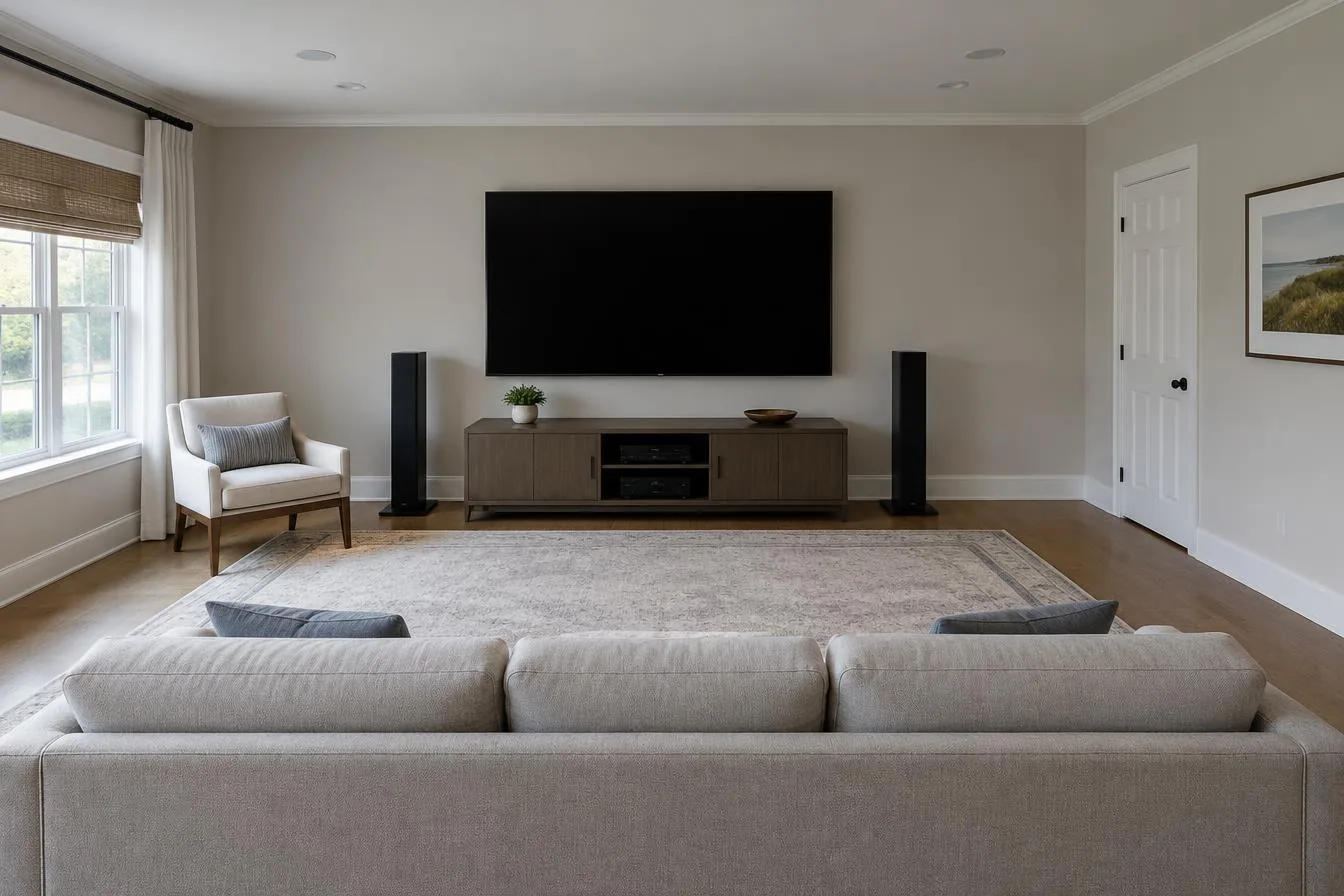
The diagonal is the wrong number to start from
Televisions are sold by their diagonal, which is the one dimension of a screen that nothing in the room cares about. The eye's experience of a picture is governed by how much of the visual field the picture fills horizontally, because that is the direction human vision sweeps across and the direction the image is composed in.
The diagonal always overstates the width. For a 16:9 rectangle — the shape of essentially everything on a modern screen — the corner-to-corner measure runs roughly fifteen percent longer than the horizontal measure. That is not a specification anyone publishes; it is the Pythagorean theorem applied to a 16-by-9 box, and it comes out to about 1.15 times the width every time, for every brand, at every size. Conversion figures circulate online that are higher than that, and a wrong multiplier makes a screen look narrower on paper than it is in the room.
Fifteen percent sounds academic until it decides a purchase. Between two screens whose diagonals are a few inches apart, the difference in actual picture width is smaller than the numbers on the boxes suggest. People who shop on the diagonal regularly end up with less additional width than they paid for, and they do that in both directions: the gain from stepping up a size is often less than expected, and so is the loss from stepping down.
Mounting depth is part of the real distance too. A screen on an articulating arm, or sitting on a cabinet with its own footprint, is closer to the sofa than the wall is. Nobody watches the wall.
What the eye can actually resolve
Human visual acuity has a ceiling. Beyond a certain angular size, two adjacent points of detail stop being two points and become one. This is why a printed page looks continuous at arm's length and like a grid of dots under a loupe, and it is the entire basis of every pixel count ever marketed.
Applied to a screen, the ceiling works like this: at any given seating distance there is a point past which adding resolution adds nothing a person can see, because the extra pixels are already smaller than the eye can separate. Sitting closer, or using a wider screen, moves that point. It is the reason the move to 4K mattered more in a theater room with a large screen and close seats than it did in a kitchen, and the reason the same panel can look genuinely sharper in one house than another with no change to the equipment at all.
The limits already in the source
Resolution is a ceiling rather than a promise. A high-resolution screen carries whatever detail the source contains and does not manufacture detail the source never had. A heavily compressed stream, a standard-definition broadcast, or an old disc transfer arrives with its limits already baked in, and a larger, closer, sharper screen does the honest thing: it shows those limits more plainly. This is why a new television occasionally makes someone's regular programming look worse, which is a confusing experience if nobody has explained the mechanism.
Scaling does not close that gap. Every modern screen stretches a smaller image to fill its panel, and the processing can make the result tidier — edges less ragged, noise less obvious — without adding information that was never recorded in the first place. What widens as the picture gets wider and the seats get closer is the distance between sources. The gap between a well-mastered disc and a thin stream is barely visible on a modest screen across a bright room and plainly visible on a large one at close range. A bigger, closer picture is a more demanding place to put an ordinary broadcast.
Where the published recommendations come from
Several organizations publish target viewing angles — standards bodies in the film and broadcast world, and the studios and theater designers who follow them. Those targets exist for a specific purpose: a reference viewing environment, where the people watching are evaluating the image and where the room, the seating and the lighting are all under control.
A living room is not that environment, and the published angles were never written for one. They are a reasonable anchor and a poor verdict. Quoting one of those figures as a household rule takes a number that was derived for a controlled room and applies it to a room with windows, a traffic path, a second row of seats and a dog. The honest statement of what those recommendations establish is directional: a picture that fills a larger share of the visual field feels more immersive and is more demanding on both the source and the viewer, and there is a band in the middle that most people in most rooms find comfortable. The precise degree value sitting inside that band is a matter for the room, not for a table.
The manufacturer's own current documentation is the place where the hard dimensions live — the actual picture width and height, the overall cabinet size, the mounting pattern. Those change by model and by year, which is why no article should be a source for them.
Too large is a real condition
The conventional wisdom is that the only risk in screen size is buying too little, and the first evening with an oversized screen disproves it quickly.
A picture that fills too much of the visual field forces the eye to work. Instead of taking in a frame, the viewer scans it — the subtitles are over here and the thing being pointed at is over there, and following a wide action sequence means moving the head. Composition stops landing, because film and television are framed on the assumption that the audience sees the whole frame at once. The effect is mild for some people and genuinely unpleasant for others, and it varies with content: a wide view that is thrilling for a feature film can be tiring for three hours of ordinary evening television.
The second cost is vertical and shows up on the wall. A larger screen is taller, and a taller screen has to start higher once its bottom edge has to clear a cabinet and a center speaker. Past a certain point the middle of the picture rises above where a seated viewer wants it, so the size that fits between the windows and the ceiling can be a size that puts the picture in the wrong place. Screen size and screen height are the same decision wearing two hats.
Bigger is useful when the distance, the source quality and the wall all support it. It is not an independent measure of how good a room is.
What actually determines the answer
The four quantities interact, and once they are laid out next to each other the decision usually becomes obvious without any arithmetic at all.
The seating distance is often fixed. In most rooms the sofa goes where the room allows it, and a fixed distance narrows the sensible range of screen widths rather than the reverse. A room still being planned has more freedom, which is why wiring and outlet locations are worth settling after the seating intent rather than before it.
The content is the second quantity, and it is the one people answer dishonestly. A screen chosen for a demonstration reel gets used for the nightly news. The material that occupies most of the evenings is the material that should drive the size, and if that material is broadcast television with its compression and its on-screen graphics, a slightly smaller picture at the same distance tends to age better than a slightly larger one.
The third is the number of seats. A screen optimized for one chair is a compromise for the other four, and a second row sits at a meaningfully different distance from the first. No single width is correct at both distances. One is usually acceptable at both, and it is rarely the largest width that fits.
The fourth is everything else the wall has to carry — speakers, cabinet, mantel, the mounting hardware itself. The screen does not get the whole wall.
Arranged that way, the question stops being how far back the couch should be and becomes which screen width the existing distance can carry, with the content and the seats already accounted for. That one has an answer.
FAQ
Frequently asked questions
Several exist, and all of them simplify. Any rule built on the diagonal alone has quietly guessed at the three other quantities that decide the answer: the picture's actual width, how much detail the source contains, and what gets watched on an ordinary evening. A formula is a reasonable anchor whose margin of error is about the size of the decision it is being used to make.
The diagonal is the one dimension of a screen that nothing in the room responds to, because vision takes in a picture across the horizontal. For a 16:9 rectangle the corner-to-corner measure runs roughly fifteen percent longer than the width, which is arithmetic rather than a published figure. Two screens whose diagonals differ by a few inches differ less in real picture width than the numbers on the boxes imply.
Yes, in two separate ways. A picture that fills too much of the visual field turns watching into scanning, so framing stops landing and following wide action means moving the head. The second cost is vertical, because a taller screen has to start higher once its bottom edge clears a cabinet and a center speaker, which can lift the middle of the picture above where a seated viewer wants it.
Higher resolution removes a penalty rather than creating a requirement. It raises the ceiling on how much detail a screen can carry, and the eye has a ceiling of its own past which additional pixels are invisible at a given distance. A sharper panel also shows the limits of a compressed stream more plainly, which is why a new screen occasionally makes familiar programming look worse than the old one did.
Plan the screen and seats
For screen size, seating and room layout, see Media Rooms & Home Theater. For choosing and mounting a TV in a shared room, see Audio / Video Systems. Screen height and wall planning are covered in our guide Before the TV goes on the wall.
Our town guides for St. James and Merrick cover TVs and audio in everyday living spaces.
Talk through the problem
Call 631-656-9180, Mon–Fri 8 AM–6 PM and Sat 9 AM–1 PM, or tell us what is happening through the contact form. We serve Long Island, Manhattan and the Hamptons.