
A brighter projector will not beat the sun
The common belief is that a bright enough projector can handle a room with windows. It cannot. No amount of brightness fixes ambient light, because brightness and ambient light add together rather than cancel, and the part of the picture that suffers is the part with no light in it at all. That is the whole mechanism, and it is worth being clear about it, because the projector-versus-television decision gets argued over resolution, lumens, contrast ratios and price when the actual dividing line is whether a room goes dark on an ordinary evening.
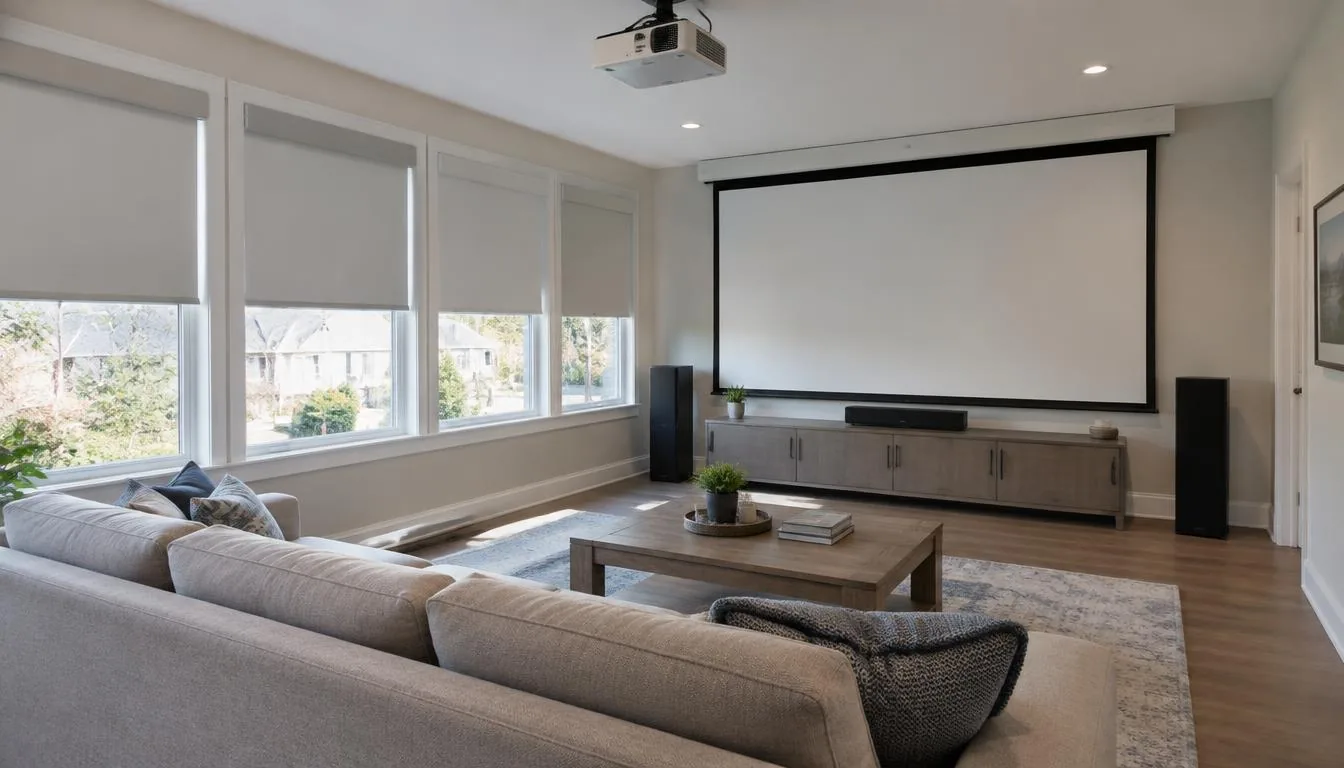
Black is the absence of projection
A projector makes a picture by throwing light at a surface and letting that surface bounce it back. Everything bright in the image is light the projector sent. Everything dark in the image is light the projector withheld.
So a projected black is not a color the system produces. It is the screen, unlit, showing whatever light happens to be falling on it from somewhere else. In a dark room that is almost nothing, and black looks black. Add a lamp, a window, a hallway light or an open kitchen, and the screen reflects that light in the dark parts of the picture exactly as faithfully as it reflects the projector's light in the bright parts.
Black turns gray. Shadow detail disappears into that gray. The distance between the brightest and darkest parts of the picture shrinks, and shrinking that distance is what makes an image look flat and washed out — a word people reach for without knowing they are describing a measurable thing.
Turning the projector up raises the bright end. The dark end stays where the room put it. The image gets brighter and no deeper, which is why a well-lit room with a very bright projector produces a picture that looks powerful and lifeless at the same time.
A panel that makes its own light
A television works from the other direction. It emits its own light, pixel by pixel, which means a dark pixel is a pixel that has been told to stop. Room light still lands on the front of the panel and still does damage, but the damage is different: it shows up as reflection and glare, concentrated where a bright window or lamp is geometrically in line with the viewer's eye.
That difference is why the two failures feel so unalike in a bright room. Light falling on a projection screen lifts the dark end of the picture everywhere in the frame at once. Light falling on a panel mostly stays where the geometry put it — a window reproduced in one corner, a lamp sitting in the middle of a dark scene — and it shifts when the viewer moves or when the screen is angled differently. The panel's finish changes the character of that rather than the amount: a glossier front keeps the reflection tight and recognizable, a more matte one spreads the same light into a haze over a wider area. Either way the result is tied to where the light source sits relative to the seats, which makes it a placement problem, and placement problems have placement answers.
What an ambient-light-rejecting screen actually buys
This is where the market offers a product in place of an answer. Specialty screen materials — the ones sold as ambient-light-rejecting — are real engineering rather than a trick. They work by being directional: the surface is built to reflect light arriving from the projector's angle back toward the seats while scattering or absorbing light arriving from other angles, chiefly from above.
So they do something. In a room where the main offender is a ceiling fixture or recessed downlights, a screen of that kind can recover a useful amount of contrast. That is a legitimate purchase. It is a legitimate purchase for a narrower problem than the one most people buy it for.
What it cannot do is reject light arriving from the same direction as the projector's own beam. A window on the back wall behind the seats, a glass slider off to the side, afternoon sun coming in anywhere near the axis the screen is built to favor — that light is indistinguishable, to the screen, from the picture. The directionality that rejects the ceiling fixture is the same directionality that welcomes the window.
These screens also narrow the useful viewing cone. Brightness and color can shift for the seat at the far end of a sectional. In a long or wide room with seating spread across it, the fix costs something at the edges.
Daylight on a screen stays a problem after the money is spent. That is the honest summary.
The dark room is where the argument flips
In a room that can actually be made dark, the whole calculation reverses, and a projector becomes the stronger choice rather than the compromise. With no stray light landing on the screen, the gray floor drops away and the image regains its depth. Dark wall and ceiling surfaces help further, because a bright picture bouncing off a white ceiling and back onto the screen is ambient light the projector generated itself.
A projector also separates picture size from the object on the wall. A large image becomes a large image rather than a large appliance, which matters in rooms where a television-sized black rectangle would dominate when nothing is playing.
None of that makes every projector right for every dark room. Throw distance, mounting height, lens shift, the available ceiling structure and the screen's own requirements all still have to line up, and a projector in the wrong position is a projector that never gets installed correctly. The dark room is a precondition, and it settles none of that.
Laser does not mean maintenance-free
The second thing sold harder than it should be is the idea that a laser light source ends the upkeep conversation.
It ends one part of it. A lamp-based projector uses a consumable light source that dims gradually across its life, and at some point it has to be replaced; the timing and the method belong to the model and its maker. A laser engine takes that recurring replacement off the table, which is a genuine advantage and worth paying for in a ceiling-mounted installation that is hard to reach.
What it does not take off the table is air. Every projector is a box that moves heat, and anything that moves air through a box pulls dust into it. Filters, intake clearance, exhaust clearance and ventilation remain whatever the manufacturer specifies, and a projector sealed into a tight soffit with no air path around it will run hot regardless of what makes the light. Heat is the thing that shortens the life of the electronics behind the lens.
When a projector of either kind does fail, it goes back to the company that built it. We handle the warranty claim and nothing opens up on a bench here — what the manufacturer offers on that claim is the manufacturer's call.
The question is the routine, not the room
One thing predicts satisfaction better than any specification on the box, and it is how the household actually uses the room on an ordinary evening.
Almost every room can be made dark. Shades close. Lamps turn off. A door shuts. Capability was never the issue. The number of evenings a year anybody actually does it is the figure that decides this, and it is usually smaller than the number quoted while shopping. A room that is open to the kitchen, used from morning onward, and shared with people who want the lights on is a room where the shades will be closed for a handful of deliberate movie nights and left open for everything else.
A projector in that room is correct for the handful and wrong for the rest. A television in a room that goes fully dark four nights a week is leaving real picture quality on the table. Both of those are ordinary mistakes, and both get made by people who were shopping specifications instead of describing their week.
So the refusal, stated concretely: a brighter projector buys a watchable daytime picture with flat blacks and no shadow detail. A specialty screen buys back some of the contrast lost to overhead light and none of the contrast lost to a window. Neither one buys a dark room, and the dark room is the only thing that makes projection look the way the demonstration looked. A room with uncontrolled daylight and a household that likes it that way is a television room, and the projector belongs in the room with the door.
FAQ
Frequently asked questions
It can produce a watchable picture and not a good one. Daylight falling on the screen lifts the dark parts of the image, because a projected black is only the unlit screen reflecting whatever else is in the room. Brightness adds to ambient light rather than canceling it, so the picture gets brighter without getting any deeper.
Partly, and for a narrower problem than they are usually bought for. They favor light arriving from the projector's angle and scatter light arriving from elsewhere, mostly from above, so they recover real contrast in a room whose offender is a ceiling fixture. Light arriving near the projector's own axis — a window behind the seats or off to one side — reads to the screen as picture. The same directionality narrows the viewing cone, which costs something at the far end of a long sectional.
No. It removes the recurring lamp replacement, which is a real advantage in a ceiling mount that is awkward to reach. It does not change the fact that a projector is a box moving heat and drawing dust through itself, so filters, intake and exhaust clearance and ventilation stay whatever the manufacturer specifies.
No. It is the only way to get one without a large object on the wall, which matters in rooms where a dark rectangle would dominate whenever nothing is playing. Televisions are built in sizes that cover a lot of this ground, and for either choice the binding constraint is seating distance rather than available wall.
Plan the picture
For projectors, screens and dark-room theater planning, see Media Rooms & Home Theater. For a TV in a shared living space, see Audio / Video Systems. Window control is covered under Lighting & Shade Control.
Our town guides for Westhampton Beach and Sea Cliff cover media rooms and viewing spaces.
Talk through the problem
Call 631-656-9180, Mon–Fri 8 AM–6 PM and Sat 9 AM–1 PM, or tell us what is happening through the contact form. We serve Long Island, Manhattan and the Hamptons.