
The wall decides more than the TV does
A room with one blank wall puts pressure on everyone standing in it. The wall reads as unfinished. It asks to be filled, and a television is the obvious thing to fill it with, so the decision gets made the way decisions get made when a delivery is already scheduled: quickly, standing up, by eye. Standing up is the problem. Almost every wall in a house is judged from a standing position, because that is the position people are in while they talk about it. Almost every television is watched from a seated one. The gap between those two eye heights is most of the reason mounted screens end up too high, and it is the reason a wall that looked balanced on a Tuesday afternoon feels wrong on the first evening someone actually uses it.
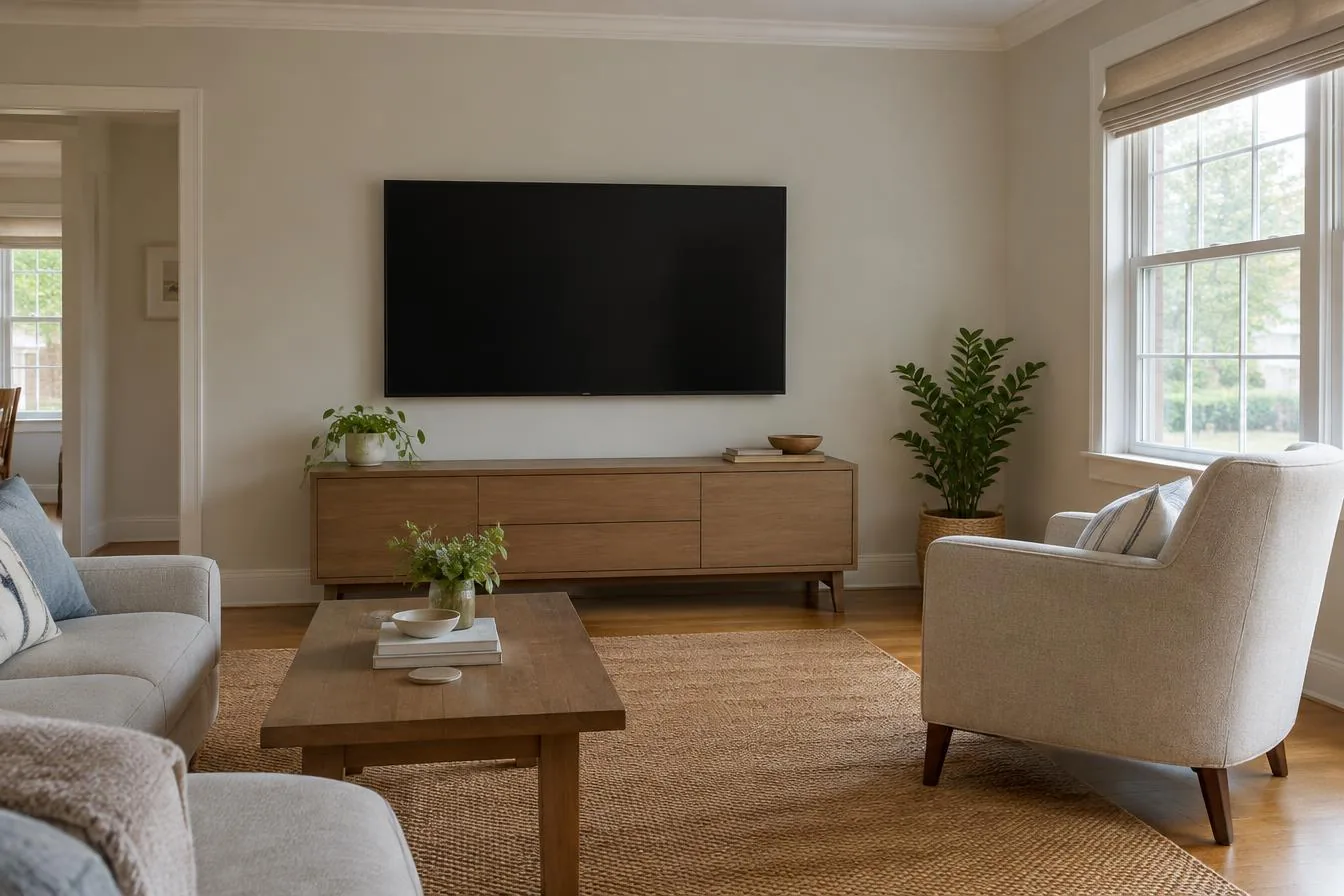
Height is a seated measurement
A screen centered on a wall is centered on the wall's geometry. It is not centered on anything a person does. The visual center of a wall usually sits well above seated eye level, and a mount that splits the difference between the baseboard and the ceiling almost always lands the middle of the picture somewhere above the viewer's natural line of sight.
The body absorbs a small amount of that without complaint. Sustained over two hours, it stops being small. Neck extension held for the length of a film is a different load from neck extension held for a glance, and the complaint it produces arrives late — a week after the install, as a vague sense that nobody really wants to watch anything in that room.
Height is also the one dimension that interacts with everything else on the wall. A center speaker or a soundbar occupies real vertical space directly under the picture. A cabinet underneath sets a floor the screen cannot drop below. Each of those pushes the screen up by its own thickness, and the pushes add. The screen height that works is the one calculated after the rest of the wall has been accounted for, which is a different number from the one that works on an empty wall.
Screen size changes the answer again. A larger picture has more vertical extent, so its top and bottom edges travel farther from the center, and the top edge of a very large screen can reach an uncomfortable angle even when the middle of the picture sits exactly where it should. So the height question gets harder as the screen gets larger.
What the surface is hiding
What reads as a single surface is an assembly, and on Long Island that assembly varies by era in ways the paint does not advertise. Newer construction is typically framed and covered in drywall. Older houses carry plaster over wood lath, which behaves like a hard shell over a soft void and holds fasteners differently. Masonry walls, exterior walls with foil-backed insulation, and walls that were opened and patched during a previous renovation all present the same smooth painted face and almost nothing else in common.
What matters more is that the cavity behind the surface is where a house routes everything it would rather not show. Electrical runs. Supply and waste plumbing. Gas lines. Low-voltage wiring from two or three previous eras of technology, some of it live, some of it abandoned in place without a label. A wall cavity near a kitchen, a bathroom above, or an electrical panel on the far side is dense with services that are invisible until something finds them.
The fact that a picture hook once held something on that wall proves that the wall held a few pounds at one point. It proves nothing about what sits two inches deeper, which is the depth a mount's lag screws reach. A television on an articulating arm also makes a lever: the farther the screen swings out from the wall, the more the fixings are being pulled outward rather than pressed down, and the load on those few fasteners climbs with the extension. A mount can be rated well above the weight of the screen and still be attached to something that was never meant to carry it.
This is the part of the project with the least reversibility and the highest consequence, and the screen itself is the easy part of it.
Power behind a screen
The outlet behind a television and the cable feeding it a picture are two separate problems that look like one problem because they end up in the same hole.
Power behind a screen is electrical work, and it belongs with an electrician, for a reason worth spelling out: the cord-and-plug assembly that ships with a television is designed to live in open air where heat can leave it and where a person can reach the plug. Cable intended to run inside a wall is a different product with a different construction and a different rating, and the distinction exists precisely because walls are closed, warm and inaccessible. Making a cord disappear and installing an outlet are not two versions of the same job.
The cable route and the future
Signal has a different enemy: the future. A single run of cable in a wall is only as good as the connector that has to pass through it on the day something changes. Routes get planned around the wire that exists today and then fail the first time a thicker connector, a different format or an additional source needs to travel the same path. Conduit helps when the bends and the end points are generous enough for a hand and a plug. Conduit sized exactly to today's cable is a decoration.
Where the sources live is part of the same decision. Equipment behind a screen has no air and no line of sight, and a box with no air gets hot while a box with no line of sight stops answering its remote. A cabinet across the room solves both and creates a cable run. Neither arrangement is wrong. They are different trades, and the trade gets made once.
The fireplace wall
The fireplace is the strongest candidate location in most living rooms and the weakest one in most measurements. Furniture is already aimed at it. The sightlines are already resolved. Everything about the room's existing geometry argues for putting the screen there, and everything about the mantel's height argues against it.
A mantel sets a floor height. Nothing about a mantel sets a viewing height. Whatever the mantel's elevation is, the bottom edge of the screen starts above it, which means the center of the picture lands higher than a seated viewer wants in most rooms with a conventional firebox. Tilting the screen downward improves the angle at which light leaves the panel. It does not lower the picture. The chin still comes up.
Heat is a separate and less forgiving constraint. A working firebox sends a plume of warm air up the face of the chimney breast, and the temperature a few inches above a mantel shelf is not the room temperature. Surrounds differ enormously in how much they deflect that plume: a deep projecting mantel does something a flush stone face does not. Two separate manufacturers have published positions on this — the fireplace maker's, on what may be installed above its appliance, and the television maker's, on the ambient temperature range its panel is warranted to live in. Those two documents govern the location. The appearance of the mantel does not, and a shelf that looks like it was built to hold a screen is not evidence of anything.
Pull-down mounts exist, and they are sometimes the right answer. They are not a way around the heat question, because the screen still parks in the hot position when nobody is watching. They add a mechanism, a greater depth, and a clearance envelope of their own.
What closes, and what stays open
Most of the choices around a television stay open indefinitely. The screen itself is a replaceable object with a finite service life; the sources attached to it will be replaced sooner than that; a soundbar can be swapped for separate speakers, and a cabinet can be swapped for a different cabinet. None of that is permanent, and none of it has to be resolved before the room is finished.
A short list closes on the day the holes go in. Height closes. The backing behind the drywall closes, or else reopening it means opening the wall. The outlet location closes. The cable route closes at whatever diameter and bend radius it was built to, and the serviceability of that route — whether a person can reach the connections in three years without taking the screen off the wall — closes with it.
A renovation is the cheap moment for all of them, because an open wall costs nothing to add backing to and a closed one costs a patch and a paint match. After the wall is closed, the same decisions are still available. They are priced differently.
The useful thing to know about a wall-mounted television is that the wall is not the last step in the project. It is the first irreversible one, and the screen that gets hung on it is the most replaceable object in the entire arrangement.
FAQ
Frequently asked questions
Because the wall gets judged standing and the picture gets watched sitting. Centering a screen on a wall centers it on the wall's geometry, and the visual center of a wall usually sits above seated eye level. Everything that lives under the screen — a cabinet, a soundbar, a center channel — pushes it higher still, and those pushes add.
Sometimes, and the limits have nothing to do with how the mantel looks. A working firebox sends warm air up the face of the chimney breast, so the fireplace maker's position on what may be installed above its appliance sits alongside the television maker's warranted ambient temperature range, and those two documents govern the location. Height is a separate constraint: a mantel sets a floor that lands the picture above where a seated viewer wants it, and tilting the screen changes the angle at which light leaves the panel without lowering the picture at all.
Yes, and by more than the weight suggests. A screen that swings away from the wall becomes a lever, so the load shifts from pressing down on the fasteners to pulling them outward, and it grows with the extension. A mount rated well above the screen's weight can still be fixed to backing that was never meant for that direction of pull.
An open wall absorbs backing, an outlet and a generous conduit path at close to no cost. A closed one adds a patch and a paint match to the same work, and a route sized exactly to today's cable fails the first time a thicker connector has to travel it.
Plan the TV installation
For TV mounting, source equipment and sound, see Audio / Video Systems. For cable routes during building work, see Smart Home Wiring & Pre-Wire. A whole viewing room is covered under Media Rooms & Home Theater.
Our town guides for St. James and Merrick cover TVs and home audio.
Talk through the problem
Call 631-656-9180, Mon–Fri 8 AM–6 PM and Sat 9 AM–1 PM, or tell us what is happening through the contact form. We serve Long Island, Manhattan and the Hamptons.