
What a thin TV does to a voice
We take a flat panel off the wall bracket and turn it over, and that is usually where the conversation about bad television sound ends. There is nothing back there. Small plastic-framed drivers, often firing straight down into the console top or straight back at the drywall. No cabinet. No volume of air behind the cone. Almost no depth to work with, on a product whose entire selling point is that it has no depth. The picture got thinner every year and the sound got worse every year for the same reason. Nobody made a bad decision. Speakers need air, and air takes space, and the space went to the panel.
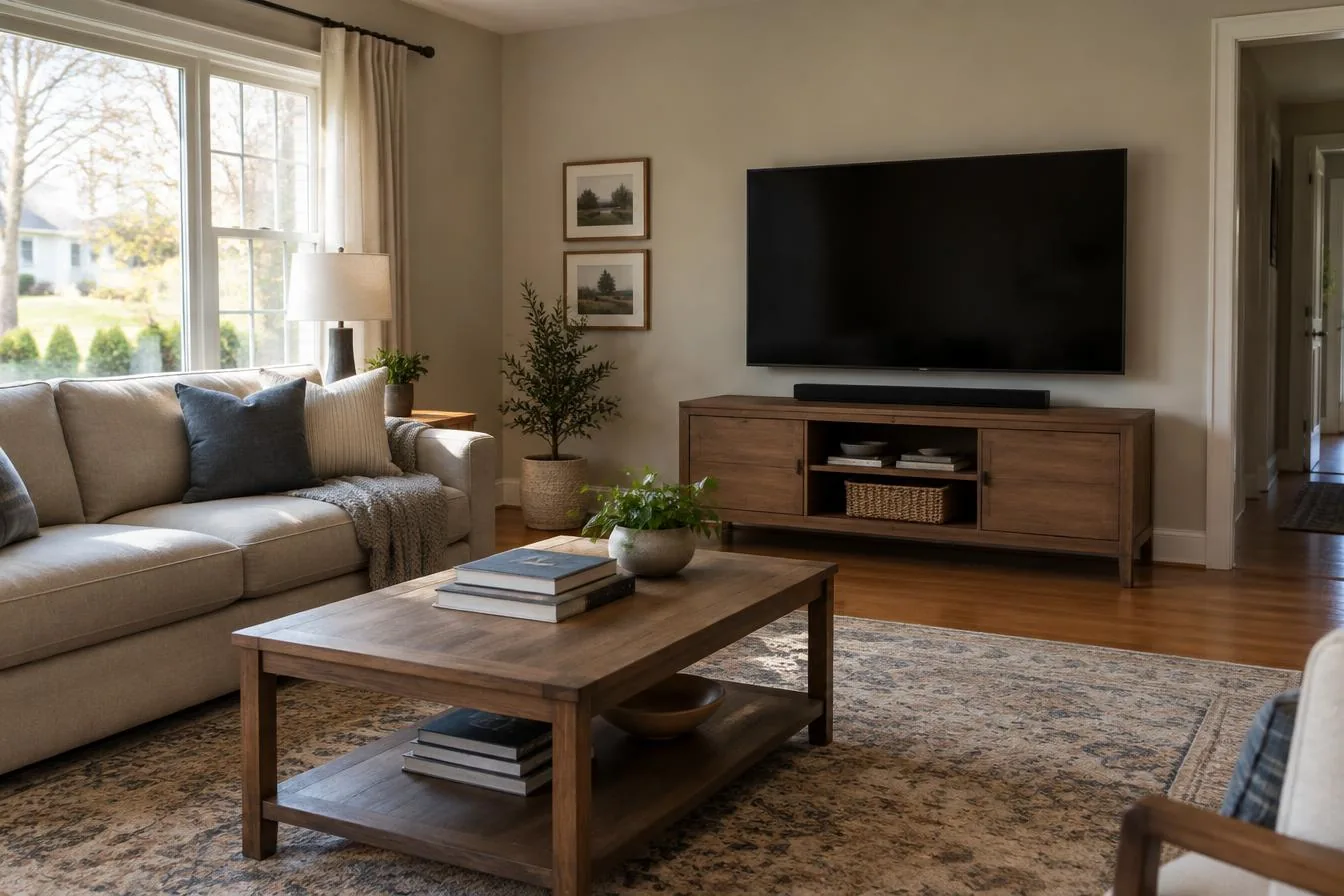
Where the sound actually goes
A driver aimed down at a cabinet top does not send sound to the sofa. It sends sound to the cabinet, and the cabinet sends some fraction of it onward, late and smeared. A driver aimed backward does the same thing off the wall. What arrives at the listening position is a reflection off that surface, and it lands after the direct sound — only slightly after, but enough.
That delay is the problem. The ear reads a sound and its own close echo as one event, and the overlap muddies the fine detail inside it. For music that detail is texture and the loss is tolerable. For speech the detail is the consonants, and consonants are the whole game. Vowels carry the volume in human speech. Consonants carry the meaning. A word with its consonants blurred is loud and unintelligible at the same time, which is exactly the complaint we get: the volume is up and the words still are not there.
Cone area is the second half of it. A small driver moves a small amount of air. Push it harder and it distorts before it gets loud, and distortion lands hardest in the range where speech lives. So the TV protects itself. Its processing compresses and limits, and the result is a sound that gets louder without getting clearer.
What the soundtrack was mixed for
The mix arrives on top of all this. A film soundtrack is built for a system with a dedicated speaker for dialogue and separate speakers for music and effects, mixed with real headroom between them. Two small drivers have to sum all of it into one output. The quiet dialogue and the loud score leave through the same pair of undersized drivers. Raising the volume raises both, so the score gets painful before the dialogue gets clear. That is not a hearing problem and it is not a bad movie.
Dialogue in a surround mix has a channel of its own, intended for a speaker at the screen, with music and effects assigned elsewhere. A panel with two drivers has no such destination, so the channel that was separated on purpose is folded back in with the score. The separation the mix was built around comes undone at the last step.
What we find in the field
Order of frequency, from what comes out of the van on a service call for bad sound.
A soundbar inside a closed cabinet. This is the most common one by a wide margin. The bar is a good product doing its job into a box of plywood. Cabinet doors on a media console are acoustic absorbers with a resonance of their own, and closing them in front of a speaker is close to not having bought the speaker.
A soundbar under a floating shelf, or recessed into millwork with a lip in front of it. Many bars send some of their output upward or sideways on purpose, and a shelf a few inches above the top surface puts a hard reflector directly in that path. The bar is then fighting the shelf.
A center speaker face-down on a shelf inside an entertainment unit, or pushed so far back into a cubby that the whole front of the box is in shadow. The center channel in a surround mix carries most of the dialogue. Burying it buries the dialogue specifically, which is why this one generates the angriest calls.
A subwoofer bought to fix speech. It will not. A subwoofer handles the bottom octaves, and no part of intelligibility lives down there. Adding one to a system with unclear dialogue adds weight under the problem and leaves the problem.
And a reasonable system in an unreasonable room. Glass, tile, a bare hardwood floor, large painted walls, a vaulted ceiling. Hard parallel surfaces return sound to the listener repeatedly and the returns pile onto the direct sound. The effect is the same smearing the TV's own down-firing drivers produce, now applied to good speakers. Furniture, rugs, drapery and upholstery absorb some of it, which is part of why a room reads as sounding better once people live in it.
Why a bar helps, and where it stops
A soundbar puts drivers in front of the listener, facing the listener, with more enclosure volume than a panel can give them. That alone recovers most of the lost consonants. It is the single highest-yield change in the whole category and for a lot of houses it is the end of the project.
The ceiling on it is real, though. One box at one location produces one sound origin. It cannot put a voice at the center of the screen, music wide to the sides, and an effect behind the room, because there is nowhere for those things to come from. Processing that claims to do it is working with reflections off the walls and the ceiling, and whether that works at all depends entirely on where those walls and that ceiling happen to be. Rooms that are open on one side generally get less out of it than rooms with symmetrical boundaries.
A bar also serves one position well. The seat at the end of a long sectional hears a different balance from the seat in the middle, and no single enclosure fixes that.
Separate speakers answer the placement question. A center channel sits at the screen where the voices belong. Left and right sit where the room allows. A receiver drives them and sets their relative levels. The cost is space, wire, a location for the receiver with air around it, and the willingness to run cable through finished walls. For a room where films are the point, or where more than two seats need to hear clearly, that is the honest answer. For a den with one chair, it is more system than the room is asking for.
The HDMI part, briefly
Audio Return Channel — ARC, and its later version eARC — is the reason a modern installation uses fewer cables than it used to. HDMI was built to carry sound and picture in one direction, from a source to the display. Once televisions started running their own apps, the sound needed to travel the other way, out of the TV and back to the speakers. ARC is the path for that, back down the same cable the picture came in on.
What it carries depends on both ends. eARC has more bandwidth and supports more audio formats, and the capability is only present when the TV, the bar or receiver, and the cable between them all support it. A mismatch anywhere in that chain quietly falls back to something simpler, and the system keeps working while delivering less than it should — which is why a setup can look correct, sound unremarkable, and have nothing wrong with any individual piece in it.
What the pattern says
The failures stack in a predictable order. The panel has no room for a speaker. The speaker it has fires away from the listener. The reflection that reaches the listener arrives late and takes the consonants with it. The processing compresses what is left. The room smears it again. Then a box gets closed in front of whatever was added to fix it.
Every one of those is a physical arrangement rather than a defect. Nothing in that chain is broken, which is why nothing in it goes back to anybody for repair — and when a bar or a receiver does genuinely fail, it goes to the company that built it and we file the claim. The rest of the time the equipment is working as designed and the design was constrained by a cabinet.
That is the thing we find most often behind a complaint about bad television sound: a sequence of reasonable choices, each one correct on its own, adding up to a room where nobody can hear what anyone said.
FAQ
Frequently asked questions
Vowels carry the volume in human speech and consonants carry the meaning. Consonants are fine detail, and fine detail is what gets destroyed when a late reflection off a console top or a wall lands on top of the direct sound. The words get louder with the volume and no clearer.
Most of it, in most rooms. A bar puts drivers in front of the listener, facing the listener, with more enclosure volume than a panel can give them, and that recovers most of the lost consonants. What one box cannot do is produce several sound origins at once, so a voice anchored at the screen and an effect behind the room stay out of reach.
No. A subwoofer handles the bottom octaves and nothing about intelligibility lives down there. Adding one to a system with muddy dialogue puts weight underneath the problem and leaves the problem untouched.
The room is half the system. Hard parallel surfaces — glass, tile, bare floors, large painted walls — return sound to the listener repeatedly, and those returns pile onto the direct signal and smear it the same way a down-firing television speaker does. Soft material absorbs some of it, which is part of why a room tends to sound better once there is furniture in it.
Plan the TV sound
For TVs, soundbars and separate speakers, see Audio / Video Systems. For a room planned around watching and listening, see Media Rooms & Home Theater. If the equipment is already there but sounds wrong, see Service & Troubleshooting.
Our town guides for Great Neck and Commack cover TVs and home audio.
Talk through the problem
Call 631-656-9180, Mon–Fri 8 AM–6 PM and Sat 9 AM–1 PM, or tell us what is happening through the contact form. We serve Long Island, Manhattan and the Hamptons.