
What closes when the drywall goes up
The framing is up. The electrician is on site, boxes nailed and homeruns pulled, and insulation is booked for the end of the week. Somebody asks whether any low-voltage wire is going in. The answer is wanted that morning, from a homeowner who has been making tile decisions for a month and has not thought about cable once. That is the actual shape of this decision. It arrives late, it arrives out of context, and it has a hard deadline nobody set on purpose.
What is on the table
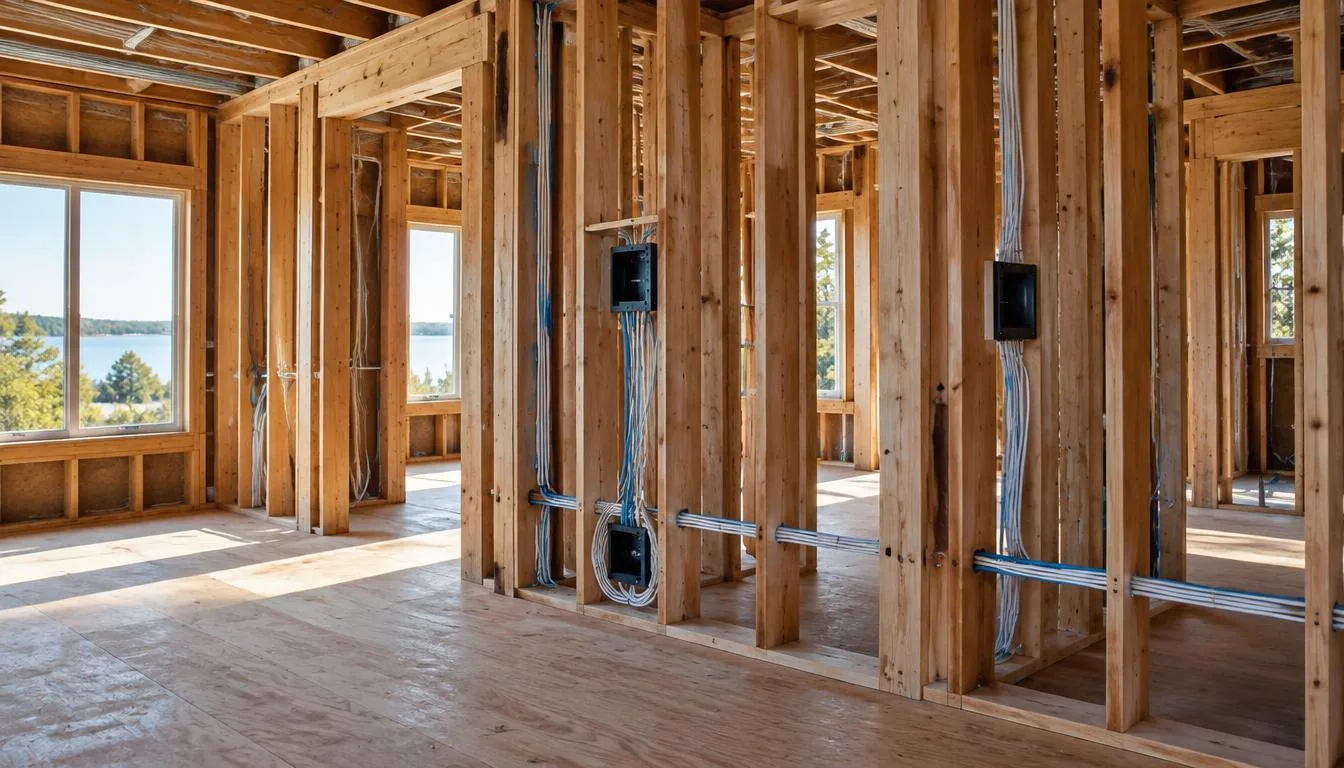
Low-voltage wire is everything that is not branch circuit power. Network cable. Speaker wire. Video cable. Control wire for lighting and shades. It goes in alongside the electrical rough-in, in the same open bays, usually by a different crew.
None of it has to terminate in anything. A run can sit behind a blank plate for years. We open blank plates in houses where the original owner never installed the television the wire was pulled for, and the wire is still good, and the second owner gets a clean install out of a decision made by somebody they never met.
The deadline is insulation and drywall. After that the same wire is a different job: cutting, fishing, patching, priming, painting, and a drywall finisher back on a schedule he already closed.
Why fishing is not the same work
A finished wall is not a wall with a cavity in it. It is a wall with obstacles in it, and we cannot see them from the hallway.
Mid-wall fire blocking sits in a lot of older framing on Long Island. Older houses carry plaster and lath, which does not patch the way drywall patches. Insulation that was blown in fills the bay the wire needed. Plumbing and ductwork take the path the wire would have taken. Any one of those turns a straightforward pull into a hole in a wall and a conversation about whether the hole is staying.
Sometimes the answer is you cannot get there from here. A second-floor ceiling under a cathedral roof has no attic over it. A soffit has been closed and tiled. A run that was easy in framing is now a run that requires opening something somebody paid to finish. We give that answer more often than people expect, and when we give it, the fallback is wireless, with everything wireless gives up.
The locations that get expensive
Not all of it closes equally. Some destinations stay reachable in a finished house and some stop being reachable at all.
Ceilings are the hard ones. The middle of a ceiling is the single worst place in a finished house to land a cable, because there is no stud bay running to it and nothing to fish along. Anything whose job depends on being in the center of a ceiling — Wi-Fi radios, overhead speakers — wants its wire while the joists are open or it ends up compromised, mounted at the edge of the room where it covers less, or not mounted at all.
Exterior corners and eaves are the next tier. A camera at the corner of a house wants one cable carrying both its data and its power, and the inside end of that run has to cross a finished ceiling or soffit to get anywhere useful. Surveillance is the thing homeowners add after they move in, which is exactly when it costs the most to add.
Anything above hardscape or under a finished slab is gone. Wire routed under a patio before the stone went down is cheap. Wire routed under a patio after the stone went down means cutting the patio and resetting stone, and the mason owns that, not us.
Behind built-ins is the quiet one. A wall that is about to receive cabinetry, paneling or a stone surround stops being a wall anyone opens again. We have fished some ugly paths to get around a millwork run that was finished months earlier.
And one spot has to exist somewhere whether anybody plans it or not: a single location where the runs come back together. A closet, a corner of a basement, a dedicated rack space. It needs power, it needs air moving through it, and it needs enough room that a technician can work with both hands. When that location gets picked after the fact, it ends up being a cabinet with no ventilation and a door that will not close over the cable, and everything in it runs hotter than it should for the rest of its life.
What the cable costs versus what the trip costs
While the walls are open, almost all of the cost is being there. The crew is on site, the bays are accessible, and the pull is the easy part. A second cable to the same destination adds very little on top of the first. That ratio is the entire economic argument for pre-wire, and it inverts completely the week after drywall.
What wireless changed and what it did not
Plenty of things no longer need a wire to them. Phones, laptops, most of what people carry, a lot of speakers, battery shades. The old idea of a jack in every corner of every room went away and is not coming back.
What did not change: the wireless devices in a house are only as good as the wired network behind them. Access points that reach each other over the air instead of over cable give back throughput and add latency, and they do it at the far end first, which is where people notice. A house with radios in the right places and no cable to them performs like a house with fewer radios.
Who is in the conversation
Three parties have to agree, and they usually have not met.
The builder or general contractor owns the schedule, which means he owns the deadline. The electrician runs power and sometimes runs some low-voltage along with it. The integrator decides what goes where and pulls the rest. The question that produces trouble when it goes unasked is which of the last two is doing which runs, because both will assume the other did.
The timing is narrow. Low-voltage goes in after framing and electrical rough-in and before insulation. That is a window of days on most jobs, and it closes whether or not anybody used it.
What we find on callbacks
Nobody has ever called us to complain that too much cable went in the walls.
The regret runs one direction, and it is specific. It is the ceiling in the family room that has no cable in it. It is the camera location at the back corner that would have taken one pull. It is the spare run to the television wall that was discussed and dropped to save a small number on a line item in a renovation that was not a small one.
We find the shape of that regret in the patches. Years later, in a finished house, the holes we cut and patch are almost always in the places somebody stood in with an open wall and a decision to make.
FAQ
Frequently asked questions
After framing and electrical rough-in, before insulation. That window belongs to the builder's schedule, not to anybody's preference, and on most jobs it is a matter of days. Once insulation and drywall are booked, the same wire becomes a cut-and-patch job with another trade attached to it.
Not for the devices that carry the house. Access points, main-room televisions, outdoor surveillance cameras and ceiling speakers all do better with a cable, and everything wireless rides on the wired network behind them. Radios that link to each other over the air give back throughput, and the far end of the house feels it first.
Often, at a different price. The work moves from a pull in an open bay to cutting, fishing, patching and painting. Some destinations stop being reachable at all, like a second-floor ceiling with no attic above it or a soffit that has been closed and tiled.
Ceilings, mostly. The center of a room has no stud bay leading to it, so a radio or an overhead speaker that wanted a wire there ends up at the edge of the room or absent. Exterior corners are the other one, because surveillance gets added after people move in.
Plan the wiring
For structured wiring and new-construction or renovation pre-wire, see Smart Home Wiring & Pre-Wire. The access points it feeds are covered under Networking & Wi-Fi, and TV and speaker locations under Audio / Video Systems.
Our town guides for Syosset and Dix Hills cover pre-wire during renovations.
Talk through the problem
Call 631-656-9180, Mon–Fri 8 AM–6 PM and Sat 9 AM–1 PM, or tell us what is happening through the contact form. We serve Long Island, Manhattan and the Hamptons.