
Letting people in when nobody is home
Most people buy a lock they can control from their phone in order to let people in. That is backwards. The value is in taking access away on a date you set, and that is the half almost nobody uses.
The painter is in the driveway at 7:40 and you are on the Expressway. He needs the side door for three days. The spare key is under the pot, where it has been for nine years. Getting him in is the easy part. Making sure the way he got in stops working on Thursday is the part that needs a system.
Three jobs people lump into one
A delivery, a dog walker and a contractor are not the same request
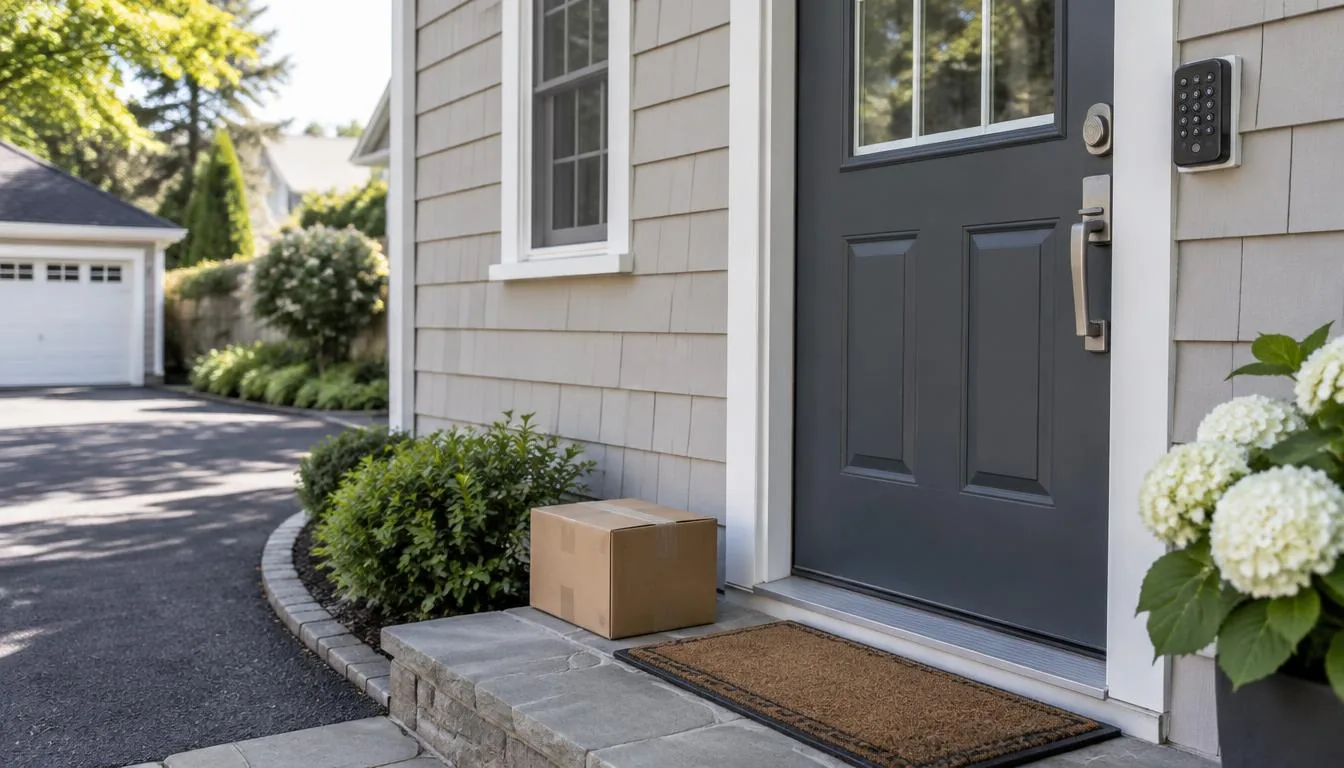
A delivery needs ninety seconds and a place to put a box. Most of the time the right answer is no access at all — a camera at the door and an instruction to leave it there. If the package truly has to come inside, that is one morning, not a standing arrangement.
A dog walker needs the same door at roughly the same time, five days a week, for as long as they have the job. That is recurring access. It should be their own code with their own name on it. When they stop walking the dog, one code goes away and nothing else about the house changes.
A contractor needs several days, often several people, often earlier than you are awake. That is temporary access with an end date, and it is the case where a permanent code causes the most damage. Crews change mid-job. People pass numbers along. The code you gave the painter in April should not still open your door in September.
A code for one morning, not a code forever
The expiring part is the feature. Without it you own a keypad.
Most controllable locks will create a code that works on a schedule or inside a date range. That is the whole reason to own one. A code that works Tuesday between 8 and 10 is not a favor you have to remember to undo. It undoes itself.
Scheduling also handles the recurring people without any attention from you. A cleaner on Tuesdays. A walker on weekday middays. A code that stops at the end of the month. Each one confines a stranger's access to the window they are supposed to be there in. Somebody trying the door on a Sunday night finds it locked.
There is a cost and it is honest: a few minutes of setup per person, and a house with eight named codes takes more attention than one code everybody knows. That attention is the product. Worth it for the people who come on a schedule. Probably overkill for your sister.
A lot of hardware gets sold on the promise of letting people in from anywhere. The part worth paying for is the part that takes access back without a phone call.
One code for everybody is an ordinary lock
A shared code cannot be revoked, and a shared log cannot answer anything
The most common way a controllable lock becomes a regular lock: one code, given to the cleaner, the walker, both kids, the landscaper and a neighbor. The lock still works fine. The record is worthless, because every line in it says the same thing.
A shared code also cannot be cut off cleanly. Remove one person and you have removed everybody, which means changing the code and notifying five people, which means nobody does it. So the code stays. It keeps working for people who left two years ago.
Individual codes cost nothing. That is the difference between a record that answers who, and a record that confirms the door opened at 9:12.
No, a lock does not tell you who walked in
That is what a camera at the door is for
The lock's history is a list of events. Code used, door unlocked, time stamped. Genuinely useful, and not the same as knowing who was standing there. Codes get shared and phones get handed to someone else, and the log reports the credential, not the person.
A camera covering the door answers what the lock cannot. How many people came in. What they carried in and what they carried out. Whether the one person you expected showed up with three you did not. Whether the door closed behind them.
Together they are far better than either alone: the time from one, the picture from the other. The camera also covers every visit where nobody comes inside at all, which at most front doors is the majority of what happens there.
A video doorbell is a legitimate purchase. It is not access control, and buying one does not solve the painter problem.
When the internet is down
The lock works. Your phone does not.
A keypad lock keeps working during an internet outage. The codes live in the lock. Your dog walker types the same numbers and the door opens with no network involved anywhere.
What stops is everything that routes through your phone. Granting access from the car. Watching the camera. Getting a notification that somebody arrived. Creating a code for the plumber who is standing outside right now. All of that needs the house online, and if the outage is at the house rather than at your office, you will not find out until you try.
Which is the argument against letting a live connection carry the access people actually need. A code already sitting in the lock opens the door through an outage. Anything that has to be created, granted or watched in the moment does not, and that is also the moment it is usually wanted. If outages are frequent at your address, that is a networking problem, and it should be fixed as a networking problem rather than worked around at the door.
Access should end when the relationship does
The code you forgot about is the code that still works
Access does not expire on its own unless you set it to. The crew that finished in spring. The house sitter from last August. The kid's friend who needed to get in once. Every one of those is a working code until somebody deletes it, and nobody deletes it, because nothing prompts you to.
The prompt has to live in the setup, because nothing else is going to supply one. An end date attached to a temporary code at the moment it is created has already handled its own removal. Codes named for the recurring people they belong to are the reason a list is readable later at all.
Most houses we look at have at least one code nobody can identify, and a code nobody can identify is a key you cannot account for.
FAQ
FAQs
Often a lock swap on the one door people actually use is enough, and that is the cheapest version that works. Houses with several entries, a gate, or a need to tie entry to cameras and other systems are a design conversation instead of a product swap.
You can create a one-time or short-window code and send it, and plenty of people do. Whether you want to is a separate question. Once somebody is inside, the door is the only thing you controlled. A camera at the door and an instruction to leave the package handles most deliveries without granting entry at all.
For contractors and landscapers the garage is frequently the better answer, because it reaches tools, a utility panel or a bathroom without opening the house. It takes the same discipline as a door code: individual access, an end date, and a view of who came and went. The interior door from the garage is a door, and it should still be locked.
Usually, and how cleanly depends on what is installed. Smart Tek is a direct dealer for Lutron, so lighting and shade work alongside entry is familiar ground; we also work with Control4 and Crestron systems through integration partners when a house is already built on one of those. Tell us what you have and we will tell you what connects cleanly and what does not.
What the lock actually buys
A lock you can control from your phone buys one thing: the painter gets in at 7:40 without a key under the pot. It does not buy the end of his access on Thursday and it does not tell you who walked through the door — those are an expiration date and a camera, and they are the two halves most people leave on the shelf.
Plan entry access
Access Control & Entry. Cameras at the door are covered under Surveillance Systems.
Our town guides for Brookville and Muttontown cover gate access and entry on larger properties.
Talk through the problem
Call 631-656-9180, Mon–Fri 8 AM–6 PM and Sat 9 AM–1 PM, or tell us what is happening through the contact form. We serve Long Island, Manhattan and the Hamptons.