
How to decide where cameras go on a house
Cameras do not really belong on a house. They belong on the few paths a person has to walk to get into one — the front walk, the driveway, the side path, the back slider, the service door into the garage. The house is only where the hardware gets fastened. The paths are what the decision is actually about, and once they are listed for one particular property the number of cameras stops being a guess and becomes a count.
Most houses need fewer cameras than people expect. Eight cameras spaced evenly around a building give you eight good views of siding. The list that matters is the set of places a person has to pass through to get in or out, and that list is shorter than the outline of the house.
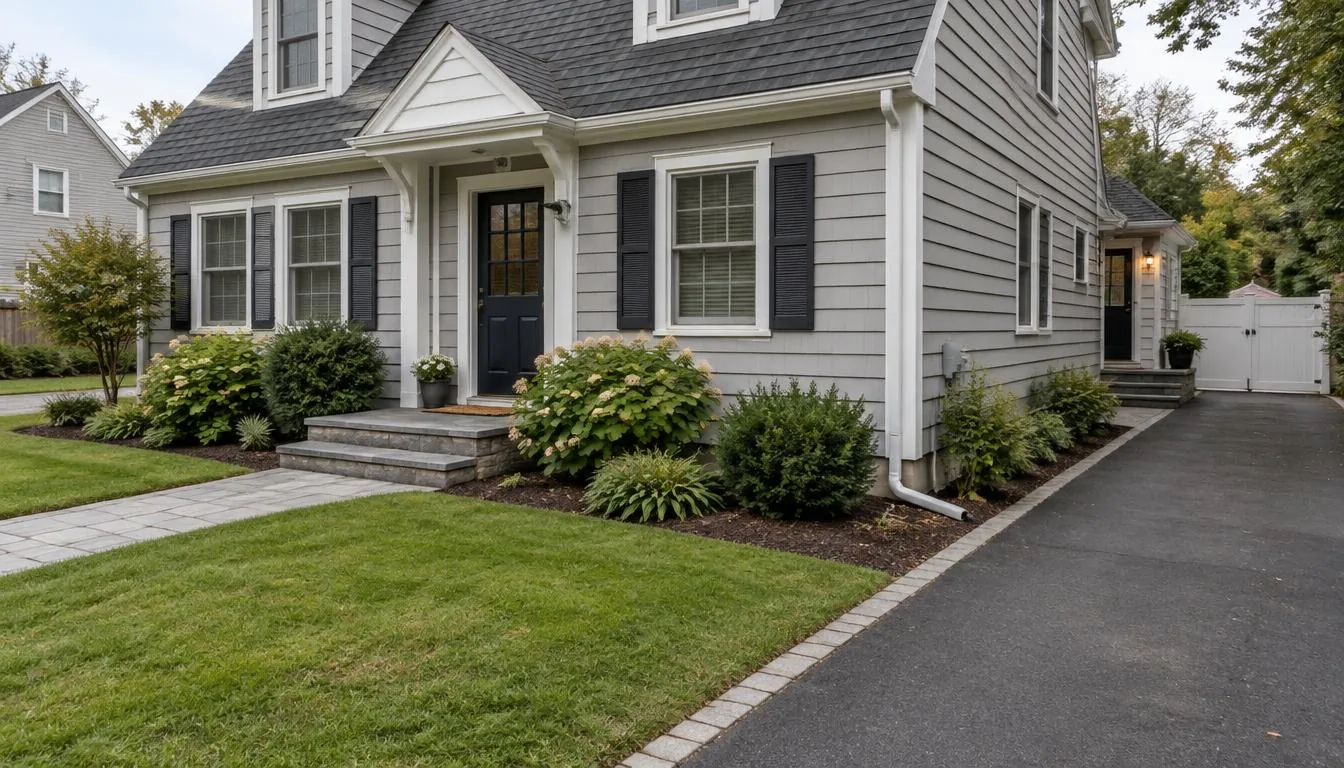
Start with the ways in, not the outline of the building
The question is where a person has to pass, not where the property ends
Think of the house the way water would think of it. Water does not spread evenly around a building; it finds the openings. People arriving at your house behave the same way. There is a front walk, a driveway, a side path, a back slider, a garage service door, maybe a gate off the deck. A few places on most properties, and two or three of them handle nearly all the traffic.
The reason the perimeter idea feels right is that it borrows a diagram from a different problem — property lines. A fence is about the boundary. A camera is about a frame. A camera pointed at the middle of your side yard records grass, weather and the occasional deer, and it will not tell you who came to the back door, because the back door is not in the picture.
So the first pass is a walk, not a purchase. The walk that matters is the one a stranger would take: in from the street, along the path they would follow, to the door they would try. The openings on that path are the frames worth buying.
The three views that carry most of the load
Front door, back door, driveway — and what each one is for
The front door camera is the one you will open most. Deliveries land there, people ring there, and it is the one location where you want a face rather than a silhouette. That means framing it close enough that a head occupies a real share of the picture, instead of a view so wide that the person is a smudge beside a large portrait of your shrubs.
The back of the house matters more than its traffic would suggest, and the reason is sightlines rather than volume. It is the side no one can see from the road. On many Long Island properties it is also where the slider, the basement door and the bulkhead all gather within a few feet of each other, which means one well-placed camera can watch the back door and the approach to it at the same time.
The driveway earns a camera because of vehicles. A plate, a color, a door opening, somebody getting out and walking off toward the house — that is a sequence, and the driveway is the only place on the property where you can record it as a sequence. If you have a detached garage or park a work van, the driveway may be the most useful single view you own.
Why mounting height costs you the face
This is geometry, not equipment
The most common thing we find on existing systems is a camera tucked under a soffit two stories up, aimed down. It is out of reach and out of the weather. It is also unable to identify anyone, for a reason that has nothing to do with the camera: a face is on the front of a head, not the top of it. From directly above, the camera records a part, a hat and a pair of shoulders.
Somewhere between the height of a door frame and a little above it is where the angle starts working in your favor. The gain from going higher is tamper resistance. The loss is identification, which is usually the only thing the camera was bought for. Both are real; one of them is the job.
Aim matters as much as height, and for the same geometric reason. A camera looking down the length of a walkway sees people approaching it, face forward, for several seconds. A camera looking across that same walkway sees each person in profile, in passing. A camera does its identifying work on whatever comes toward it.
What one camera can describe, and how far
Detail is a budget, and a wide view spends it faster
Resolution — the amount of detail a camera has to work with — is fixed, and it gets divided across whatever the lens is pointed at. Spread that same detail across a wide view and each square foot of the scene gets a thinner share of it. This is why the camera that reads a face at the front step shows you a person-shaped figure at the end of a long driveway. The camera is behaving correctly. It was asked to describe more ground than it has detail for.
A useful way to think about it: a camera has a fixed number of words and you choose how much of the scene it has to narrate. Narrate the doorstep and the description is specific. Narrate the whole front yard and you get a summary.
That makes the decision per location a short one. You want either identification, which needs a tighter view at a shorter distance, or awareness that something happened, which tolerates a wide view. Most houses want identification at the doors and awareness everywhere else, and making that one call tends to set the entire layout. The honest limit is that no single camera does both jobs from the same spot, and a wide view plus a tight view is two cameras. For how a specific model divides its detail across its field of view, the manufacturer's current documentation is the thing to read, not a general rule of thumb.
Night is a lighting question before it is a camera question
Infrared is the fallback. Light is the plan.
Cameras at night can only work with the light available to them. Infrared illumination — invisible light the camera supplies itself — produces a usable gray image at close range, which is better than nothing. It also drops color entirely, flattens detail, and falls off with distance faster than most people expect. Color at night comes from real light.
Light you already own often helps more than another camera would. A fixture over the back door, a path light along the walk, a lamp on the garage front. Light that falls where the camera is looking is what keeps the night image from being the weak half of the system. Motion-activated light works, with one caveat worth understanding: a camera watching a scene that jumps from dark to bright has to re-expose each time, and it spends the first moment of the event adjusting.
Where the light sits matters as much as whether it exists. A bright fixture inside the frame washes out everything behind it. A porch light mounted directly above a camera turns rain and insects into a snowstorm, because the lens is being shown lit particles a foot away. The subject wants the light; the lens does not.
Where a camera is allowed to look
Two separate questions, and the people who can answer each one
Mounting equipment on the outside of a house is generally regulated locally on Long Island and the East End, and the requirements are not the same from one village to the next. Some places are concerned with what gets attached to a facade, some with exterior lighting, some with anything visible from the street. We check what applies at your address before anything goes on the outside of the house. The village or town is the authority on that question; nobody else is.
Where a camera points is a different question from how it is mounted, and it is better raised before the holes are drilled. A camera covering your driveway will also take in part of the street, and that is ordinary. A camera framed so that most of what it watches is the neighbor's yard, deck or windows is a different situation, and it is the kind of thing that turns into an argument months later. We are not attorneys and this is not legal advice; it is a question to settle during the walkthrough.
The remedy is usually small. A few degrees of rotation, a tighter view, or a move to the other side of the opening. The result covers your own property without pointing into someone else's, and it is work that belongs in the walkthrough rather than in a return visit to reposition.
FAQ
FAQs
Fewer than most quotes include. On a typical Long Island house, the front door, the back door and the driveway cover most of what people actually go looking for. A side path, a gate or a detached garage can earn one more. The number should come out of counting the ways in, not out of a package.
Some people do, usually in a main hallway or over a back entry, and it has real value when the question is what happened after someone came through a door. It is also the camera your family will have the strongest feelings about, so it belongs in a household conversation rather than an install detail. Placement matters more here than count.
It covers the doorstep, which is a large share of the value, and at that one opening it is often enough. What it cannot do is move: it sits where the old doorbell was, at that height and that angle, which may not be where you would have chosen to mount a camera. Treat it as the doorstep view, not as coverage of the front of the house.
Some can, and whether it holds up depends on the house, the construction and how many devices are already competing on the network. Wired cameras remove the question. They are usually the better answer where walls are open or an attic run is possible. If the network is the weak link, fixing the network first is the cheaper path.
What the layout comes out of
So the facts end up arranged like this: the ways in are a short list, identification needs a close view at something near door height, awareness tolerates a wide one, and night is settled by the light already on the house before any camera is chosen for it. Which openings get a face and which get only awareness is the homeowner's call, and the whole layout comes out of that one call.
Plan the camera layout
For camera placement, recording and remote viewing, see Surveillance Systems. If an existing system needs checking, see Service & Troubleshooting. Exterior lighting is covered under Lighting & Shade Control.
Our town guides for Kings Park and Locust Valley
Talk through the problem
Call 631-656-9180, Mon–Fri 8 AM–6 PM and Sat 9 AM–1 PM, or tell us what is happening through the contact form. We serve Long Island, Manhattan and the Hamptons.