
Why your old cameras look worse than day one
Ladder goes up on the driveway side. The camera comes off the bracket and you can read the whole story before the glass is clean. Front element gone milky. Gasket hard as a washer off an old hose bib. Two wasps in the mounting arm.
Somebody clips the mailbox. Days later the homeowner pulls that camera up and gets a gray band across the top of the frame and a car-shaped smear. Years ago it was sharp enough that they remember being impressed. Nothing was changed. Nothing was ever reported broken. It got worse at a rate too slow to notice.
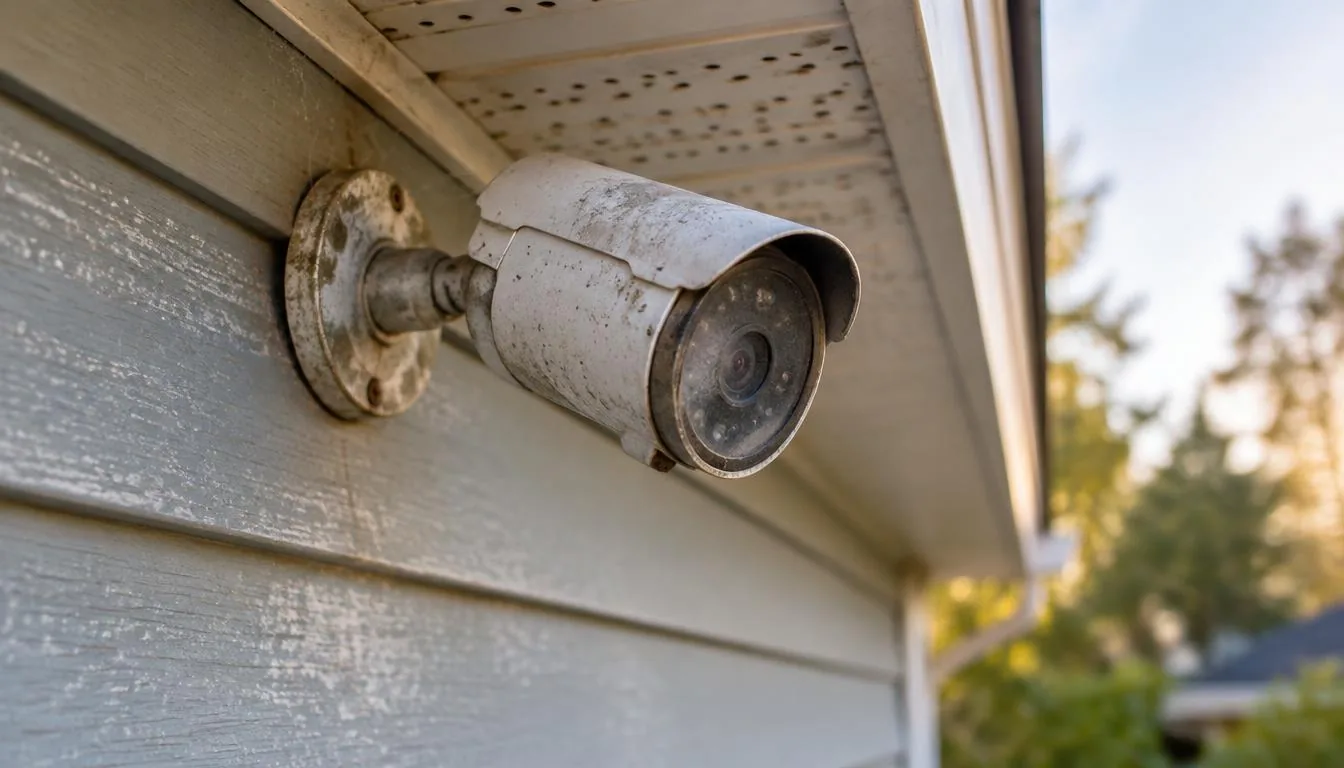
What we find when the camera comes off the bracket
Lens, housing, seals, infrared array, cable. Each one fails its own way.
The lens goes first, from the outside in. Pollen, exhaust film, pressure washing, salt, UV. The front element hazes over. Haze does worse than dim the picture — it scatters light. Contrast dies. Every bright point blooms. A hazy lens on a good sensor looks exactly like a bad sensor, and that is what gets blamed.
Housings and seals run their own clock. Plastic goes brittle in sun. Gaskets harden and quit sealing. Once moisture is inside the housing it fogs the glass from behind, where no cleaning reaches. Condensation inside a camera means the seal is finished. Seals do not come back.
Infrared arrays dim with use. They only run at night, so nobody watches them go. The daytime picture holds up while the night picture loses range, and the view at 2 a.m. covers less ground than it used to. That is the footage people need.
Then the cable, which outlasts everything until it doesn't. Outdoor connectors. Splices in a soffit. Anything sitting at a drip edge. Corrosion starts there and produces the symptoms everyone pins on the camera — dropouts, a flickering image, a channel that goes black in the rain and comes back when it dries.
Salt air and sun do most of the damage
Near the water, outdoor hardware ages faster. Plan on it.
Salt air works on the parts nobody inspects. Mounting hardware. Screw heads. Connector shells. The drain holes in a housing. A camera a few hundred feet from the Sound lives a harder life than the same camera in the middle of Smithtown, and the difference shows up years earlier.
Sun does the rest. A south-facing camera bakes every afternoon. Heat hardens gaskets, clouds plastic covers and shortens the electronics inside. A camera under a deep soffit on the north side can still look fine long after its sunny twin has gone soft.
Winter finishes a tired seal. Water finds a hairline gap, freezes, widens it, melts, goes deeper. Outdoor equipment on Long Island runs that cycle all winter, every winter.
Half of it is aim, focus and spiders
Not hardware
Focus drifts. Temperature swings, vibration off a door or a garage, years of expansion and contraction move the lens barrel. A camera set sharp at install goes soft at the distance that matters. The picture reads as cheap equipment. It needs a refocus.
Spiders cause more bad night footage than anything else we see. Infrared pulls insects, insects pull spiders, and a web lit from behind by the camera's own illuminators turns the frame into a glowing smear. Wasps and mud daubers pack housings and mounting arms. None of it shows during the day.
Aim moves. A ladder leaned on the gutter. A nest behind the bracket. A loose set screw and a few winters of wind. The camera that watched the walkway now watches the hedge. On any system with some years on it, at least one view has wandered off what it was set to cover, and the live picture looks fine the whole time.
The recorder disk is a wear item
It writes every second of every day. Then it stops.
A recorder disk works continuously from the day it goes in. That is the job, not abuse. It also means the disk has a finite life like any other moving part. A recorder sitting quiet in a closet for years gives you nothing to go on, which is the problem.
A disk on the way out rarely fails clean. It drops footage. It corrupts clips. It leaves gaps in the timeline. It fails on playback while live view still looks perfect. Live view is what people check and the last thing to go, so a system looks healthy while its history comes apart.
Recorders report disk trouble. That report goes nowhere when nobody reads it. Most systems we open have warnings sitting in them that nobody has ever seen. Replacing a disk on purpose is routine work. Replacing one after an incident is a conversation about footage that does not exist.
What gets cleaned, what gets replaced
Not everything old is worth money. Some of it is worth an hour.
Haze, focus drift and webbing account for a large share of the cameras written off as failed. The hardware is intact. The picture is not. A service pass on the glass, the housing and the aim gets a usable picture back out of equipment that owes you nothing, and it is the right first move on any older system.
Moisture inside the housing, a dimmed infrared array, a corroded connector — that camera is done. Replace it. Smart Tek does no repairs in-house. We are not a repair shop and we never take equipment back to a bench. If a unit is still under manufacturer warranty we will help you with the claim, and what the manufacturer offers is what you get.
The wiring and the mounting points are where an old system still has value. They cost the most to create and they often have years left. Swapping a camera onto existing good cable is a much smaller job than a new install. That is why replacing the two or three views you actually watch usually beats replacing all eight. The ones aimed at scenery can wait.
Mounting anything on the outside of the house brings the local rules back in, replacement included. Requirements for exterior equipment differ village to village on Long Island and the East End. We check what applies at your address before we mount outside; the village or town is the authority on it, not us. A view that has drifted toward a neighbor's property over the years gets settled before the camera goes back up, not after.
Sometimes the answer is you can't get there from here. A camera on a two-story gable with no attic access above it and corroded cable behind it is not a cleaning and it is not a swap. That one is a wiring job, and we will tell you so instead of putting a new camera on a bad run.
"It works" and "it would be useful" are two standards
One means the picture is on. The other means the footage answers something.
A camera that produces an image passes the first one. That is the standard most people apply, because the app opens and something appears. Low bar. A gray, soft, hazy picture of your driveway is a picture.
The second standard is whether the footage would be useful on the worst day. Could somebody identify a face at the front door from it. Could you read a plate in the driveway. Would the night view give you a person at the back of the house or a shape. Would last Tuesday still be on the disk, with the right time on it.
Each camera gets judged against that second standard on its own, and the list gets short fast. Usually it comes out as a cleaning on several, a refocus on a couple, one or two replacements where the housing is gone, and a hard look at the recorder. Cheaper than a new system, and it puts usable footage back on the views you care about.
FAQ
FAQs
Depends on exposure, so a flat number is a guess. A camera under a soffit on a shaded wall ages slowly. One in full sun a block from the water ages fast. Judge by the picture and the housing, not the install date.
Reach is the whole question, and anything off the ground is ladder work — that goes on the service list, not the Saturday list. The part worth knowing either way: pressure washing a camera or its housing drives water straight past seals that have already hardened, and once moisture is inside, the glass fogs from behind where no cleaning reaches.
Sometimes. Depends on the recorder's age and what it supports. An older recorder can also cap what a new camera gets to record, which means paying for detail that never makes it to the disk. We check the recorder before recommending cameras so the money lands where it changes the footage.
Almost every one of these systems got worse at a rate too slow to notice: haze on the glass, focus off the distance that mattered, a web in front of the illuminators, a disk writing quietly in a closet with a warning on it nobody read. A service pass brings most of that back, and what it does not bring back is the housing that let water in.
What we find
Almost every one of these systems got worse at a rate too slow to notice: haze on the glass, focus off the distance that mattered, a web in front of the illuminators, a disk writing quietly in a closet with a warning on it nobody read. A service pass brings most of that back, and what it does not bring back is the housing that let water in.
Plan the system check
For on-site diagnosis of an existing system, see Service & Troubleshooting. For camera replacement and recording, see Surveillance Systems.
Our town guides for East Setauket and Wantagh cover inherited systems and troubleshooting.
Talk through the problem
Call 631-656-9180, Mon–Fri 8 AM–6 PM and Sat 9 AM–1 PM, or tell us what is happening through the contact form. We serve Long Island, Manhattan and the Hamptons.