
What the buttons on a keypad should actually do
"How many buttons do I get?" is the first question almost everybody asks about a keypad, and it is the wrong end of the problem. The number of buttons is a product line item. What the buttons do is the part that decides whether anyone in the house ever presses them, and that part gets settled in conversation, usually months before a single piece of hardware is ordered. A keypad, for anyone who has not met one: a wall device with labeled buttons, each of which sends an instruction to a lighting system rather than switching the circuit behind it. That distinction is the whole reason this article exists. A switch can only control the wire it sits on. A keypad button can control anything the system can reach, which means the question of what it should control is genuinely open.
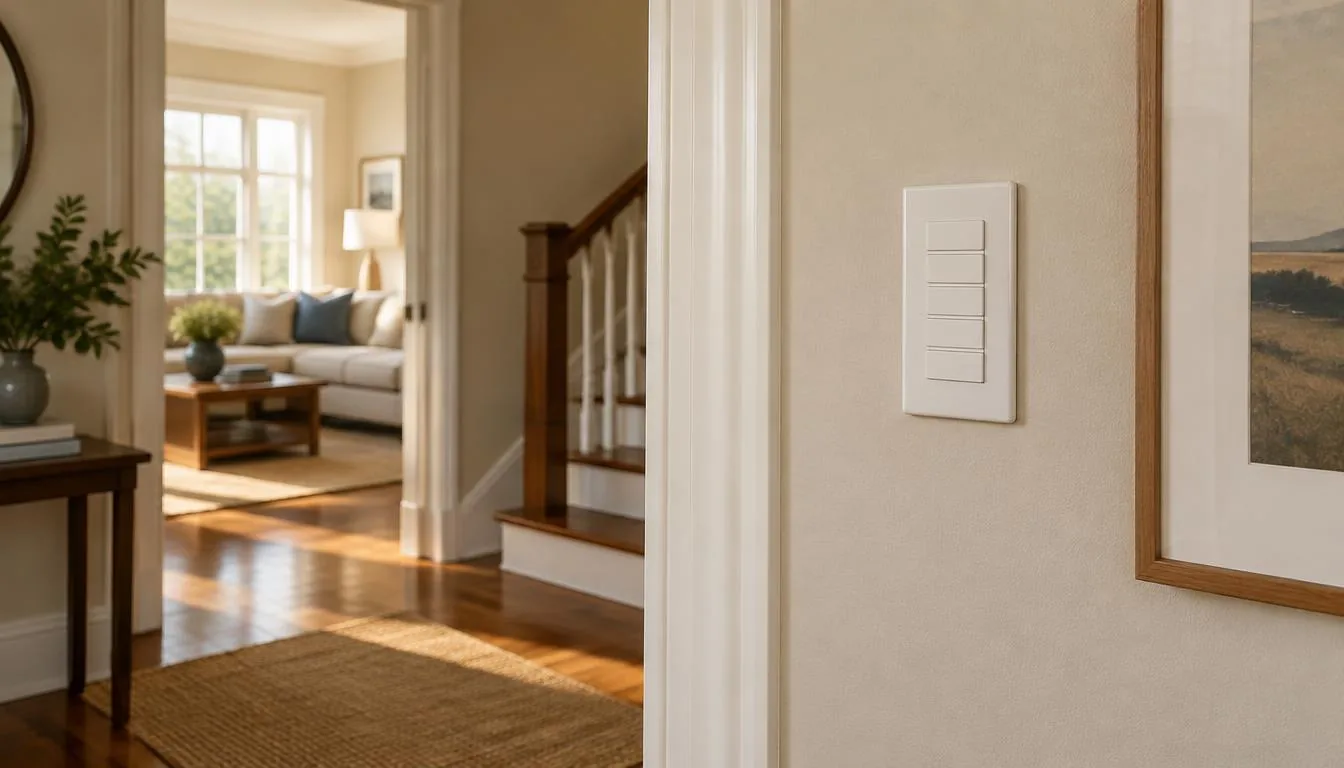
One button per fixture, and why it disappoints
The tidy-looking layout gives every circuit in the room its own button. Cans. Pendants. Sconces. Under-cabinet. Cove. It looks thorough on a drawing, and it is the layout most people describe when asked what they want.
In the room it underperforms, for a reason that has nothing to do with the hardware. Nobody memorizes which button is the cove. Getting the room to look right means pressing several of them and then trimming a few, every time, which is more work than the switches it replaced and more expensive. A wall of named circuits asks the person walking in to design the room from scratch at the moment they walk in.
Individual circuits do not stop existing. They are addressable in the system and reachable from the app or from a raise-and-lower pair. The argument is about what deserves the front row on a wall by a doorway, not about what the system can do.
What a scene actually is
A scene is one instruction that sets several loads — lights, and often shades — to stated levels at the same time. A kitchen scene might bring the cans to full and the under-cabinet lights with them. An evening scene in the same kitchen might drop the cans low, hold the pendants over the table, and add the sconces. One press puts the room in a known state.
The useful property is not the convenience. It is that a scene is a decision somebody already made, on purpose, with the room in front of them, which means it is reproducible. The room looks the way it looked last Tuesday. That is a different experience from a wall of dimmers and a memory.
Levels inside a scene stay editable for as long as the system is in service, and the first few weeks of living with a house usually move several of them. A scene that was set at a design meeting in February and gets adjusted in May has not failed; that is the normal arc.
Names people use
Scenes get named after what somebody is doing, not after which loads are involved. "Evening" is legible to everyone in a house. "Cans 40" is legible to the person who programmed it and to no one else, and a button that only its author understands is a button that gets pressed by its author.
This sounds like a style point. It is closer to a reliability point: a keypad is a shared interface in a house full of people who did not attend the design meeting, and the labels are the only documentation it has.
The shape of the conversation
The layout for a room comes out of a fairly specific discussion, and it is not one the homeowner is expected to run alone — the questions are the kind that only make sense with somebody in the room who knows what the system can do.
It starts with the hours the room gets used and what happens in them. A kitchen tends to produce a bright morning state, a working state while somebody is cooking, a softer one once people are sitting down, and an off. A family room produces a television state, a reading state, something brighter for cleaning, and an off. A primary bedroom frequently needs a low path to the bathroom more than it needs a bright scene at all, and that one surprises people.
Then it moves to where a person is standing when they reach for the wall. The keypad inside the garage door is answering a different question than the one by the bed; one of them is about arriving and leaving, the other is about shutting a floor down and finding the bathroom at three in the morning. Same device, different vocabulary.
Last comes subtraction, which is the part that actually determines whether the keypad gets used. Fewer, well-named buttons get pressed. A crowded keypad gets skipped in favor of the app, or the lights get left on, and either way the wall device stopped earning its place. The restraint has little to do with how the wall looks and everything to do with how many options a person can resolve while carrying groceries.
Engraving, and the part that stops being editable
Lutron keypad buttons carry their labels as engraving. The words are cut into the button, so there is no sticker to peel and relabel — if a scene's purpose changes after installation and the word on the button no longer describes it, the correction is an engraved replacement button kit, ordered and fitted.
Space on a button is tight, and the character count permitted per line is set by the current Lutron engraving documentation rather than by anything we can promise in an article; all-capital labels fit fewer characters than mixed case. The practical shape of that limit is familiar enough: single plain words land, and a phrase describing which fixtures are involved does not.
So the engraving is the one element of a keypad that behaves like millwork rather than like software. Scene levels are soft. Button assignments are soft. The words are committed. That ordering is why the scene list tends to get agreed before the engraving order goes out, and why the people doing this work push the naming conversation earlier than homeowners expect.
Two jobs that share a wall box
Some keypads are doing a small job. They sit by a door, they set the room they are in, and the reasonable contents are a few scenes and an off.
Others are doing something categorically larger: the whole downstairs, the exterior lights, every shade on a floor. Those belong where people leave and where people go to bed — a main entry, the door to the garage, a bedside. A single "goodnight" or "all off" in one of those positions replaces a circuit of the house with the lights going off behind you.
The reason this matters before anything is ordered is that the two have different requirements of their location. A whole-floor keypad needs to be where the traffic actually is, with labels clear enough for guests, because more people will use it for more things. A room keypad can sit wherever the switch would have sat. Which one a given wall box is getting is a decision made on a plan, and plans are cheaper to change than finished drywall.
What gets decided when
Smart Tek is a direct dealer for Lutron, Sonos and Sony, and the Lutron design and programming is work we do ourselves. That has not made the product choice the hard part. Which Lutron system suits a house follows from its size, from whether the walls are open or closed, and from what else the lighting has to coordinate with — audio, shades, surveillance, the network behind all of it.
The expensive-to-reverse decisions are the physical ones: where the keypads live, what wiring reaches them, and the words on the buttons. The cheap-to-reverse decisions are the ones homeowners worry about most: which scene is on which button, and exactly how low "evening" goes.
Houses in renovation have the whole set open at once, which is both the opportunity and the pressure. Once the walls close, keypad locations stop being a drawing and start being a drywall repair.
FAQ
Frequently asked questions
Fewer than most layouts start with. What sets the practical limit is how many choices a person can resolve in the couple of seconds they spend at a wall; past a handful, the keypad gets skipped in favor of the app. Individual lights remain reachable in the system no matter how few of them reach the wall.
Not on the button itself, because the label is cut into it rather than printed on a cover. A change means an engraved replacement button kit, ordered and fitted. That permanence is the reason scene names get settled earlier in a project than homeowners expect.
Yes. A keypad at a main entry or a bedside can run scenes across a floor or the whole house, which is where an "all off" or a "goodnight" earns its place. What changes with that scope is the location and the clarity of the labels, since more people will use those buttons for more things.
No, and the order usually runs the other way. How each room gets used determines what the buttons should do, and the system that suits the house follows from its size, from whether the walls are open or closed, and from what else the lighting has to coordinate with.
Plan the lighting
For keypads, dimming, scenes and shades, see Lighting & Shade Control. If keypads need to sit where there is no wiring yet, see Smart Home Wiring & Pre-Wire. To tie lighting into audio, shades and the rest of the house, see Smart Home Integration.
Our town guides for Lloyd Harbor and Brookville cover lighting control in larger houses.
Talk through the problem
Call 631-656-9180, Mon–Fri 8 AM–6 PM and Sat 9 AM–1 PM, or tell us what is happening through the contact form. We serve Long Island, Manhattan and the Hamptons.