
What the one-app promise actually buys
The belief is simple: the problem with the house is that there are five apps, and the fix is one app. No. The number of apps is a symptom, and a mild one. Houses where every control was consolidated into a single interface years ago still produce the same call: nobody except one person can operate anything, and when that person is out, the house runs at whatever setting it was left on. An icon count is easy to measure, which is why it became the thing people shop for. It is not the thing that is wrong.
What a control interface can pass through, and what it cannot
Why one app is possible at all is what sets the ceiling on everything it can deliver.
Two systems work together over a control interface — a defined set of commands and status reports that a manufacturer chose to expose to outside software. Not everything a device does reaches that interface. A thermostat might expose setpoint and mode and withhold its scheduling. A television might accept a power and input command and expose nothing about apps running on it. A speaker system might expose grouping and volume and keep its service logins to itself.
So the set of functions available to any single outside app is the intersection of what every device chose to publish, which is necessarily smaller than the set of things those devices actually do. So one app presents whatever survives that intersection: a reduced version of what the house can do.
The functions that get dropped are consistent, and they are the ones people assume will come along: account setup, firmware, service logins, device-level diagnostics, warranty registration. Those stay in the manufacturer app whether anyone wants them to or not, which means the honest version of "one app" has always been "one app for everyday use, plus the original apps for everything else." That is still a real improvement. It is not the thing that was pictured.
The phone, the wall, and what each is good for
Turning on a light with a phone requires locating the phone, waking it, unlocking it, finding the app, waiting for it to load, waiting for it to report the current state of the house, and then pressing something. Every one of those steps is a place to fail, and several of them fail routinely — the phone is upstairs, the app logged itself out, the state is stale, there is no signal in the basement.
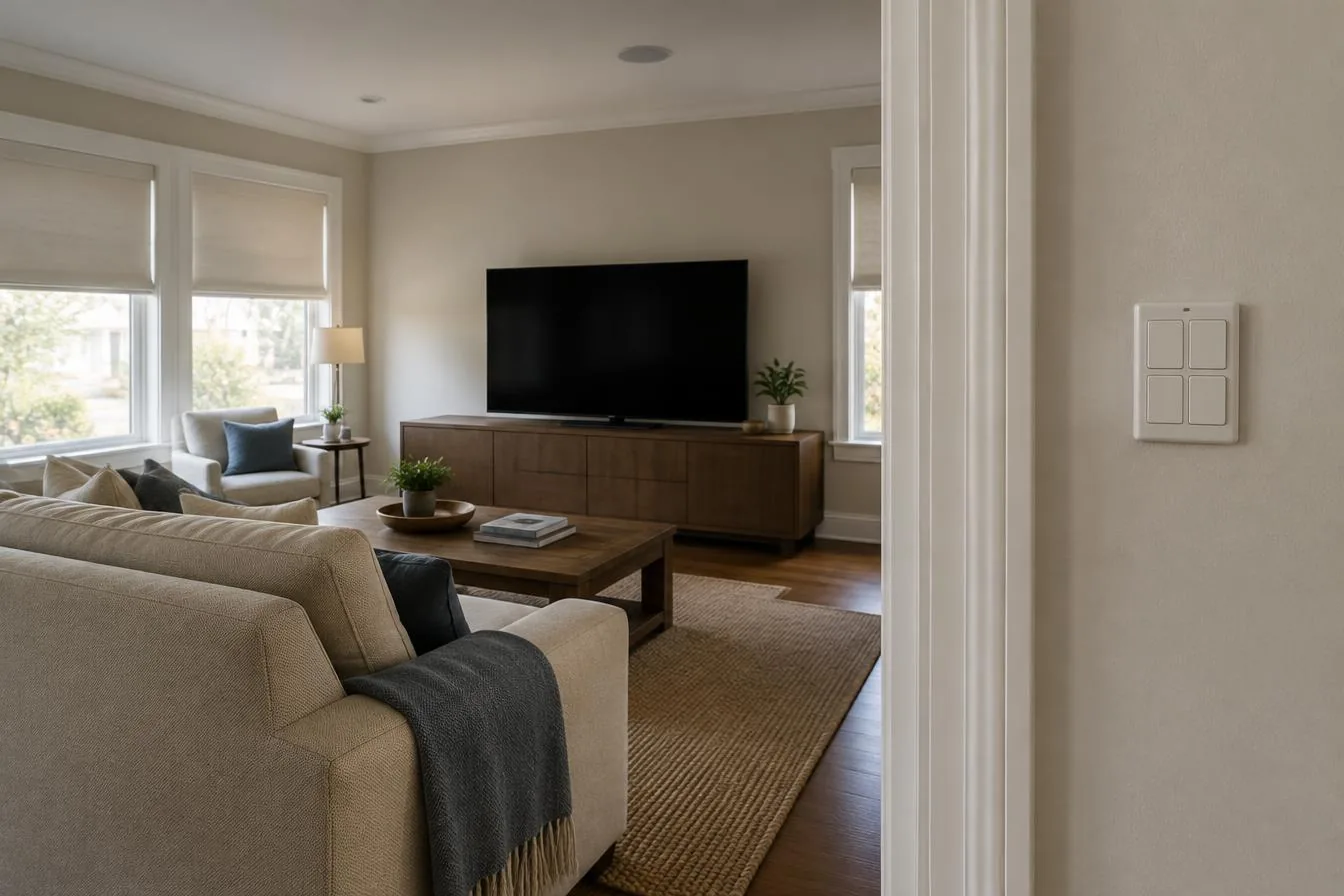
A wall control asks for none of that. The hand is already moving toward the wall because that is what a lifetime of living in houses taught it to do, and the control is in a fixed location that does not need to be found, charged or unlocked.
A phone is an excellent tool for the things only a phone can do: operating the house from somewhere else, adjusting something fiddly, setting up a schedule, reviewing what happened. It is a poor tool for the ordinary small actions that happen between the garage door and the kitchen. That is a legitimate purchase and a legitimate capability, used for the wrong half of the job.
Wall controls win on two mechanisms, and neither has anything to do with preference.
The first is that they do not require identity. A keypad by a door works for a guest, a babysitter, a grandparent and a contractor, none of whom have been added to an account, invited to a household, or handed a password. An app requires every one of those people to be provisioned, and nobody provisions a babysitter.
The second is that they stay in the house. The control is physically present whether or not a phone is present, charged, signed in or on the network.
The trade is real and it goes the other way too. A wall control does one small set of things from one place and cannot be rearranged from the couch. Labels have to be decided once and they are what everyone lives with.
One app, one account, one way to be down
Consolidation concentrates dependency, and this is the cost that never gets priced.
Five independent systems fail independently. One of them going out leaves four working, which is annoying and survivable. Push all five through one interface, one account and one cloud service, and the failure modes merge. A service outage, an expired payment method, a software update that goes badly, or an account owner who changes their password now reaches everything at once.
There is a further version of this that shows up on handover: the account that everything is tied to belongs to one person, often with recovery tied to one email address and one phone number. The household as a whole has no way in. That is not a technology problem, it is an ownership problem, and it is created by consolidation rather than solved by it.
The counterweight is control that runs on site. Some systems evaluate everything locally and treat the outside connection as a convenience for remote access. Others route ordinary commands out and back. Those two architectures look identical in a showroom and behave nothing alike during a storm on a Tuesday night, and the difference is a property of the specific equipment, documented by its manufacturer, not a general fact about smart homes.
What is being sold here
One app is a sales line because it demonstrates well. It can be shown on a tablet at a glance, it photographs nicely, and nothing in a showroom reveals how a household with four people and a dog walker will actually use it.
What does not demonstrate well is the quieter specification: wall controls in the places hands already go, local operation for the daily actions, the manufacturer apps left where they are for maintenance, and a short written record of which account owns what. None of that photographs. All of it is what determines whether the house is still usable in two years.
For Lutron lighting and shading work, Sonos audio and Sony video, we are a direct dealer and the specification is ours to make. If Control4 or Crestron is part of the plan, we support that work through our integration partners, not as a direct dealer. Nothing on this page is a reason to replace equipment that is working; most of these houses already own the hardware they need and were never given a way to use it.
The ground worth conceding
Several things in the one-app pitch are true, and dismissing them would be dishonest.
Consolidating the actions that span systems is genuinely valuable, and it is the one thing separate apps cannot do at all. No lighting app can dim the room and change the television input, because the sequence crosses a boundary only an integration can cross. That is the real product.
Fewer accounts to maintain is a real benefit. Consistent room names across systems is a real benefit, and the absence of them is why voice control gets abandoned.
And there are houses where the right answer is a single well-built interface, because the household is one or two technically comfortable people who want depth and do not care about handing the house to a stranger.
What a one-operator house costs
The cost is not abstract. It shows up as capability that was bought and is not used.
There is a gap in most houses between what the system is capable of and what the household actually does with it, and it is wider than the people who paid for it would guess. In a house with controls only one person understands, that gap stops being a question of what was purchased. The scenes exist, programmed and working, and nobody touches them because touching them means asking. The shades sit where they were left. The theater gets used for the television because the person who knows the sequence is not home. The household quietly converges on the lowest common denominator of what everyone can operate, and that denominator is the physical switches.
Meanwhile the one person who does know becomes the help desk for their own house. Every unfamiliar guest, every babysitter, every contractor is a phone call. That is the actual recurring cost of a single-operator system, and it is paid in a currency nobody put on the proposal.
Five apps is a minor irritation. A house that answers to one person is the expensive condition, and collapsing the apps does not touch it.
FAQ
Frequently asked questions
No. A single interface reaches only what each manufacturer chose to expose to outside software, which is always less than everything a device does. Account setup, firmware, service logins and device diagnostics stay in the original apps whether anyone wants them to or not, so the honest version of the promise is one app for daily use alongside the original apps for maintenance.
It can be, for one reason separate apps cannot cover: a single action that crosses systems. Dimming the room and changing the television input is one intention and two products, and nothing inside either app can reach across that boundary. Where no daily action crosses a boundary, consolidation buys tidiness.
Because it requires no identity and it stays in the house. A keypad works for a guest, a grandparent or a contractor, none of whom have been added to an account, and it sits in a fixed place that does not need to be found, charged or unlocked. A phone is the better tool for operating the house from somewhere else.
That depends on the equipment rather than on integration as an idea. Some systems decide everything on site and treat the outside connection as a convenience for remote access; others send ordinary commands out and back. Those two architectures look identical in a showroom and behave nothing alike during a storm, and the difference is a documented property of the specific equipment.
Plan the everyday controls
For coordinating daily controls across the house, see Smart Home Integration. Wall keypads and scenes are covered under Lighting & Shade Control, and TV and music controls under Audio / Video Systems.
Our town guide for St. James covers whole-house work led by TVs and home audio.
Talk through the problem
Call 631-656-9180, Mon–Fri 8 AM–6 PM and Sat 9 AM–1 PM, or tell us what is happening through the contact form. We serve Long Island, Manhattan and the Hamptons.