
What rugs and curtains actually absorb
The call comes in after the room is done. Television up, furniture in, everything paid for, and the room sounds wrong to the person who paid for it. Somebody has already suggested a rug.
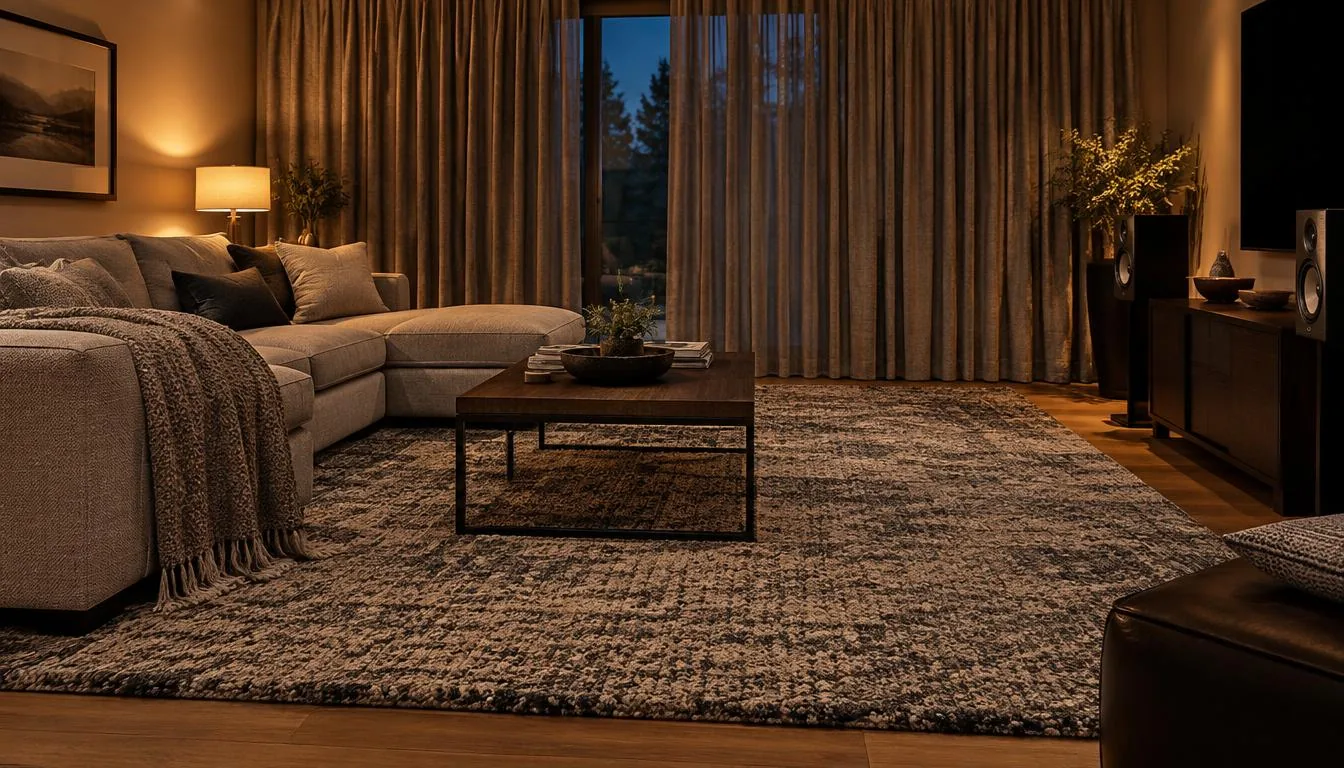
What we count walking into a finished room
So we count. The soft things first: a sofa, maybe a rug, maybe one drape at one window. Then the hard ones: drywall on four sides, a ceiling, a wood or tile floor, a glass table, a cabinet, a television. The second count wins in almost every room we walk into. That imbalance is why soft material gets recommended. It is also why it gets oversold.
A rug does change the sound. A rug is also the most oversold fix in home audio. Both of those are true at once, and one piece of physics explains both.
What fabric reaches, and what goes straight through it
Soft material removes the high and middle range from a reflection. It barely touches deep bass. Everything in this article comes off that sentence.
A window screen stops what is small and fast and stays wide open to what is large and slow. Bugs out, wind through. Fabric behaves the same way toward sound. The dividing line is wavelength, meaning the physical length of one cycle of a sound wave.
High and middle sounds are short, rapid pressure waves. They push into fiber and padding, drag against millions of tiny surfaces, lose energy as heat, and come out the far side much weaker. That loss is what absorption means here. It is also the range human speech lives in, which is why adding soft surfaces so often makes dialogue easier to follow.
Deep bass is a long, slow wave. An inch of fabric is not an obstacle to a wave that long. It passes through a rug and a drape much the way it passes through a wall.
Which is how a room goes dull and still booms, and that is the part that catches people out. The fabric took the top end. The heavy one-note low end was never in play, because the fabric never reached it. Described out loud it sounds like a contradiction: muffled and boomy in the same sentence. It is not a contradiction. It is an accurate description of what happened to that room, and more soft material will not touch the second half of it.
The surfaces that earn it
The floor between the seats and the speakers is the highest-value surface in the room. The bounce off it is short and direct. It arrives early enough to interfere with the original sound. And it is a large flat plane that was going to get covered with something regardless. A thick rug with a pad under it, over real floor area, does the work. A small square in the middle of a big hard floor does not.
The wall sections flanking the screen are next. They take the earliest reflections. An early reflection — one arriving within a hair of the direct sound — is the kind that interferes most with what you are trying to hear.
Those two surfaces hold most of the improvement that is available from soft material. Past them the returns drop off fast, and a good deal of what gets bought past them only looks like treatment. A thin rug on top of existing carpet does close to nothing. The floor was already absorbing. A second thin absorbent layer on an absorbent surface changes very little anybody will hear.
A small decorative panel on the wall behind the couch does almost nothing either, for two reasons. It is small, and it sits behind the listeners' heads, where sound arrives late and already weakened. Panels do real work when they are large and when they sit where early reflections land.
Throw pillows are not treatment. They are soft, so they feel like they ought to count. Their total surface area is trivial next to a floor, a window or a ceiling. No room has ever been fixed with pillows.
The furnishings nobody has to be sold on
A full bookshelf does something a bare wall cannot. Books at varied depths break up a flat plane and absorb a share of what reaches them. In a room where panels would look out of place, a wall of books is a legitimate move.
Full-height drapes are the best value in the room, because one piece of hardware handles the window and the light at the same time. Heavy fabric, floor to ceiling, gathered rather than pulled taut, on a track wide enough to clear the glass. The gather is the part people skip. The same fabric stretched flat has less surface area and does less work.
Upholstered furniture gets no credit and does plenty. Fabric seating absorbs where leather reflects. A large fabric sectional in a reflective room is doing acoustic work every day of its life, and nobody had to be talked into owning a couch.
The hard surfaces that show up late
A glass coffee table sits in the sound path in front of the seating and returns everything that reaches it. It also tends to arrive after the room is finished, when nobody is thinking about sound anymore.
A mirror over the mantel is a large, flat, hard surface on the wall people face all evening. It returns sound about as efficiently as it returns light. A big framed piece under glass on a side wall near the speakers behaves the same way.
Tile across an open plan is the significant one. We see it most in renovations where a kitchen and a family room get one continuous hard floor. Now the floor is hard across the whole space, there is no wall between the two rooms to interrupt anything, and the sound has nowhere to go but back. That can still be the right floor for the house. It is better known going in than discovered afterward.
And sometimes the answer is you can't get there from here. A great room with a glass wall down one side and tile underneath has more hard surface than furnishings can offset. Fabric takes the edge off it. That is the whole of what fabric does there, and anyone promising more is selling something that will not arrive.
Trying to beat a room like that with sheer quantity is how the opposite failure gets built. We have been in rooms with soft material on every surface. They sound closed-in and lifeless. They can still boom, because the fabric never reached the low end. That room is harder to live with than the bright one it replaced, and all of the material has already been bought.
What closes in a day
When we open a ceiling in a house that is already finished, what we find is the part of the job that stopped being negotiable the day the drywall went up. No blocking behind the surface where something heavy was going to hang. No wire to the speaker position the room now wants. No depth behind a plane for anything recessed. All of it cost almost nothing while the studs were still visible.
FAQ
FAQs
No. Boom is low-frequency energy, and a wave that long passes through an inch of fabric about the way it passes through a wall. A rug does clean up harshness and help dialogue, both worth having on their own terms. The boom belongs to the dimensions of the room, the position of the subwoofer and where the seats are.
Thickness helps and a pad under it helps, but area does more than either. A thick rug over a small patch of a large hard floor leaves most of the reflecting surface exposed and still working. The floor between the seats and the speakers is the part carrying the early bounce, which is where coverage pays and where a small square does not.
Often, because blackout fabrics tend to be heavy and lined, and weight and thickness are what absorb. Full height and a generous gather matter as much as the fabric itself, since the same curtain pulled flat across a window has less surface area and does less work. One piece of hardware handling both the light and the window is why drapes are the best value in most rooms.
Yes, and it is unpleasant in its own way. Soft material on every surface strips out the high range and the room goes closed-in and lifeless, and because fabric never reached the low end, it can be lifeless and boomy at once. Over-treating is a real failure mode, and by the time a room is in it the material has already been bought.
So the two lists sit very differently. The furnishings are decoration that happens to do acoustic work, and they stay changeable for years — a rug comes up, a drape goes in, a fabric sectional replaces a leather sofa, and none of that requires a trade. The ceiling plane and the wall cavities are construction. They close on one day, and they close whether anybody was thinking about sound or not.
Plan the finishes and the sound
For room acoustics, speakers and construction planning, see Media Rooms & Home Theater. For shades and drapes coordinated with the room, see Lighting & Shade Control.
Our town guides for Sea Cliff and Lloyd Harbor cover media rooms, lighting and shades.
Talk through the problem
Call 631-656-9180, Mon–Fri 8 AM–6 PM and Sat 9 AM–1 PM, or tell us what is happening through the contact form. We serve Long Island, Manhattan and the Hamptons.