
Ceiling, wall or stand: what each commits to
The first thing a finished room does to this decision is hide the part of it that matters. Four painted planes, a ceiling, a floor; the room presents itself as geometry and says nothing whatsoever about what is behind any of it. Almost everything that determines whether a speaker can live inside one of those planes is in the space you cannot see, and it was decided by a framing crew who were not thinking about music. So the choice between a speaker in the ceiling, a speaker in the wall and a speaker standing in the room is only partly a choice. One part is what you want to hear and what the household is willing to look at. The other part is what the house will allow, and the house has already voted.
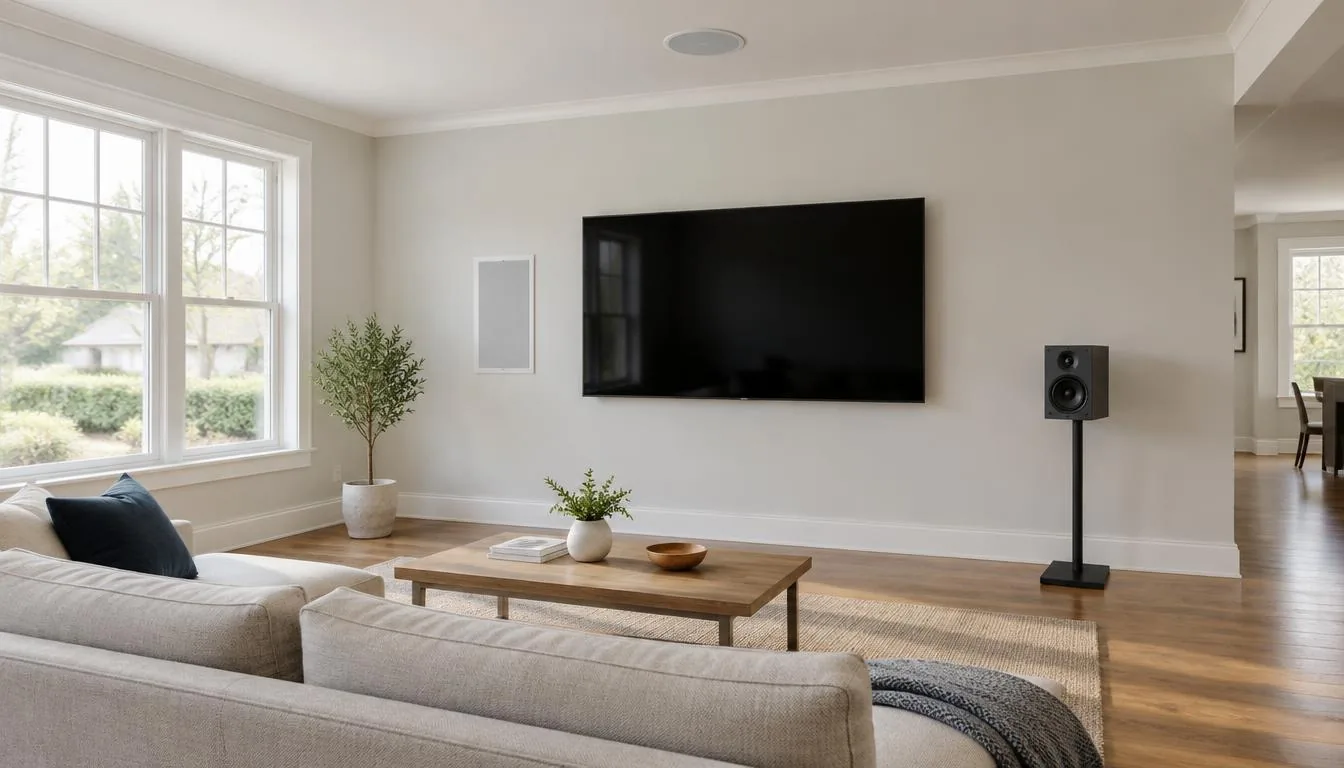
What a ceiling speaker is for
A speaker set into a ceiling is a downward-facing source in a horizontal plane, and its useful pattern is a cone. Directly beneath it is the loud, bright part of that cone. A listener standing across the room is near the edge of it, hearing a duller and quieter version of the same thing.
In a kitchen that is usually fine, and often it is the entire point: music present everywhere, dominant nowhere, and no box occupying a surface somebody wants for a cutting board. In a bedroom with the pair placed over the foot of the bed, the same geometry puts the brightest part of the pattern on the blanket and the dullest on the pillow, which is a strange way to spend an evening reading.
The ceiling also brings its own grid. Joists run one direction and, more than taste does, they govern where a pair can sit with any symmetry. In a room where they run the wrong way for the layout the plan wants, the symmetrical pair is not available at all, and what remains is an asymmetric pair or a different plan.
Why the front of a theater is a different job
Sound tied to the picture — a voice, a door closing in frame, a car crossing left to right — reads as coming from wherever the speakers producing it are. When that information comes from overhead, the picture sits in one place while its sound sits above it. The mismatch does not announce itself. It quietly makes the image less convincing, and people describe the result as the sound being fine but the room never quite pulling them in. A center speaker below the screen anchors dialogue; it does not re-anchor the left and right information still arriving from the ceiling.
An overhead position also removes the adjustment. Aim and distance to the seats are among the few variables in a front stage that reward small changes, and small changes are exactly what a fixed cutout in the plane above your head cannot offer. Some ceiling models include aimable elements. The range of that aim is a property of the particular model, and it is narrower than most people picture.
Ceiling speakers have a real job in a theater. It is surround and height, where being overhead is the reason they are there.
What the cavity decides, and for how long
An in-wall speaker borrows the wall. Most of them use the cavity behind the finished surface as part of the enclosure, which means the volume of that cavity, the depth between the face of the drywall and whatever stands behind it, and whether the space is shared with insulation, a duct, a drain or a run of conduit all become part of how the speaker behaves. The grille is the smallest part of the product.
This is the portion of the decision that nobody controls. A house built in the twenties on the North Shore has plaster over lath, shallow bays, and diagonal bracing in places no drawing anticipates. A house built in the eighties has deeper bays, a more predictable layout, and a decent chance of a return duct passing through the exact bay the layout wants. Neither is a defect. Both are the condition the speaker has to live inside, and both were fixed long before anyone was choosing between models.
The specification sheet for a particular model — not for the category — carries the cavity depth it needs, the opening it needs, and whether it requires a back box of its own. Two speakers that look identical behind the same grille can differ on all three.
Once the opening exists, the speaker is where it is. It cannot be slid an arm's length to improve the spread of a front pair, or pulled away from a corner to soften a boundary effect, or nudged to follow a sofa that moved. Changing its position means a second opening, a patch in the plaster or the drywall, and a finisher whose job is to make the first opening disappear. Nothing is wrong with the speaker and nothing goes anywhere to be worked on; the entire cost sits in the wall and the finish.
An in-wall decision is therefore a layout decision made at full commitment, usually while the room is still a drawing and before anyone has watched anything in it. That is a perfectly reasonable thing to accept. It is less reasonable to accept it without knowing that was the trade.
What a stand gives back
A speaker on a stand or a shelf keeps its position negotiable. Distance from the wall behind it, spacing between the pair, angle toward the seats — all of that stays adjustable after the room is furnished and the first few evenings have been spent in it. The connections stay reachable. The speaker can move when the furniture does.
The trade is visible in both senses of the word. A stand occupies floor, wants a position where nobody will walk into it, and arrives with a cable that has to reach it along a route somebody has to live with. And a speaker pushed into whatever gap the furniture happened to leave is not in a negotiated position at all. It is in the last one available.
Appearance belongs in the specification
A pair of large cabinets on stands in a room with a plaster ceiling and fine trim looks like equipment that wandered in from somewhere else. Some rooms carry it easily — a room with industrial proportions and a dark ceiling absorbs a pair of boxes without comment. A formal living room generally does not, and the household that tolerates them for a month and then quietly pushes them into the corners has made the acoustic decision with furniture.
The opposite failure is quieter and lasts longer. A nearly invisible speaker in a position that produces the wrong result still produces the wrong result, and because it is invisible, it is not the thing anyone looks at later when wondering why the room never sounded the way it was supposed to.
What is still decidable
Mixed houses are the normal outcome and not a compromise: ceiling speakers for music through the living spaces, conventional or in-wall speakers across the front of a theater, ceiling speakers again overhead for height. No single type has to win the whole house.
In a room that has not been built yet, what is still decidable is which rooms get which type, whether the theater front stage goes into the wall or stands on the floor, where a cable can plausibly reach, and which grille finish vanishes into the ceiling it is going into.
In a room that is already finished, what has closed is cavity depth, joist direction, where the duct runs, and whether a wire exists in the plane you now want a speaker in. Those are not preferences anyone can be talked out of. They are the house.
FAQ
Frequently asked questions
They can be wired that way, and the usual result is sound that reads as detached from the picture, because the image sits in one plane while its sound arrives from above. A center speaker below the screen anchors dialogue without re-anchoring the left and right information still coming from overhead. For surround and height channels, being overhead is the whole point, and they do that job well.
The cavity does. Most in-wall speakers use the space behind the finished surface as part of their enclosure, so its depth, its volume, and whether it is shared with insulation, a duct or a drain all become part of how the speaker behaves. Framing direction and what runs through a given bay were settled when the house was built, which means the wall narrows the list of positions before anyone has chosen a model.
They are more adjustable, which matters wherever position matters: distance from the wall behind them, spacing between the pair and angle toward the seats all stay negotiable after the room is furnished. The trade is floor space, visible equipment and a cable route somebody has to live with. In a kitchen where nobody wants a box on the counter, that flexibility buys nothing at all.
No, and mixed houses are the ordinary outcome: ceiling speakers for music through the living spaces, conventional or in-wall speakers across the front of a theater, ceiling speakers again overhead for height. Each type is good at a particular job and awkward at the others. What the household is willing to look at in a given room is part of that choice rather than a footnote to it.
Plan the speaker locations
For speakers throughout the house, see Audio / Video Systems. For a surround layout around a screen, see Media Rooms & Home Theater. Cable routes and preparation before drywall are covered under Smart Home Wiring & Pre-Wire.
Our town guides for Syosset and Dix Hills cover wiring and speaker locations before walls close.
Talk through the problem
Call 631-656-9180, Mon–Fri 8 AM–6 PM and Sat 9 AM–1 PM, or tell us what is happening through the contact form. We serve Long Island, Manhattan and the Hamptons.