
What Atmos is actually doing overhead
"Do I have to cut my ceiling open for this?" That question arrives with almost every Atmos conversation, usually before anybody has said the word speaker. It is the right question, and the answer turns on something more interesting than the ceiling: how a pair of ears decides where a sound came from, and how much of that decision the room gets to make on your behalf.
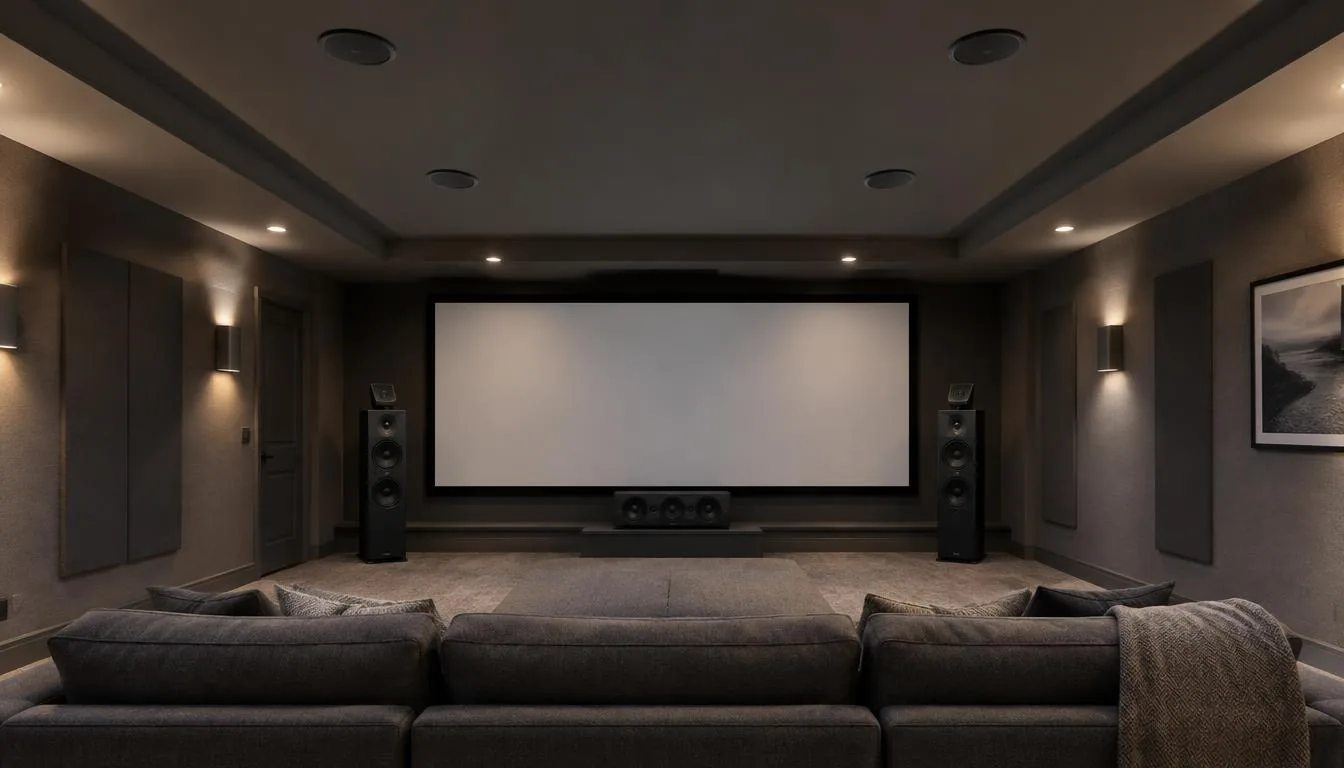
The height layer, and what it is a layer of
Ordinary surround sound places speakers around the listening area at roughly ear height and sends each one its own fixed signal. That is channel-based audio — one track per speaker, decided in the mix, long before anybody's living room existed.
Atmos works differently. It is object-based, which means a sound in the soundtrack carries position information along with it: a helicopter arrives in the soundtrack described as up and to the left and moving, rather than assigned to a particular speaker. The processor in the receiver, called the renderer, then works out which of your actual speakers should produce that sound and at what level, using a description of your layout that it has been given.
That last clause is the entire article. The renderer is doing arithmetic against a description of your room. What comes out of it is only as good as the agreement between that description and the sound that actually arrives at the seat.
How anybody locates a sound in the first place
Two ears, set apart on either side of a head. Side to side is the easy axis: a sound from the left reaches the left ear slightly sooner and slightly louder, and the brain reads the difference as direction. It is very good at this.
Up and down is a harder problem, because both ears sit at the same height. A sound directly overhead arrives at both ears at the same instant and the same level, so the timing cue gives almost nothing. Elevation is judged mostly by spectral shape — by what the outer ear does to the sound on its way in. The folds of the pinna, the visible part of the ear, reinforce some frequencies and notch out others depending on the angle of arrival, and a lifetime of listening teaches the brain to read those signatures as height.
Two things follow from that, and they matter more than any specification on a box.
First, overhead imaging is carried largely by high-frequency content, because that is where the ear's own filtering operates. Second, elevation cues are fragile. Anything that alters the spectrum on the way to your ear also alters the apparent height of what you are hearing.
A direct source and a borrowed one
Somebody talking to you from the top of a staircase is located instantly, eyes open or closed. The same person standing beside you, facing the wall and talking at it, is still perfectly audible — but where they seem to be has become a property of the wall.
That is the difference between a speaker mounted in the ceiling and a module that fires upward off it. A ceiling speaker aimed down at the seating area gives you one path: short, direct, high frequencies intact, and an angle set by where the installer put the box. An upward-firing module aims a band of sound at the ceiling and depends on a specular reflection — the mirror-like bounce a hard, flat surface gives back — to carry that sound down to the seat.
A reflected path is longer, so it arrives later. It gives up some high frequency to the ceiling material, and high frequency is the part the ear uses for height. And its apparent direction is set by where the bounce happens, which depends on the ceiling's height, the module's aim, the position of the speaker underneath it, and where the listener is sitting. Change any one of those and the virtual speaker moves.
The conditions a bounce is asking for
An upward-firing module is designed around an assumed reflection. The manufacturer picks the firing angle and the frequency band on the assumption that the sound will meet a flat, hard, reasonably ordinary ceiling at a reasonably ordinary height, and come back down into a seated head.
Ceilings on Long Island frequently decline to cooperate. A cathedral or shed ceiling redirects the bounce toward a wall instead of the sofa. Beams and coffers break the plane into separate panels at separate heights. Acoustic tile, stretched fabric, open joists and heavy spray insulation absorb the band the module needs reflected. A ceiling much higher than the module expects pushes the reflection point outward and delays it further.
The modules themselves are sound engineering. What they are is conditional, and the condition they depend on is a specific piece of architecture that somebody else already decided, often before the house changed hands.
Where the actual limits sit for a specific product is a question with a real answer, published by the people who built it: the placement documentation that ships with the module, and the layout guidance Dolby publishes for its own formats. For theater layouts more broadly, the CEDIA and CTA recommended practice for immersive audio is the document the trade works from. Those three sources know; a generic diagram on a forum does not.
Why predictability outranks channel count
A renderer is told it has a set of overhead speakers in known positions. It then places sounds among them with some confidence, because it knows what it is steering.
If some of those positions are reflections whose arrival angle depends on a sloped ceiling, the renderer's model and the physical reality have quietly disagreed. The sound still comes out. The precision it was computed with is gone, and what the listener hears is a general sense of upness where a located object moving across the room was intended.
This is also why a modest layout in good positions can outperform a larger one in awkward positions. More speakers in compromised locations give the renderer more places to send sound and less certainty about where any of it ends up. A surround channel firing into the back of a sofa, or an overhead pushed to the edge of the room by a duct, adds energy without adding information.
And none of the height layer substitutes for the layer under it. Overhead effects are the top of a structure whose foundation is the three front speakers, the position of the main seats, and the subwoofer's relationship to the room. A height layer built over a weak foundation sounds like a weak system with something happening above it.
What the real trade looks like
With the two set side by side, the choice is reasonably clean.
Ceiling speakers give a direct, predictable overhead source whose behavior is largely independent of what the ceiling is made of. They cost ceiling access: cutting, wire, and coordination with joists, ducts and lighting, which means they belong to a renovation or a new build rather than to an afternoon. In a finished first-floor room with occupied space above, that access can be the whole conversation.
Upward-firing modules cost no ceiling work at all, and they ask the ceiling for a favor instead. In a flat, hard, ordinary-height room they can deliver a convincing height layer. Under a cathedral ceiling, a heavy beam grid, or an absorptive finish, the favor is one the ceiling cannot do, and no number of additional modules changes that, because they would all be bouncing off the same uncooperative surface.
So the ceiling is where this decision actually gets made, which makes the question people walk in with the right one. What is overhead decides which of the two approaches is a design decision and which is a gamble.
FAQ
Frequently asked questions
No. Upward-firing modules are a genuine alternative, and what they ask for is a favor from the ceiling: a flat, hard surface at an ordinary height to bounce a band of sound off and down into the seats. Where a ceiling can do that, the height layer can be convincing. Where it slopes, steps into coffers or absorbs, the reflection ends up somewhere other than the listening position.
Elevation is the hardest direction for a pair of ears to judge, because both ears sit at the same height and the cue comes mostly from the way the outer ear filters high frequencies arriving from above. A reflected path arrives later than a direct one and surrenders some of exactly that high-frequency content to the ceiling material. What reaches the listener reads as a general sense of height where a placed object was intended.
It is worth paying for when the room can give every one of those speakers a position worth having. The renderer places sounds using a description of where the speakers are, so a channel in an awkward spot adds energy to the room without adding information about direction. A smaller layout in honest positions gives that arithmetic something true to work with.
It plays. The renderer maps the sounds it is given onto the speakers it has been told exist, so nothing is lost in the sense of going silent. What it cannot do is produce a source above a listener when there is nothing above the listener, and that source is the entire reason the format exists.
Plan the height channels
For an Atmos speaker layout around the seats, see Media Rooms & Home Theater. For ceiling and other speaker types, see Audio / Video Systems. Cable routes before finishing are covered under Smart Home Wiring & Pre-Wire.
Our town guides for Jericho and Dix Hills cover media-room layouts and pre-wire.
Talk through the problem
Call 631-656-9180, Mon–Fri 8 AM–6 PM and Sat 9 AM–1 PM, or tell us what is happening through the contact form. We serve Long Island, Manhattan and the Hamptons.