
Why the room decides where a subwoofer goes
"Does the subwoofer have to go in the corner?" It arrives in almost those words, usually after someone has read that corners are either mandatory or ruinous depending on which page they landed on. The honest answer is narrower than either claim. A corner is where a subwoofer will be loudest in a given room, and that loudness belongs to the walls rather than to the box. Understanding why is most of what anyone needs to make a reasonable decision about where the thing goes.
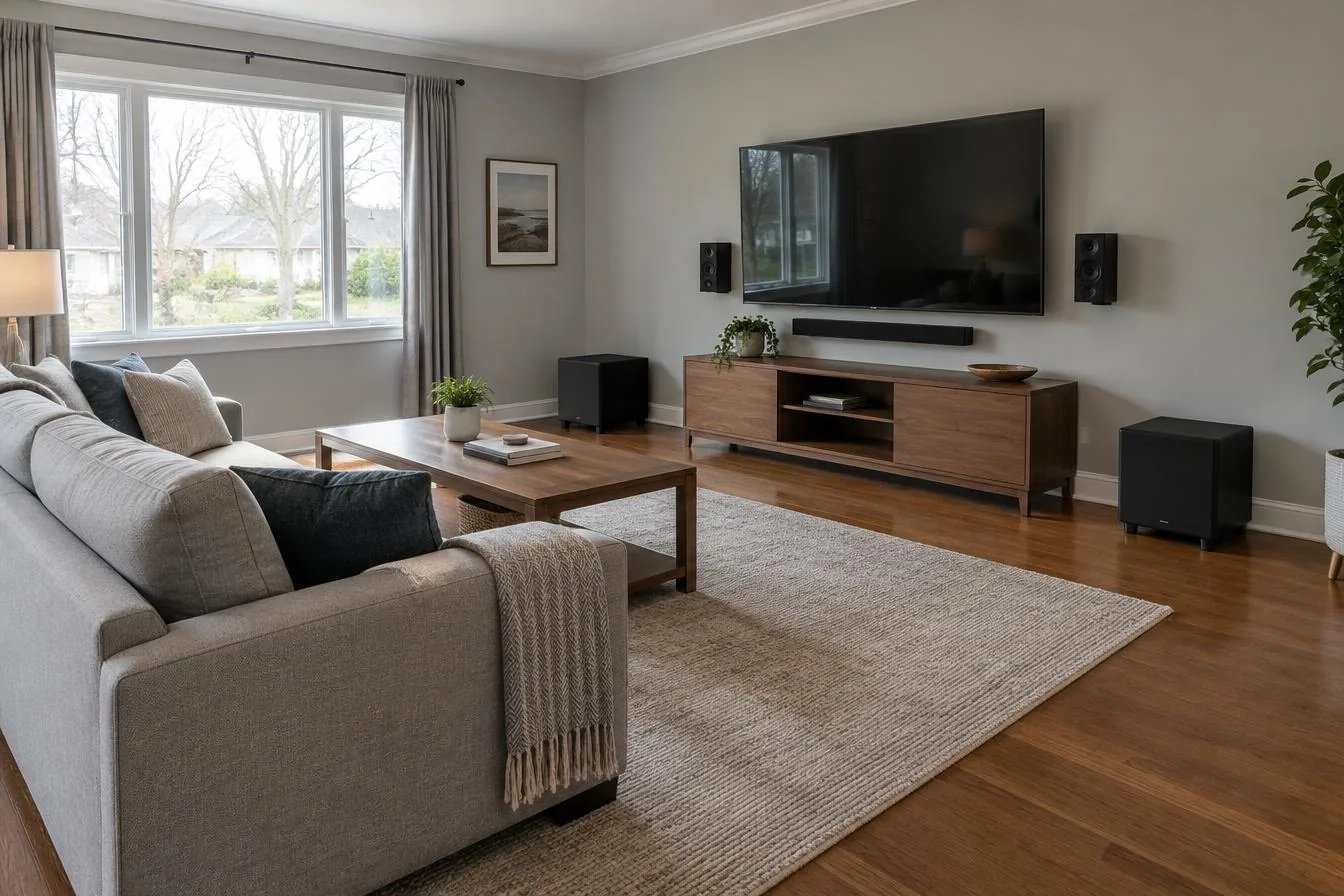
What a long wave does not notice
The useful term here is wavelength, which is the physical length of one cycle of a pressure wave. The notes a tweeter handles have cycles measured in inches. The notes a subwoofer handles have cycles measured in feet — long enough to be comparable to the dimensions of the room they are released into. That single difference drives everything else in this article.
Here is the clean version of what a nearby wall does. A loudspeaker in the open middle of a field radiates outward in every direction, and the energy leaving the back of it keeps going and is gone. With the same loudspeaker set against a wall, the directions behind it are closed off. Energy that would have traveled away comes back into the room instead. That is boundary reinforcement: a surface close to the box adds to what reaches the room rather than letting part of the output escape.
Why this applies to bass and not to the rest of the range comes back to wavelength. For the direct sound and the reflection off that wall to add together, the two have to arrive roughly in step. A wave whose cycle is measured in feet cannot distinguish the box from the wall a short distance behind it — relative to a cycle that long, the two are practically the same place, so they sum. A tweeter's wave is short enough that the same distance puts the reflection badly out of step with the original, and the effect smears rather than adds.
The floor counts as one of these surfaces. Nearly every subwoofer sits on a floor, which means nearly every subwoofer already has one boundary working for it before anyone thinks about walls. A wall adds a second surface. A corner adds a third. More surfaces means more of the escaping energy folded back into the room, which is why the same subwoofer with the same amplifier sounds like a bigger product in a corner than it does out in the floor.
Loud and even are two different measurements
The reinforcement is not spread evenly across notes, and it is not spread evenly across the room. Some notes get the addition and sit heavy and slow to clear. Others land where the arriving paths oppose each other and cancel — a null, meaning a place where a note that is present in the room is absent at that particular chair. Lowering the level lowers the heavy notes and the thin ones together. It moves the whole pattern down without changing its shape.
This is why one subwoofer earns two different reviews inside one family. From one seat a movie's low end is overwhelming. From the seat beside it the same scene sounds thin and disappointing. Neither person is mistaken about what they heard. The pattern of peaks and nulls is fixed by the proportions of the room and by where the box is, and it differs from chair to chair.
Why that pattern exists at all is the room's business and a subject of its own. For a placement decision the relevant part is smaller: the pattern is set by the dimensions of the room and the position of the box, the only way to change it is to move one of those two, and the dimensions are not moving.
The locations a house actually offers
A subwoofer needs a floor that carries its weight, a path for power and signal that does not cross a doorway or a walking route, and a footprint that is not where a door swings or where the room has to be walked through. Which means a serious share of any placement conversation is about furniture and traffic rather than acoustics. The acoustically interesting positions in most rooms are already occupied by something somebody likes. Part of the reason corners are popular is that corners are the one piece of a room nobody else wants.
Floor construction matters here in a way people do not anticipate. On a suspended wood floor, a subwoofer couples into the joists and the structure carries part of the low end through the house — the room below gets a share of the movie, and what arrives at the seat tends to sound slower than it is. On a slab, that path is mostly closed. Two rooms with identical dimensions, one over a basement and one on grade, do not take the same placement.
Why a second subwoofer gets specified
The reason is evenness across seats. Two boxes in different positions produce different patterns of peaks and nulls, and where one has a hole the other often has level, so the sum across a row of chairs is flatter than either one alone. Measured at a single chair, one well-placed subwoofer and a pair of them can land close to each other. Measured across a sofa and two side chairs, they usually do not.
Two is also two of everything: two positions that have to be physically available, two signal paths, and more alignment work to get right. What a given receiver or processor can drive, and how it handles a pair, is a property of that equipment. The current documentation for the specific model is the authority on it, and the answer varies between models from the same maker in the same year.
One limit worth stating plainly: if the complaint in the room is unclear dialogue or a hard, bright high end, a second subwoofer is a legitimate purchase aimed at a different problem.
What correction reaches, and what it does not
Room correction — the measurement-and-adjustment routine built into most current receivers and processors — takes microphone readings at one or more seats and adjusts the output to flatten what it measured. Peaks respond well to that. A peak is surplus energy, and surplus can be taken away.
A null does not respond in the same way. At that frequency and that position, the arriving energy is canceling. Equalization asking for more of a note that cancels is asking the subwoofer to work harder with nothing extra arriving at the chair to show for it: more cone movement, more demand on the amplifier, same hole in the same place.
That puts the two tools in an order. Placement and seating change the shape of the pattern. Correction smooths what is left at the positions it was able to measure. The second one is good at its job and cannot perform the first one's.
What the room has already decided
By the time anyone is choosing a subwoofer, most of this is settled. The proportions of the room are settled. So is where the window is, where the fireplace is, which route has to stay walkable, and how many chairs are expected to hear roughly the same thing. Those facts determine which boundaries are even available, which means they have already decided most of the placement before anybody has an opinion about it.
What remains open is narrower and more useful to know about. Which of the available boundaries the box ends up against. Whether the room gets one or two. And, in a house where the walls are still open, whether a signal path exists to a second position that nobody intends to use this year. A cable run to an unused corner during construction costs almost nothing. The same run after the finishes are on costs a wall, a patch and a painter.
FAQ
Frequently asked questions
No. A corner is where a subwoofer will be loudest, because several nearby surfaces fold energy back into the room that would otherwise escape. Loudest and most even are two different outcomes, and in plenty of rooms a corner delivers the first at the cost of the second. Whether it is a good position in a particular room depends on the proportions of that room and on where the chairs have to be.
Low notes have cycles long enough to be comparable to the size of the room, so the direct sound and the reflections combine into a fixed pattern of strong and weak places. One chair can sit where a note reinforces while the chair beside it sits where the same note cancels. Nothing is wrong with the equipment or with anyone's hearing; the pattern belongs to the room and to where the box sits in it.
Output is the smaller part of why anyone specifies a pair. Two boxes in different positions produce different patterns of strong and weak spots, and the sum across several chairs is more consistent than either one alone, so the benefit tends to show up as evenness across a sofa rather than as volume at one seat. A pair also needs two workable positions, two signal paths and more alignment, and what a given receiver or processor does with them is a property of that equipment.
Partly. Correction measures at the seats it can reach and pulls down a peak well, because a peak is surplus energy and surplus can be taken away. A null is energy canceling at that spot, so asking for more of a note that cancels produces more cone movement and the same hole. Position does the coarse work for that reason, and correction smooths what is left.
Plan the bass and speakers
For subwoofer and speaker placement in a viewing room, see Media Rooms & Home Theater. For speakers and systems in shared living spaces, see Audio / Video Systems. If the existing system needs checking, see Service & Troubleshooting.
Our town guides for Commack and Dix Hills cover media rooms and the wiring behind them.
Talk through the problem
Call 631-656-9180, Mon–Fri 8 AM–6 PM and Sat 9 AM–1 PM, or tell us what is happening through the contact form. We serve Long Island, Manhattan and the Hamptons.