
Will Better Speakers Fix a Bad-Sounding Room?
The common belief is that a bad-sounding room is a speaker problem waiting for a bigger budget. It is not. Better speakers reproduce a room's faults more accurately, which most people experience as the same problem at higher resolution.
The working order is room, then placement, then equipment. Almost every sales conversation runs it backwards.
The order gets sold in reverse, and the reason is boring
The room sets the ceiling on what is possible. Placement decides how much of that ceiling you reach. Equipment decides quality once the first two are settled.
Run that order backwards and the money lands on the item with the least leverage.
Equipment is easy to put on a quote. A model number has a price, a photograph and a delivery date. "Pull the couch off the back wall and put a rug down" has none of those, and nobody invoices it, so it falls off the page.
That is not usually a con. It is what happens when a conversation starts with a product list instead of a room. Someone asks which speakers to buy, and they get an answer to the question they asked rather than the one they needed answered.
Be alert to one specific pattern, though: a recommendation that arrives before anyone has heard your room is a sale, not advice. It can still be a good product. It is not yet a plan.
Four problems equipment really does fix
Not enough output for the room is the first, and it is a genuine equipment problem. A large open space, a two-story volume or a room with a lot of seating can ask for more than a small system can deliver, and no amount of furniture arranging produces output that was never there.
A missing center channel is the second, and the most underrated fix in home theater. Dialogue comes from the center channel. A startling share of rooms where people complain they cannot hear what anyone is saying have no center channel at all, or have one shoved into a cabinet facing a shelf.
A missing subwoofer is the third. Low end has to come from somewhere, and small speakers are not going to invent it.
Wrong settings are the fourth, and the cheapest. A system told the wrong speaker sizes or the wrong distances is working against itself on purpose, and correcting that costs nothing but attention.
All four are legitimate purchases. They are simply the wrong purchase for the problem most people are actually describing.
What no purchase fixes
Echo. Boom, meaning that one-note heaviness where every low sound in a movie turns into the same low sound. Both happen after the sound leaves the speaker, which puts them outside what any speaker can control.
A seat jammed against the back wall. Low frequencies pile up against a hard surface, and the headrest is sitting in the pile.
A square room, where the distance between one pair of walls matches the distance between the other pair and the room's own resonances land on top of each other instead of spreading out.
Sound leaking between an open kitchen and a family room. There is nothing between those two rooms to stop anything, and this one deserves a flat statement because it comes up constantly: an open floor plan is a room without boundaries, and no receiver setting changes architecture.
Same speakers, two houses on the same block
Two houses built by the same builder, same speakers, same settings, and the owners describe two different results. Both are telling the truth.
One has a sectional, a rug and heavy drapes. The other has wide-plank floors and a glass slider.
The speaker's job ends a few feet from its cabinet. Everything that happens after that belongs to the room: the dimensions, the surfaces, the seat positions, the ceiling height, and whether the room opens into another room.
This is also why a speaker review only takes you so far. The reviewer heard that speaker in their room.
Rooms with nothing to work with
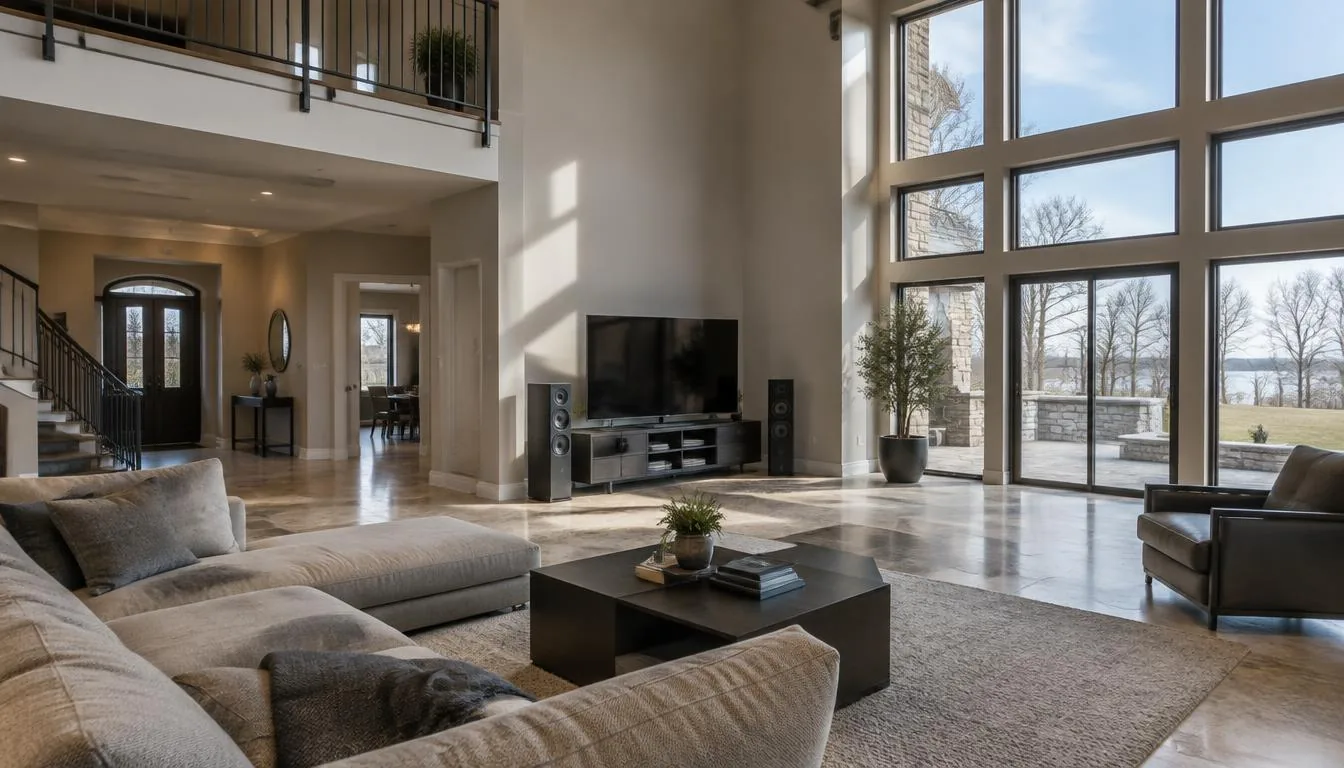
Some spaces cannot be treated the usual way because the usual surfaces are not there. A two-story foyer has no ceiling over the listening area at any workable height. A great room open to a second-floor landing is the same situation with a different staircase.
The honest conversation in those rooms is about what the system is for. Audio that fills a space pleasantly is a different goal from a movie room that holds dialogue together, and a room without boundaries suits the first far better than the second. Forcing the second usually means spending a great deal and still not getting it.
A space that is still being framed changes the answer, because the room is still an argument at that point. A dropped soffit, a moved wall or a defined seating area decided this week costs a fraction of what it costs to want it later. After the finishes go on, the list of available moves is short.
What a real second opinion looks like
Someone sits in your actual seat. Something plays that you already know well, ideally dialogue from a movie you have seen a hundred times, because a demo track is chosen to flatter equipment.
Then things move. The couch comes off the wall and the same scene plays again. A speaker walks a foot to the left. Watching someone do that in your room is the difference between advice and a product recommendation wearing the costume of advice.
Only after that does a product conversation make sense. Smart Tek is a direct dealer for Lutron, Sonos and Sony, and works with integration partners on Control4 and Crestron systems. A brand list is not a plan, and nobody should be reading you one before they have heard your room.
FAQ
FAQs
It depends on the room, which is unsatisfying and also true. In a reflective room with hard floors and a lot of glass, the room dominates and equipment upgrades get swallowed whole. In a room that already has soft flooring, drapes and upholstered seating, equipment accounts for a much larger share of what you hear.
Neither, until the room and the seating positions have been accounted for. A system that still sounds thin or strained at a normal volume in a room that has been dealt with is short on output, and that points at speakers and amplification together. A dialogue complaint points at the center channel and the settings, not at either box.
It can tidy up a system that is otherwise set up sensibly. It operates on the signal going to the speakers, which means it cannot remove a reflection that happens after the sound is already in the room. It is a final adjustment, not a substitute for the room.
A showroom is a room built or chosen to make systems sound good, with controlled surfaces and seating placed deliberately. Your house was built to live in. The equipment did not change on the drive home.
Better speakers buy resolution, output, and a center channel where there was none. They do not buy a seat that is off the back wall, a room that is not square, or a wall between the kitchen and the family room, and those are the three things most of the complaints turn out to be.
Start with the room
Media Rooms & Home Theater. For whole-house listening, see Audio / Video Systems.
Our town guides for Sea Cliff and St. James cover theater, TV and audio work in existing houses.
Talk through the problem
Call 631-656-9180, Mon–Fri 8 AM–6 PM and Sat 9 AM–1 PM, or tell us what is happening through the contact form. We serve Long Island, Manhattan and the Hamptons.