
Why a movie room echoes
The center seat of a newly finished media room tells you about the room before it tells you anything about the system. Something in the air is brighter than the plan promised. Voices sit a half step off the mouths on screen, footsteps carry a thin edge trailing behind them, and the soundtrack seems to be happening in a space slightly larger and harder than the one holding the furniture. The equipment is new, the wiring is right, and the room is doing this anyway.
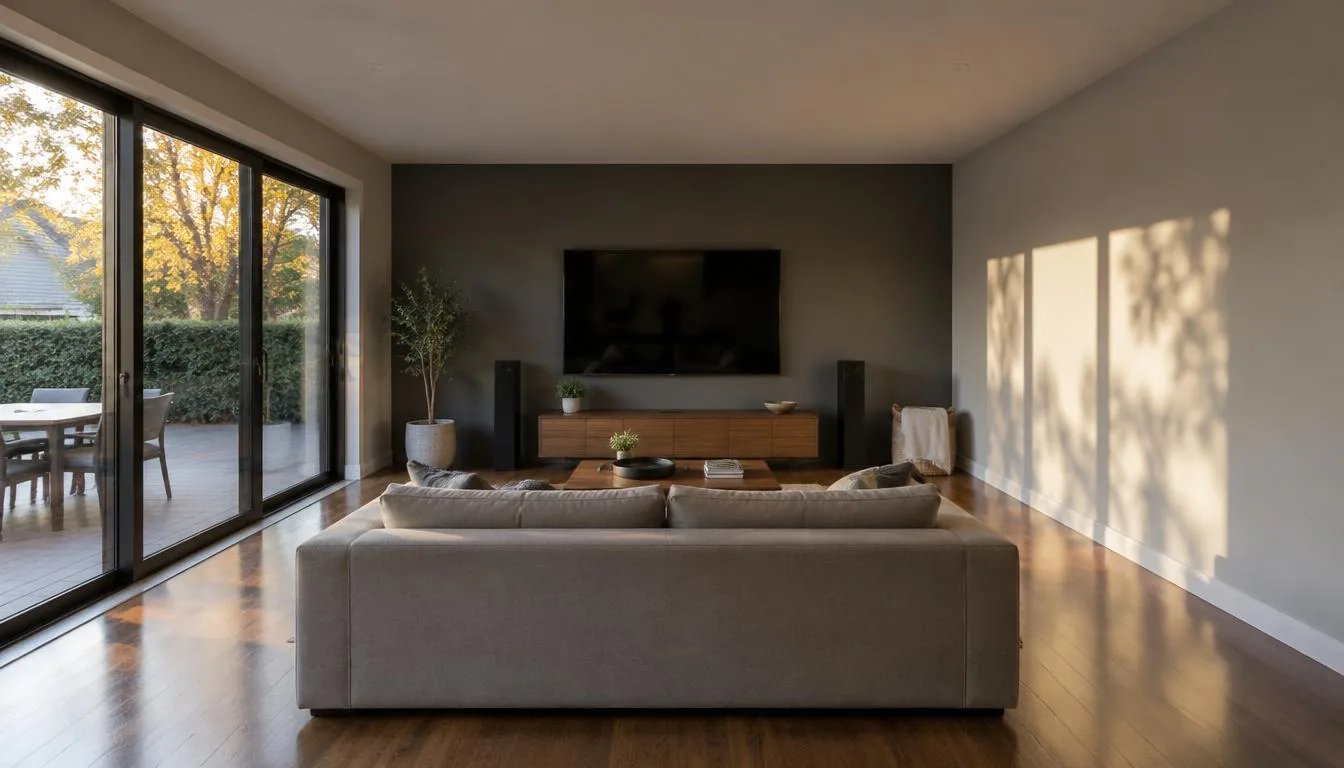
The same sound, twice
Sound leaves the speaker, crosses the room and arrives at the ear. Then a copy arrives: the portion that went past the listener, struck a hard surface and came back. The gap between the two arrivals is too short to experience as two events, so they fuse into one slightly unfocused event, and that loss of focus is what makes dialogue difficult to follow.
Geometry decides how much of this a room produces. Two hard surfaces facing each other across a short span make a corridor for sound, and the most common version of that corridor in a Long Island family room is a glass slider on one side and a flat painted wall directly opposite. Nothing along that path removes any energy, so the sound keeps crossing until it wears itself out, which takes longer than anyone would guess.
Which is why a worn-in den with a thick rug and heavy curtains can sound better than a room that cost many times more to finish. The den was absorbing by accident. The new room reflects by default, because clean planes, hard finishes and uninterrupted surfaces are decisions that read beautifully in daylight and poorly at volume.
Three surfaces, doing most of it
The floor is first and largest. A bare floor sends a short, direct bounce up into the seating area, and the material barely matters to that bounce — hardwood, tile, polished concrete and vinyl plank all behave as reflectors. It is also the one surface lying in the straight path between the speakers and a seated pair of ears.
The glass is second, and a slider is the hardest case because it is tall, flat and almost always facing a wall with nothing on it. Blinds help less than people hope; slats are hard, thin and mostly air, which makes them a window covering with no acoustic ambition.
The flat ceiling over the seats is third, and it is the plane nobody looks at. Drywall overhead, a hard floor underfoot, a person sitting between the two: a pair of parallel surfaces with a head in the middle of them. Everything leaving the front of the room has an unobstructed run across the top of it.
Where the volume knob sits in this
Outside it. A reflection scales with whatever produced it, so turning the level down carries the direct sound and its copy down together, in step, and leaves the relationship between them exactly as it was. The result is quiet mud.
Turning it up is worse, and people feel that before they can explain it. More energy in the room means more energy available to bounce, and reflections begin stacking on each other before the earlier ones have faded. That is usually the moment somebody asks everyone else to stop talking so they can hear the movie.
Three purchases that leave the geometry alone
New speakers come first, and they deliver what they promise: a clearer original sound and an equally clear copy of it off the glass. The result gets described as sharper and louder but no easier to follow, which is what a reflective room does to anything accurate put into it.
A subwoofer comes next, usually because the room feels thin and hollow and bass seems like the missing ingredient. A subwoofer operates at the deep end of the range. Echo lives in the middle and upper range, where speech lives, so low end underneath a middle-range problem covers it over without touching it.
A soundbar is the third attempt and it moves sideways. Collapsing separate speakers into a single bar changes where the sound originates; it leaves untouched what happens to that sound on the way across the room. The glass is still glass.
What is still decidable in a finished room
A real rug on the floor between the seats and the speakers is the largest single move still available. Thick, with a pad under it, covering the floor area that matters instead of a polite square in the middle. Most people hear the difference the day it arrives, and it is the change that comes up most often afterward as the one that mattered.
Full-height drapes across the glass are the next, and the most forgiving choice in the room, because they address a plane that was going to be dressed anyway. Heavy fabric, floor to ceiling, hung with real fullness in it; a pleated panel carries far more surface area than the same fabric stretched flat. Closed during a movie, that window stops behaving like a mirror.
Upholstered seating and speaker aim finish the list, and both are trade-offs the owner gets to make rather than faults to be repaired. Fabric absorbs where leather reflects, which is a real choice between two honest preferences about how a room should feel to sit in. Rotating the main speakers changes which surface takes the first bounce, and a small amount of toe is sometimes the difference between a reflection landing in your lap and landing behind your head.
None of those is decisive alone. Together they generally move a room from frustrating to comfortable, and how far they move it depends on how much hard surface is left around them.
Panels have a place in this, with a condition attached: they work when they are large enough and placed where the first reflections actually land, which is the floor area, the wall nearest the speakers, and the ceiling above the seats. A small decorative panel on the wall behind the couch is a picture. How much any panel earns depends on how much untreated surface remains in the room around it.
One thing worth separating out, because it gets blamed often and is rarely responsible: a larger picture does not create echo. A hard screen surface is one more flat reflector on a wall, which is true and minor. What a bigger image does is pull people fully into a room they had been half-using, with their whole attention, and now they notice. The room was doing this the entire time.
What closed when the drywall went up
Treatment inside the ceiling above the seating area belongs to the framing stage, while the cavity is open and somebody is still deciding what goes into it. Once that plane is closed and painted, what remains is what can be hung in a room somebody also has to live in, and that is a narrower set of choices than existed a month earlier.
Building a wall out, adding depth behind a finished surface, breaking the parallel between two facing walls — all decided before the board goes up. The same applies to wire run to speaker positions nobody has committed to yet. After the drywall, those become demolition work.
FAQ
FAQs
The den was absorbing sound by accident — a thick rug, curtains, upholstery, a wall of books. A newly finished room reflects by default, because clean planes, hard floors and uninterrupted drywall are decisions that read beautifully in daylight and poorly at volume. Nothing about the finish is wrong; those surfaces are doing what hard flat surfaces do.
They earn their place when they are large enough and when they sit where the early reflections land: the floor area between the speakers and the seats, the wall closest to the speakers, the plane above the seating. Area and position are what does the work. A small square hung for looks on the wall behind the couch is decoration, and how much any panel accomplishes depends on how much untreated hard surface is left around it.
Rarely. A reflective room hands back a copy of whatever it is given, so accurate speakers produce an accurate copy off the glass, and the result gets described as sharper and louder with the dialogue no easier to follow. The character of the room shows up in whatever gets installed in it.
The soft surfaces, and they carry more weight than people expect: a thick rug with a pad under it covering the floor between the speakers and the seats, full-height drapes with real fullness across glass, upholstered seating. What closed with the drywall is the shape of the room, the depth available behind a finished surface, and the cavity above the seats. That line is the honest boundary of what a finished room can still do for itself.
Room shape is the largest of them and the least negotiable. A room close to square, or one with a hard surface staring at another hard surface across a short span, begins at a disadvantage no equipment list corrects. While the room is still on paper, every one of those is a line on a drawing. Afterward, the drawing is a wall.
Plan the room and the sound
For room layout, speakers and theater construction, see Media Rooms & Home Theater. For listening throughout the house, see Audio / Video Systems.
Our town guides for Sea Cliff and Commack cover media rooms in existing houses and converted spaces.
Talk through the problem
Call 631-656-9180, Mon–Fri 8 AM–6 PM and Sat 9 AM–1 PM, or tell us what is happening through the contact form. We serve Long Island, Manhattan and the Hamptons.