
Does Projector Screen Material Matter?
Screen material matters less than the room it hangs in, which is not the same as saying it does not matter. A family room at four o'clock in November takes light from three directions at once, and the wall you intend to project onto is already working: it holds a sheen, it carries the window's reflection, it hands part of the afternoon back to you. A finished basement with no windows does none of that. Same wall, same paint, same projector, same material. Two different pictures.
Most of a projector budget goes to the projector. The screen gets chosen last, off a list of names that read alike, in the final minutes of a meeting. The geometry of that is backwards. The screen is the plane you look at for two hours; the projector is a box behind your head.
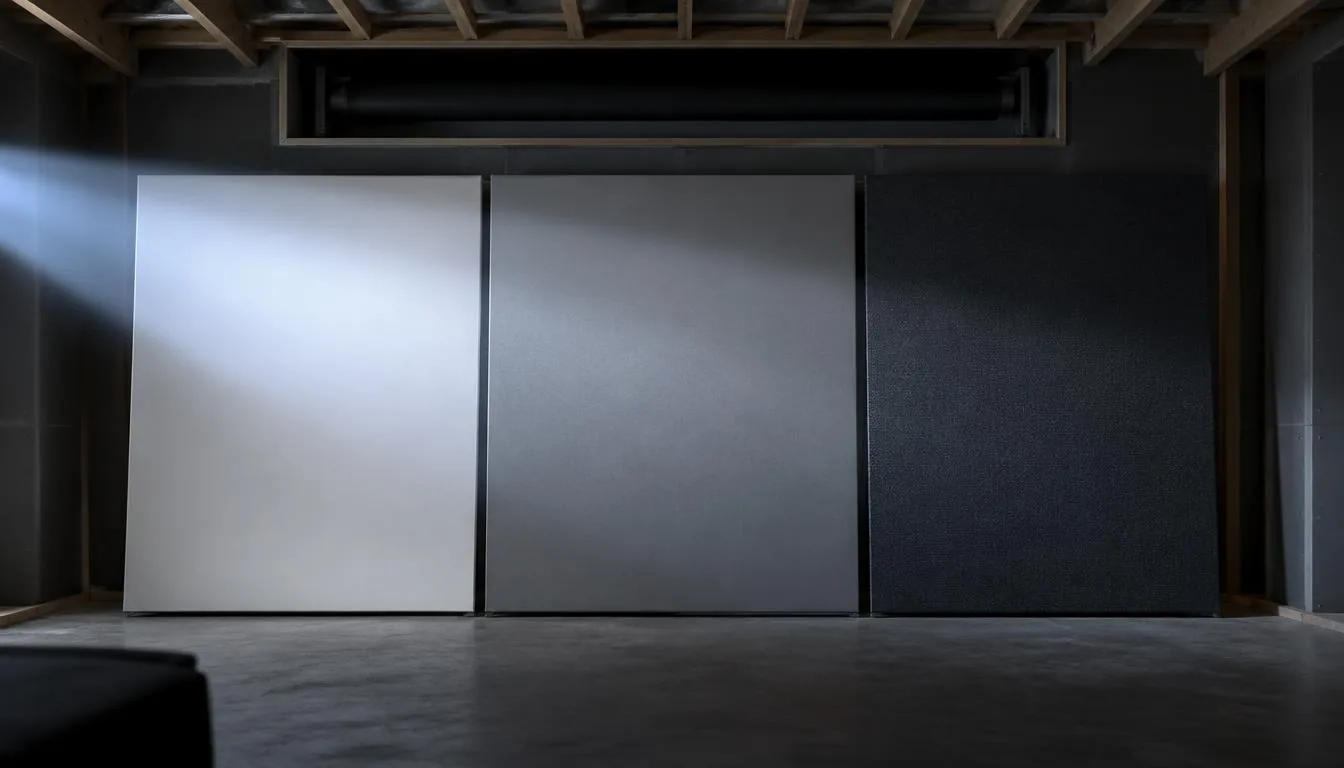
The room decides the material before you do
Light in the space narrows the choice before you touch a sample.
In a basement you can make dark, you are free to chase contrast and a deep black, because nothing competes with the projector for the surface. In a bright room you share that surface with the windows, the ceiling, the lamps and the hallway, and every one of those lays light on the screen whether you wanted it there or not.
So the question is not which material. The question is when you watch. Sunday afternoon with the shades up is a different room from Friday night with everything off, and plenty of houses on the North Shore and out east use the space both ways. When a room has two uses the screen is chosen for the harder one; a material that only behaves at night fails half your week.
The surfaces around the screen belong to the same decision. A white ceiling above a bright image returns light down onto it. A glass table and a pale floor do the same from below. Dark paint, a rug and shade control change the answer, which is why the conversation that produces a good screen is a conversation about the whole room rather than a product name.
White, gray, and light-rejecting
Each one gives something up to get something else.
White is the straightforward surface for a room you can darken. Color reads naturally, the image is bright, nothing exotic is happening. Its honesty is also its limit: a white surface reflects whatever lands on it, so the moment a lamp goes on the blacks go gray.
Gray lowers the whole image, blacks included. In a room with some stray light that reads as better contrast, because the dark parts of the picture hold their shape. You pay in punch. A gray surface in a properly dark theater can look muted beside white, and no projector setting fully returns what the material took.
Gain is a trade rather than an upgrade. A surface can be built to send more light back toward the seats instead of spreading it around the room, which helps the middle seat and narrows the useful viewing cone in the same move. If the seating is a wide sectional, high gain works against the floor plan; the ends of the couch pay for the center.
Light-rejecting material is the one people ask for by name. Its structure accepts light arriving from the projector's direction and turns away light arriving from elsewhere, which is how it holds an image with the shades open. The compromises are geometric. It behaves as intended only when the projector sits where the material expects it, so a ceiling mount and a table in front of the screen are not interchangeable. The structure itself can read as sheen, as texture, or as a brighter patch toward the middle depending on where you sit. It costs more than plain white and forgives less when seats are spread wide.
When the speakers live behind the screen
Perforated material solves a placement problem and introduces its own.
In a dedicated theater the right place for the center speaker is behind the middle of the image, so the voice comes from the mouth rather than from above or below it. Perforated material, also called acoustically transparent, is woven or micro-perforated so sound passes through the surface.
What follows from that is less obvious. A surface that passes sound also passes light. Everything behind the screen has to be dark and stay dark: the speaker cabinets, the wall, the wiring. The cavity is not storage. Up close the texture can be visible, and certain combinations of projector and material produce a faint patterned interference across the image. Sound passing through a surface is not free either; it is accounted for when the system is tuned, not wished away.
Maintenance changes with it. A perforated surface is not wiped the way a solid one is. And the framing for speakers behind a screen belongs to rough construction, not to the week the furniture arrives.
Fixed frame, motorized, manual
What needs power, what needs framing, what tends to quit later.
A fixed frame is a flat surface held in a black velvet border, permanently on the wall. No motor, no fabric to roll, nothing mechanical to fail. The border does real work: a defined black edge makes the image look sharper and better contained than the same image floating on a wall. The cost is the wall. You are giving it to the screen full time.
A motorized screen needs power at its location and usually a control wire or a trigger so it drops when the projector comes on. To disappear when it is up, it needs a pocket framed into the ceiling before the drywall goes on, and the lighting plan has to make room for that pocket. More parts means more to fail later: motors, control boards, and fabric that can develop waves after years of rolling.
A manual pull-down is the inexpensive option and behaves like one. The spring mechanism is the usual complaint, and the fabric tends to hang slightly crooked as it ages. The screen that disappears when you are not using it is the screen most likely to need service someday. The one that never moves never breaks.
What gets built before the screen is chosen
Pocket, blocking and power are framing decisions, not finish decisions.
A ceiling pocket has to be framed. Blocking for a fixed frame has to go into the wall. Power and control at the screen location have to be pulled. All three happen while the ceiling and the walls are open, which is usually months before anyone settles on a model.
That is the part of a projection room that closes. Once the ceiling is up and the paint is done, changing from a fixed frame to a recessed motorized screen means opening the ceiling again, and in a finished house that is construction with painters in it.
The way around it is to decide early and buy late. The size, the type and the position belong to the framing stage, along with the power and the control that serve them; the model itself can wait until the room is closer to done. That one sequencing decision separates the rooms that go smoothly from the rooms that need a patch.
Size is a seating question
The front row sets the largest screen that still works.
Bigger is not automatically better. From a close seat an oversized image makes your eyes travel to follow the action, and any softness in the source becomes plain. The right size comes from where the seats are, not from the width of the available wall.
Aspect ratio belongs in the same conversation. Movies and television are not shaped alike, so one of them carries black bars somewhere unless you add masking, or a wider screen and a lens that can handle it. Whichever one the house watches most is the shape the room gets built around. Splitting the difference produces a room nobody is quite happy in.
FAQ
FAQs
Yes, with the right material and some control of the light. Light-rejecting material does real work in a bright room and shade control does more; we are a direct Lutron dealer, so motorized shades and the room's lighting can be set to drop together when the projector comes on. The honest version is that a bright room will not look like a dark room. It will look good for the room it is.
No. Material governs how light is handled once it arrives, not how much light the projector makes. A dim image points at the projector, the throw distance, the image size or the room's light. Choosing a high-gain surface to compensate moves the problem out to the end seats.
Sometimes. Some fixed frames are built so the surface can be replaced and some are not, and that is a property of the product rather than a rule you can rely on. A motorized screen is usually a single assembly, so a material change there means a new screen. Worth asking before you buy if the room's use might change.
Decide the room first. The light you are dealing with and the seats you are keeping point to a material; the size and position set the framing and the power; the projector is chosen to suit all of it. Buying the projector first and shopping for a surface afterward is how a screen ends up fighting its room.
The model is the part still open on the day the painters leave. The pocket, the blocking and the position are not, and they were settled months earlier by whoever was standing in the room while the ceiling was still open.
Plan the screen and the room
Media Rooms & Home Theater. For daylight control, see Lighting & Shade Control.
Our town guides for Sea Cliff and Oyster Bay
Talk through the problem
Call 631-656-9180, Mon–Fri 8 AM–6 PM and Sat 9 AM–1 PM, or tell us what is happening through the contact form. We serve Long Island, Manhattan and the Hamptons.