
Can I Paint the Wall Instead of a Screen?
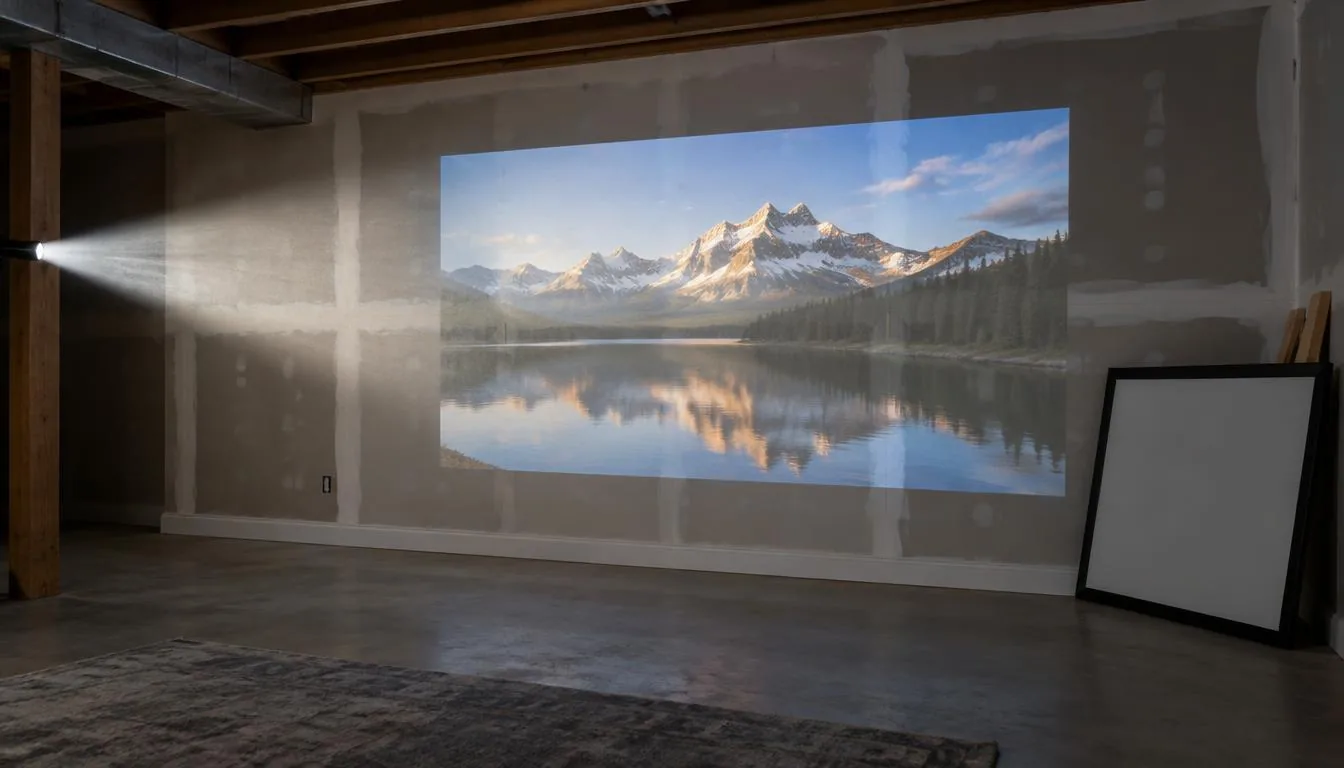
Plenty of these calls start with the wall already painted. Somebody rolled on the screen paint, hung the projector off the joists, shut the lights off, and the picture came up big. Then they walked up to it. A taped seam runs through the middle of the frame like a scar.
That is the whole story of painting a wall instead of buying a screen. It works. It also shows you everything the wall has been hiding.
Rooms where paint holds up
Big, cheap, casual. Nobody studies the edges.
A basement playroom is the best case there is. Kids want the image huge. They watch cartoons and play games. Nobody grades black levels. We paint the wall, aim the projector, and move on. The money you did not spend on a surface buys a better projector or a pair of speakers.
Bunk room. Garage. Rental. A basement that is not finished yet. Same answer. A wall you use once a month for a ballgame gets the same answer. Size helps paint's case too, because a screen costs more as it gets bigger and a gallon of paint does not.
Budget counts as a reason. A projector on a painted wall beats no projector. It beats a projector with nothing left for sound. We would rather set that up right than talk somebody into money they had planned to spend elsewhere.
What paint cannot do
No black border, so the image has no edge.
Pull a framed screen out of the box and the first thing you see is the velvet border. That border is not trim. It gives the image a hard edge, it swallows small misalignments between projector and screen, and it makes the picture read sharper than the identical picture on bare drywall.
Paint has no border. The image fades out into the wall. Corners go soft. Light spills past where you think the picture stops.
Alignment goes with it. On a framed screen you nudge the projector until the image sits inside the border and you are done. On a wall the image lands where it lands. A picture sitting a hair crooked on a plain wall is the thing people notice and then cannot stop noticing.
What the wall is hiding
A projector is a work light aimed across a surface.
Here is what we find when we put an image on a wall nobody prepped. Taped seams. Patched nail holes. The shadow of an old shelf bracket. Roller marks. The lap line where two coats met. A skim of texture somebody rolled on years ago.
None of it shows under a lamp. All of it shows in a movie. Lamp light hits the wall from the front and fills the defects in. A projector hits the wall from an angle and rakes across them, the same trick a body shop uses to find a dent.
The failure pattern holds up job to job. The defects that show first sit closest to the projector's side of the wall, because the light strikes them at the sharpest angle there.
Flat paint and screen paint
Two trades. Neither one is free.
Flat white interior paint is the starting point. Flat matters more than color. Any sheen throws a hot reflection of the lens back at one of the seats, and eggshell is enough sheen to do it.
Screen paints get mixed and sold for this job. Some are built around a gray tone or a particular finish for rooms with light in them. They cost more per gallon than wall paint. They want more care going on. The result leans hard on the surface underneath and on an even coat, and a streaky coat of screen paint looks worse than a clean coat of flat white.
Neither one changes the room. Both reflect light the way a wall reflects light. The room's light still decides the outcome, same as it does with a screen.
The bright room is a dead end
Paint has no structure. Light-rejecting material does.
Light-rejecting screen material is built with physical structure that takes light from the projector's direction and turns away light from everywhere else. That is construction, not color. No paint has it, and no paint color substitutes for it.
So a painted wall in a room with windows washes out in the daytime. Darker paint does not rescue it. Dark paint pulls the bright parts down along with the dark ones, and you trade a bright washed-out picture for a dim washed-out picture.
Sometimes the answer is you cannot get there from here. A room with daylight you want to watch in needs a screen. Make the room dark and paint comes back on the table.
Everything already mounted inside the picture
Switches, outlets, vents, hooks.
Once the image is up, whatever is on that wall is in it. A light switch at the edge of the projection area sits inside the picture. So does an outlet, a thermostat, a return air vent, a dead cable plate, a sconce, the hooks from whatever hung there before.
Every one of those casts a shadow and breaks the image. A switch plate in the lower corner of a movie never stops being annoying. Some of it moves. Some gets covered. A vent usually goes back to somebody with a sheet metal brake. All of it costs less before the paint than after.
Baseboard and crown are the last two. An image that runs down into the baseboard or up into the crown is being cropped by trim. The size and the height get settled before anybody opens a can.
The fallback uses the same wall
A fixed frame goes where the paint was.
Paint does not hold up in every room, and the exit is clean. A fixed frame screen mounts in the same spot. It brings the black border, a flat engineered surface and a defined edge, and it covers whatever the paint was showing. The projector does not move. The wiring does not change.
The prep overlaps either way. Flat, smooth surface. Trim and devices handled inside the projection area. Blocking behind the drywall so a frame has something to grab later. That work gets done once and both paths stay open.
That is how we handle an undecided room: prep the wall, paint it, and let the room have a season with it. If the room turns out brighter or more serious than expected, the screen goes onto a wall already ready for it.
FAQ
FAQs
Both. Finish first. Flat keeps the lens from reflecting into somebody's seat, and any sheen above flat will do it. Color shifts the whole image after that, so a gray wall pulls the bright parts down with the dark ones. In a room you can darken, flat white is the answer.
Probably. A wall that looks smooth under a lamp is lit from the front, and front light fills a defect in instead of showing it. A projector lights the same wall from an angle, and that is what stands the seams up.
You can. The texture stays. Paint coats texture, it does not fill it, and a bright image across a textured wall reads as a fine pattern laid over everything on screen. Skim coating it flat is the real fix, and skim coating a wall starts to add up to screen money.
Two problems at once there. The wall above a firebox is often brick, stone or textured plaster, and the heat and the mantel geometry fight the projector position. It can be done. That wall gets looked at in person before anybody commits to paint.
What we find on these walls is almost never the paint. It is the taped seam, the patched nail hole and the lap line the lamp was hiding, standing up in the middle of a movie because a projector lights a wall the way nothing else in the house does.
Prepare the wall and the room
Media Rooms & Home Theater Service & Troubleshooting.
Our town guides for Sea Cliff and Great Neck cover theater and audio/video work in existing rooms.
Talk through the problem
Call 631-656-9180, Mon–Fri 8 AM–6 PM and Sat 9 AM–1 PM, or tell us what is happening through the contact form. We serve Long Island, Manhattan and the Hamptons.