
Why Your Landscape Lights Keep Burning Out
Pull up to a house with a dead landscape light and the first thing we do is not touch the dead light. We walk the run. We count the heads, find the transformer, and note which ones are dim and where they sit. Most of the time the pattern names the fault before a screwdriver comes out of the pouch.
Outdoor fixtures rarely fail at random. They fail in order. The ones farthest from the transformer go first. The ones sitting out in the lawn go before the ones tucked into a bed. Read the pattern and you stop buying replacement fixtures and start fixing the thing that keeps killing them.
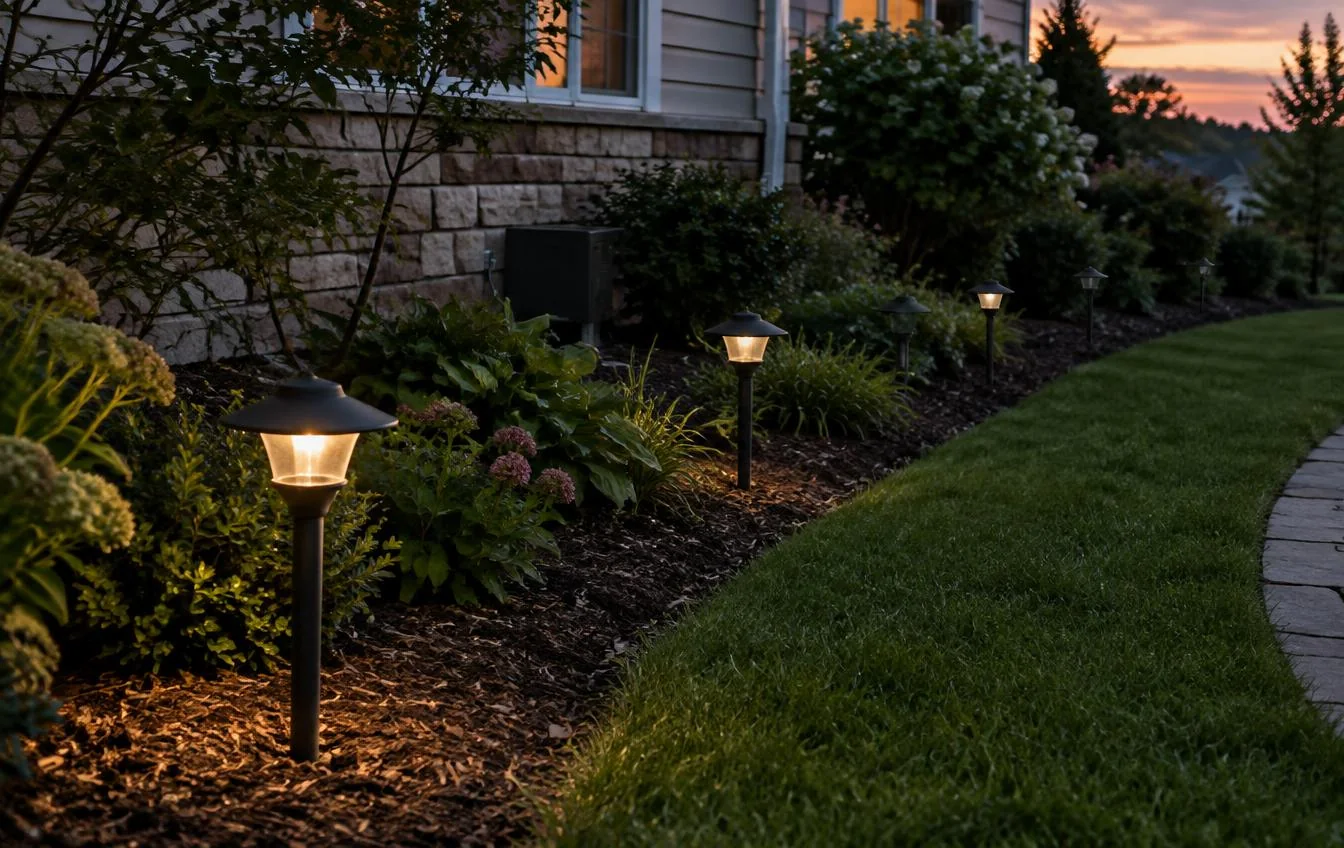
The far end of the run dies first
Voltage drop, no math.
Power leaves the transformer and travels down a wire. The wire takes a cut the whole way out. Every foot of cable and every fixture tapped into the run pulls the voltage down a little more. The head at the end of a long run is being fed less than the head nearest the transformer.
Feed an LED driver less than it wants and it does not fail politely. It runs dim. It runs warm. It flickers at dusk. It quits early.
That is why six path lights look right and the last four look tired. Nothing is wrong with the last four. They sit at the end of a budget that ran out before it reached them.
Four things push on that number. Run length. Wire gauge. How many fixtures share the run. Where the transformer sits. A long run on heavy wire behaves nothing like a short run on thin wire, so we calculate it against the actual property instead of guessing at it. Sometimes the fix is bigger wire. Sometimes it is splitting one long run into two short ones. Sometimes it is moving the transformer. And sometimes the answer is you can't get there from here, and that leg gets rebuilt rather than patched.
Open the splice before you blame the fixture
What "direct burial" is supposed to mean.
Most dead outdoor fixtures are not dead fixtures. They are good fixtures on the far side of a bad splice.
Every spot where two wires meet underground is a spot water can get into. Water gets into copper, copper corrodes, resistance climbs, and the light downstream dims or drops out. Twist-on wire nuts and electrical tape belong indoors. In wet soil they are a countdown.
Connectors described as direct-burial are built for the condition they live in — made to be sealed against moisture and to sit in soil without a protective enclosure around them. That is a category of product, not a promise about any one part, so the specifics come from the manufacturer's own current documentation rather than from us. The difference in approach is the point. A connection meant for a dry junction box inside a wall is doing a job it was never built for once it ends up six inches down in a wet bed.
Buried splices are also the part nobody can see, which is how they survive so long in bad shape. A fixture that comes back when you wiggle it is telling you the fault is in a connection. So is a fixture that works in the rain and not in the dry.
What keeps water out is not what sold you the fixture
Bodies, gaskets, threads, leads.
Two fixtures look identical lit and behave nothing alike after three winters. The difference sits in the body material, the gasket behind the lens, the thread quality where the two halves meet, and whether the lead exiting the fixture is sealed.
A thin stamped housing with a press-fit lens lets moisture in eventually. Brass and copper take the abuse differently than coated aluminum. Coated aluminum takes it differently again depending on the coating.
Finish is a style choice. Sealing is a lifespan choice. They get sold in the same box, which is why people buy on looks and get surprised two seasons later.
Gaskets age on their own. Rubber compresses, dries out and takes a set. A fixture that was sealed on install day can open a path for water years later with nobody touching it. Fog on the inside of a lens means water is already in the housing.
When the LED is built in, the fixture is the part
Nothing to change out.
Plenty of outdoor fixtures now have the LED built into the body. No bulb. No socket. No lamp to pull. When that LED or its driver goes, the fixture goes, because there is no replaceable piece inside it. That costs you something real. A failure that used to be a bulb is now a dig, a splice and a new fixture.
Fixtures that take a separate lamp keep that door open. A dead lamp comes out without disturbing the housing, the wire or the connection. The trade is that a socket is one more place for moisture to find, and lamp types get discontinued.
Neither approach is wrong. Know which one you own before something fails, because it changes what a repair looks like and what it costs. Smart Tek does no bench repair — nothing goes back to a shop — and on a failed fixture still inside its warranty period we assist with the manufacturer's claim. What that warranty covers, and what the manufacturer sends back, is set entirely by the manufacturer.
Most of what kills these is mechanical
Trimmers, mowers, shovels, frost.
The hardest thing on landscape lighting is not electricity. It is a string trimmer. Nylon line at full speed cuts a low-voltage cable clean and the operator never feels it. The fixture that goes dark is usually downstream of a nick nobody noticed.
Mower decks catch fixture tops. Shovels find wire. Irrigation work and lighting work live in the same shallow layer of soil, so a sprinkler repair takes out a lighting run and nobody connects the two events.
Then frost. Ground that heaves over a Long Island winter lifts fixtures out of plumb, pulls on leads, pushes stakes sideways and loosens connections that were tight in October. A crooked row of path lights is not only a look problem. Something pulled. Pulling is how connections open.
Bed or turf decides how long it lives
Where it sits is most of the answer.
A fixture in a planting bed has the easiest life available. Mulch covers the stake. Nothing drives over it. The cable follows the bed edge. The only regular traffic is a person with hand tools.
A fixture in turf gets a mower over it every week in season, an aerator now and then, and a trimmer around it every time somebody edges.
Wire depth works the same way. Cable sitting just under the surface is in the zone where everything else happens. How deep a given cable should sit depends on the wiring method and on current local requirements, so we confirm it rather than assume it. Deeper is generally safer from tools. Deeper is also harder to find later, which is why we document the route when we run it.
Anything mounted on the outside of the house — a wall fixture, a transformer, a soffit light — falls under requirements that differ from one village to the next, covering what may be mounted where and how the installation is to be done. Smart Tek checks before mounting anything outside.
FAQ
FAQs
That section shares a run, and the run has one fault on it. A cut cable or a failed connection kills everything downstream of itself while everything upstream keeps burning. Good news, actually. It narrows where to dig.
Yes. A fixture failing short, or a corroded connection acting like extra wire, drags voltage down for everything sharing that run. A system that got dimmer all over usually has one bad spot, not twenty tired fixtures.
Usually not by itself. If the voltage is getting lost in the wire on the way out, a new transformer in the same spot feeding the same runs loses it the same way. A bigger transformer helps when it is genuinely out of capacity. That is a different fault from distance.
Changing the light source does not change the wiring. LEDs draw less and that relieves some runs. A corroded splice, a cut cable or a run too long for its wire stays exactly as it was. Wiring first. Lamps last.
The far end dies first. That is what we read when we walk a run, and it is why the dead fixture in somebody's hand is almost never the part that failed.
Plan and service outdoor lighting
For an existing lighting system that keeps failing, see Service & Troubleshooting. For lighting design and control, see Lighting & Shade Control.
Our town guides for Water Mill and Remsenburg cover outdoor audio and landscape lighting.
Talk through the problem
Call 631-656-9180, Mon–Fri 8 AM–6 PM and Sat 9 AM–1 PM, or tell us what is happening through the contact form. We serve Long Island, Manhattan and the Hamptons.