
Outdoor light that shows the house, not the bulb
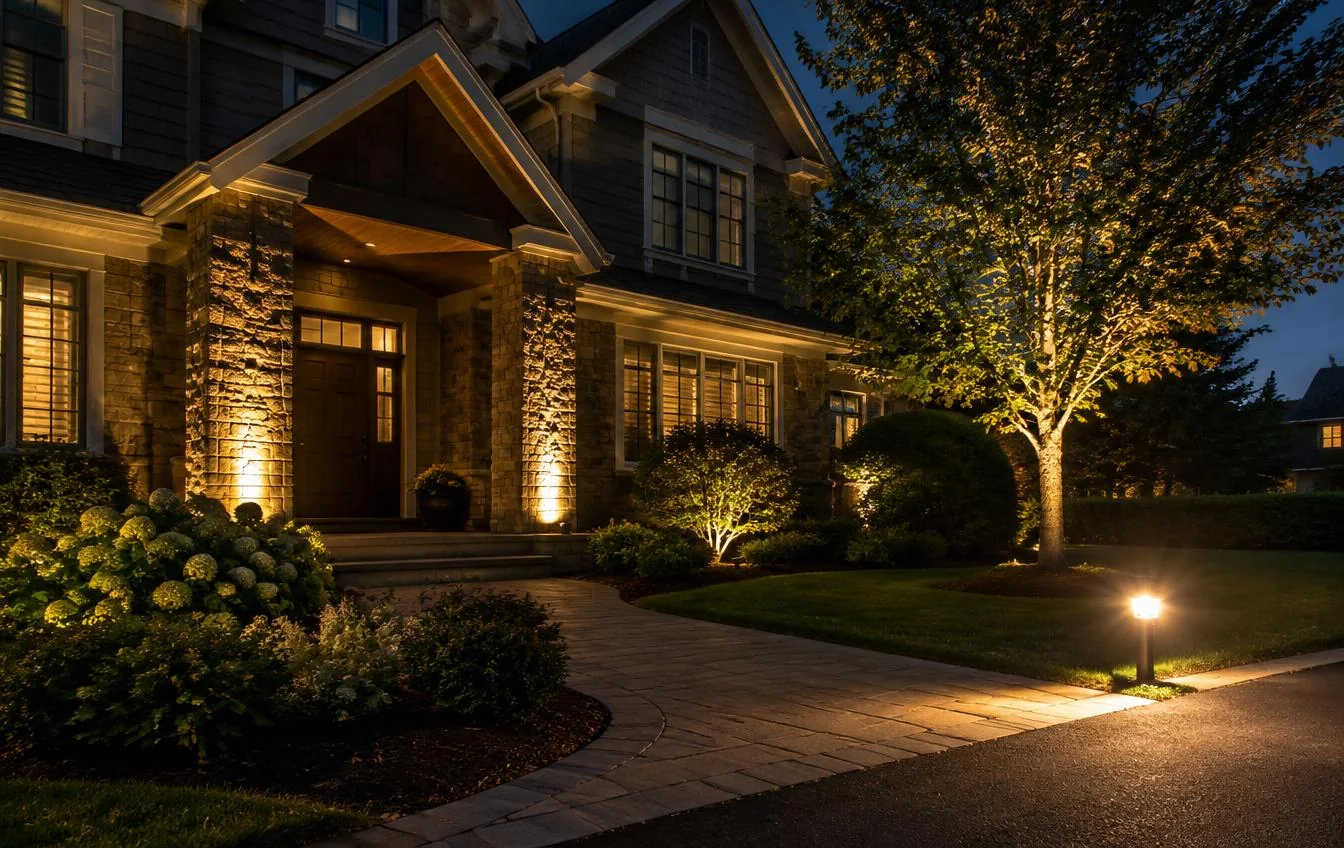
A house at night shows only what the light leaves visible, and the light is rarely working on the house. On most front elevations the eye arrives and finds bright points floating in front of the brick, and the brick itself has gone soft and brown behind them. Nothing out there has failed. The fixtures are performing exactly as aimed, and what they have been aimed at is the person looking.
The brightest thing in the frame
Vision is comparative. The eye sets its working range from the brightest thing in view and treats everything below that as shadow, which is a useful habit indoors and a destructive one on a dark property. A bare lamp sitting in the field of view is, by a wide margin, the brightest thing out there — brighter than the stone it is lighting by a factor the eye cannot hold in the same frame. So the pupil closes down around the lamp, and the depth of a stone course, the shadow line under a cornice, the texture of cedar shingle, all of the things the fixture was bought to reveal, drop below the threshold the eye is now set for.
This is why a property can carry more light and read as less visible. The light that reaches a face is light that never reached the surface, twice over: once because it went the wrong direction, and again because it raised the bar everything else now has to clear.
What dimming reaches, and what it does not
Lowering the output helps a little, in the way that whispering helps a little in a quiet room. What hurts is not the quantity of light leaving the lens; it is the ratio between that lamp and the darkness immediately around it. That ratio stays enormous at any level a fixture is useful at. A dimmed glare source is a dimmer glare source and still the brightest thing in the frame.
Dimming earns its place after the geometry is settled. It sets how bright an already-invisible fixture makes the wall, which is a question of taste and of what the neighbors across the street are living with. It cannot substitute for an opaque edge.
Shielding, which is physical and therefore first
A cowl, a hood, a glare guard, a lens recessed deep enough into its housing that the source disappears behind the housing's own lip — any of these put solid material between the lamp and the angle a person actually occupies. Nothing about the output changes. The light still leaves the fixture and still lands on the wall. It stops leaving in the directions where there are eyes.
Shielding is also the only one of these corrections that cannot be undone by weather, by a landscaper's shovel, or by somebody bumping a fixture with a mower. A hood is still a hood years later.
Aim, the cheapest correction in exterior lighting
A fixture rotated a few degrees tighter to the wall throws the same light onto the same stone and leaves the sightline entirely. More of the glare we get called about turns out to be an aiming condition than a hardware condition, which matters mostly because the instinct when a light is uncomfortable is to replace the light.
Fixtures drift. Frost heave moves a stake. A trimmer knocks a knuckle loose. Aim is not a thing that gets set once and holds forever on a property with seasons.
Aim decides composition as well, and that is where the cost is less obvious. A front elevation lit evenly across its full width reads as a painted backdrop. Nothing advances; nothing recedes; everything got the same treatment, so nothing has anything to be measured against. Shape comes from the parts left alone. A column, a chimney face, a dormer cheek, a specimen tree with structure in it — those have geometry worth describing with light, and they only describe it against something darker.
The even wash also manufactures the glare it then spends money fighting. Wide beams aimed up a flat wall overshoot the wall. What continues past the roofline continues into the street, into second-floor windows, into the property next door, and that is where complaints are born. A narrower beam on a surface worth seeing puts the same light where it does work.
The sharpest version of that overshoot sits under a window. Glass is not a wall, and a fixture set below a sill and aimed up does not stop at the sill. The beam continues through the glass and lands on the ceiling of the room directly behind that window — that room, not the one above it — spreads across the plaster, and stays there until the timer or the photocell lets go of it. If that room is a bedroom, somebody is sleeping under a lit ceiling. The fixture is behaving exactly as its aim describes, and the aim was decided by someone standing outside in the afternoon.
Height as a trade, not an error
Height is the argument people actually have, and it is a real one, because two unrelated things move at the same time.
Raising a source widens the ground a single fixture can cover, which is the whole reason anybody mounts anything high. It also changes the angle at which the source enters a sightline, and generally in the helpful direction: a lamp well above head height sits outside the cone a person's eye sweeps while walking toward a front door, and the same lamp at shoulder height sits squarely inside it. The common belief that height makes glare worse has it backward for the ordinary case.
Shielding is what decides glare, at any mounting height. An unshielded lamp mounted high is a floodlight raking the street at a shallow angle, and it will reach bedrooms across the road that a low fixture never could. The same lamp behind a deep cowl disappears from the sidewalk and still covers the ground it was raised to cover. So the honest version of the height question is a coverage question — how much ground per fixture, at what spacing, and does the fixture at that height have an opaque edge where it needs one. Lower mounting with more heads costs more in hardware and in wire and buys light a person can stand inside of. Both answers are defensible. Neither is a mistake.
A walkway is where that trade gets settled in public. A walkway fixture has one subject and it is the walking surface: the nosing of a step, the lip of a bluestone, the point where the pitch changes. The moment such a fixture reaches somebody's eyes it has stopped doing that job, because a person squinting at a light is a person who cannot see the step. Low, shielded, aimed down and spaced closer together gives a readable surface. Tall, bright and far apart gives a row of hot circles with dark intervals between them, which is harder to walk than honest darkness.
Stairs, grade changes and the joint where a driveway meets the walk are where people actually trip, and with real consistency they are the dark parts of a property whose facade behind them carries a row of fixtures.
What stays open, and what the patio closed
The forgiving decisions stay forgiving for as long as the fixture is sound. Aim, beam spread, lamp color where the fixture takes a lamp, dimming levels, schedules — all of that is an afternoon with a technician, no digging, no masonry, no drywall.
Lamp color is the item on that list that gets away from people, because it moves slowly. Color temperature — how warm or cool the white reads — is the one property the eye judges instantly and unforgivingly, but only in comparison. A single temperature across a property looks like a decision. Two temperatures in the same view look like a fault, and the eye finds the seam before it finds the architecture.
Properties almost never go wrong here on day one. They drift. A fixture gets added one year, two more the next, from a different supplier, with whatever lamp was in the van, and each addition is a small compromise nobody wrote down. Several years on the front of the house carries more than one white and nobody can say which year it started. The record of what is installed where is worth more than any single taste call, because it is the only thing that keeps the fixture added later from starting the drift again. Where a property has already drifted, the correction is usually a group at once rather than one fixture at a time.
The unforgiving ones were settled by the trades who came before. A fixture location is a wire location, and moving one means moving the other. Wire routed under hardscape is wire that now lives under hardscape; getting a new run beneath a set patio means cutting the patio, and resetting stone so the repair does not announce itself is a mason's work. Transformer capacity is a hard ceiling — when it is full the answer is a second transformer, a second location, and a feed to reach it, which is a project rather than an adjustment.
FAQ
FAQs
Often, yes. Re-aiming, adding a shield or a glare guard, and changing the lamp where the fixture takes one all work on hardware already in the ground, provided the housing and the wiring are sound. Replacement belongs to fixtures that are failing or that have no way to accept a shield.
Only partly. Output drops, but the contrast between a visible lamp and the darkness around it stays extreme, and that contrast is what the eye reacts to. Dimming does its real work after the source is already hidden, when the question becomes how bright the wall should read.
They can, and from the street they tend to read as a fault rather than as variety, because most front elevations put both in view at once. Separation by distance helps only where the two never appear together from any normal vantage point, which is rare in a front yard. One temperature across a property is the easier discipline to hold.
Because the facade is what people picture when they think about lighting, and the walking surface is what they actually use. Step and path fixtures are small, inexpensive and invisible in a rendering, so they are the first things deferred. The geometry is indifferent to that: the step is still where the trip happens.
That is the real division on any lit property: the things that are still a conversation, and the things that stopped being a conversation the day the stone went down.
Correct outdoor lighting glare
For fixture placement, shielding and lighting control, see Lighting & Shade Control. For an existing system that needs correction, see Service & Troubleshooting.
Our town guides for Water Mill and Amagansett cover landscape lighting near the water.
Talk through the problem
Call 631-656-9180, Mon–Fri 8 AM–6 PM and Sat 9 AM–1 PM, or tell us what is happening through the contact form. We serve Long Island, Manhattan and the Hamptons.