
Can Landscape Lighting Go In Without Digging?
One low-voltage cable does nearly all the work on a landscape lighting job. It leaves the transformer, reaches the first fixture, and keeps going until it reaches the last one. What the job costs, and how much of the property gets disturbed on the way, comes down to what that cable has to get past — and the obstacle that costs the most is not the one people brace for.
So the useful question is not whether the yard has to come up. Mostly it does not. The useful question is how many times a wire has to get to the other side of something.
First: the soft ground, which is most of the job
Bed edges, foundation lines, tree bases.
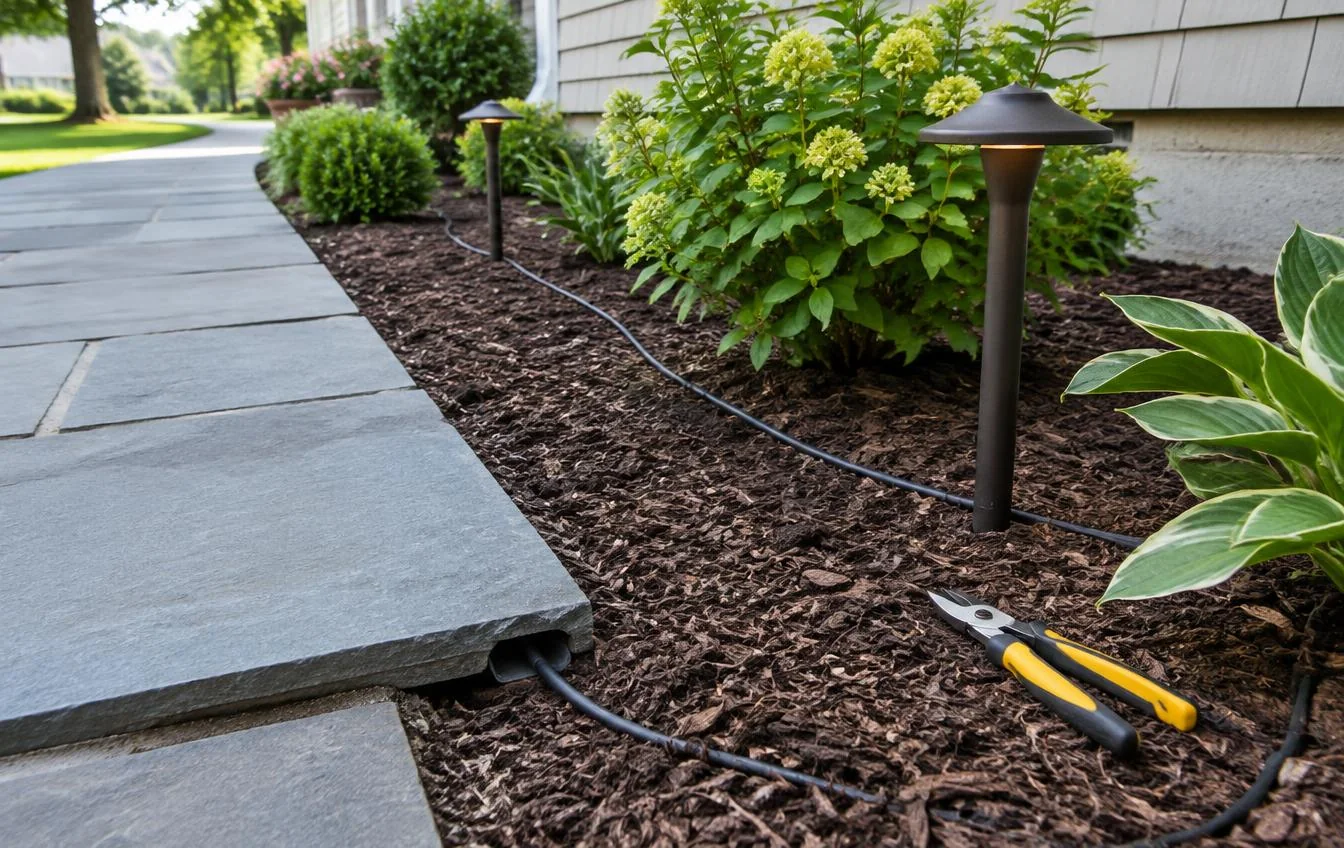
Cable running along the inside edge of a planting bed is light work. The soil is loose, there is mulch to hide under, a hand tool is sufficient, and the route is invisible by the next watering. A foundation line behaves the same way, because there is almost always a soft strip between the house and the lawn.
That covers a surprising share of a typical plan. Front of the house, the beds, the foundation plantings, the trees along a bed line — all of that goes in with very little disruption. People brace for a construction site and get a wheelbarrow.
What determines this is the plan rather than the technique. Fixtures grouped where wire can travel through soft ground are inexpensive to connect. Fixtures scattered so each one needs its own crossing are expensive to connect, though the fixtures themselves cost the same either way.
Second: the crossings, which is where the money is
Lawn is routine. Hardscape is not.
A lawn crossing is manageable. Wire goes under turf through a narrow slit rather than an open trench, and the turf closes back over it. It is not free, and it is not invisible at first, but it is routine work with a predictable result.
A driveway or a patio is a different item entirely. Getting a wire under asphalt, concrete, pavers or bluestone means boring beneath it or opening it and putting it back, and putting hardscape back so it matches is a mason's scope, not a lighting scope. The crossing can cost more than every fixture on the far side of it.
Which is why that part of the conversation belongs before the plan is final rather than after. The cheap move is to group fixtures so the crossing is not needed. The expensive move is the crossing itself. The cheap one goes first, and whatever is still left over is the real cost of the job. Occasionally what is left is better solved by a second transformer on the far side, fed from a different circuit, instead of one wire fighting its way across.
The one nobody checks: sleeves, while the paving is open
The least expensive line item in this entire article.
A sleeve is an empty conduit buried under a driveway, walk or patio so a wire can be pulled through it later. While the paving is already being poured or set, adding one costs almost nothing. It is the highest-return item on any outdoor project, and it is the item that gets left off almost every time.
After the paving is down, that option is closed. Adding a crossing then means cutting or boring, and the bill covers the crossing, the repair, and the chance the repair is visible afterward.
So when hardscape work is coming — a new driveway, a walk being reset, a patio extension — sleeves are what we specify to the mason or the GC, whether or not lighting is in that year's budget. More of them than the current plan needs, and set where the natural crossings actually fall rather than where a spare pipe happens to be. The same sleeve later serves lighting, irrigation, a gate, a camera or a speaker.
A property with no sleeves still works. A property with sleeves is the one where the next addition is a pull rather than a demolition. That is the difference between something functioning and something being useful later.
What else is in that shallow layer
Locate first. Dig second.
Sprinkler lines, drip tubing, invisible-fence wire, low-voltage runs from an earlier lighting job, and landscape wiring from previous owners all live in the top few inches of soil. So does a new lighting run. That is a crowded layer, and the only way to avoid cutting something is to know where it is before anything opens the ground.
Locating comes first on every job. Irrigation zones get identified, fence loops get traced, existing lighting runs get found. Older properties are the ones that bite, because work has been layered in across decades and nobody holds a drawing of any of it.
In order of how much trouble they cause: an invisible-fence loop is the worst, because the system goes down quietly and the dog finds out before the owner does. A drip line is next, and it reports itself as a dead plant in July. An old lighting run is third and is often a favor, since finding it explains a section that stopped working years ago. None of these is catastrophic. All of them are avoidable by locating before anything opens the ground.
The tree you are lighting is the tree you can hurt
Roots are shallower and wider than people assume.
Up-lighting a mature specimen tree is one of the better things outdoor lighting does. Trenching through that tree's root zone to get the wire there is one of the worse. The feeding roots sit shallow and spread well past the canopy, and cutting through them for the sake of a straight run can cost the tree the lighting was meant to show.
Route and technique are the fix. Wire comes in from the side instead of straight through, follows an existing bed line where one exists, and gets worked in by hand near the trunk rather than by machine. It takes longer. It is the right order of operations.
A tree that declines seasons after a lighting install is rarely connected back to the install at all.
The transformer location, set once
One decision fixes every run length after it.
A transformer needs three things: power it can legally and sensibly be fed from, access for someone to service it, and a position that is not the first thing a visitor sees. Reachable, openable without moving furniture or shrubs, and close enough to the lighting that the runs stay sane.
That last one gets underestimated. Transformer position sets the distance to every fixture, and distance is what drives voltage drop. A transformer at one corner of the house feeding fixtures around to the far corner builds a long run in on day one. Two transformers in sensible places can come in under one transformer plus a lot of heavy wire.
Sizing is the related decision, and it gets made against the finished plan rather than phase one. If the plan is front yard now and back yard in two years, then transformer capacity, wire gauge and sleeve locations get set for the finished plan, so adding fixtures later is a connection instead of a rebuild. Lighting installed in stages is normal. Lighting sized in stages means doing the infrastructure twice.
Anything mounted on the outside of the house, a transformer included, falls under requirements that vary by village — where it may be mounted, and how it is to be installed and fed. Smart Tek checks before mounting anything outside.
FAQ
FAQs
Not generally. Most wire follows bed edges and foundation lines through soft ground, and lawn crossings are usually made with a narrow slit rather than an open trench. Disruption concentrates at crossings, which is why the plan works to keep the count of them down.
It can be done and it does not last. Mulch gets turned, beds get weeded, and cable sitting in the top inch is cable waiting for a shovel or a trimmer. Proper burial is the difference between a system you forget about and a system you keep calling about.
Mostly it is done on finished properties. What a finished property changes is the route, not the feasibility — the plan works around existing hardscape instead of under it. Hardscape crossings are the only place where during-construction would have been materially cheaper.
Some of it can be located and some has to be inferred from how the property was built and worked on. Irrigation controllers, fence transmitters and existing lighting transformers tell you a system exists; tracing tells you where it runs. Locating before digging is part of the job rather than an extra.
The soft ground is most of the work and almost none of the cost. What this job really is, is the number of times a wire has to reach the other side of something nobody wants cut — and on the property where sleeves went in while the paving was open, that number was settled years before anybody picked a fixture.
Plan lighting routes and crossings
For sleeves, cable routes and future additions, see Smart Home Wiring & Pre-Wire. For the lighting plan itself, see Lighting & Shade Control.
Our town guides for Wainscott and Massapequa cover pre-wire during construction and renovation.
Talk through the problem
Call 631-656-9180, Mon–Fri 8 AM–6 PM and Sat 9 AM–1 PM, or tell us what is happening through the contact form. We serve Long Island, Manhattan and the Hamptons.