
Landscape lighting that doesn't look like a runway
The complaint that gets misread most often is the one about brightness. Hardly anyone who says their landscape lighting is too bright means there is too much light in the yard. What they are reacting to is being able to see the sources: a line of bright points along the driveway, two floodlights over the garage doors, and a house gone dark behind both of them. Every fixture is working. Nothing is broken. The answer is not about how much light you have; it is about which light your eye is allowed to see.
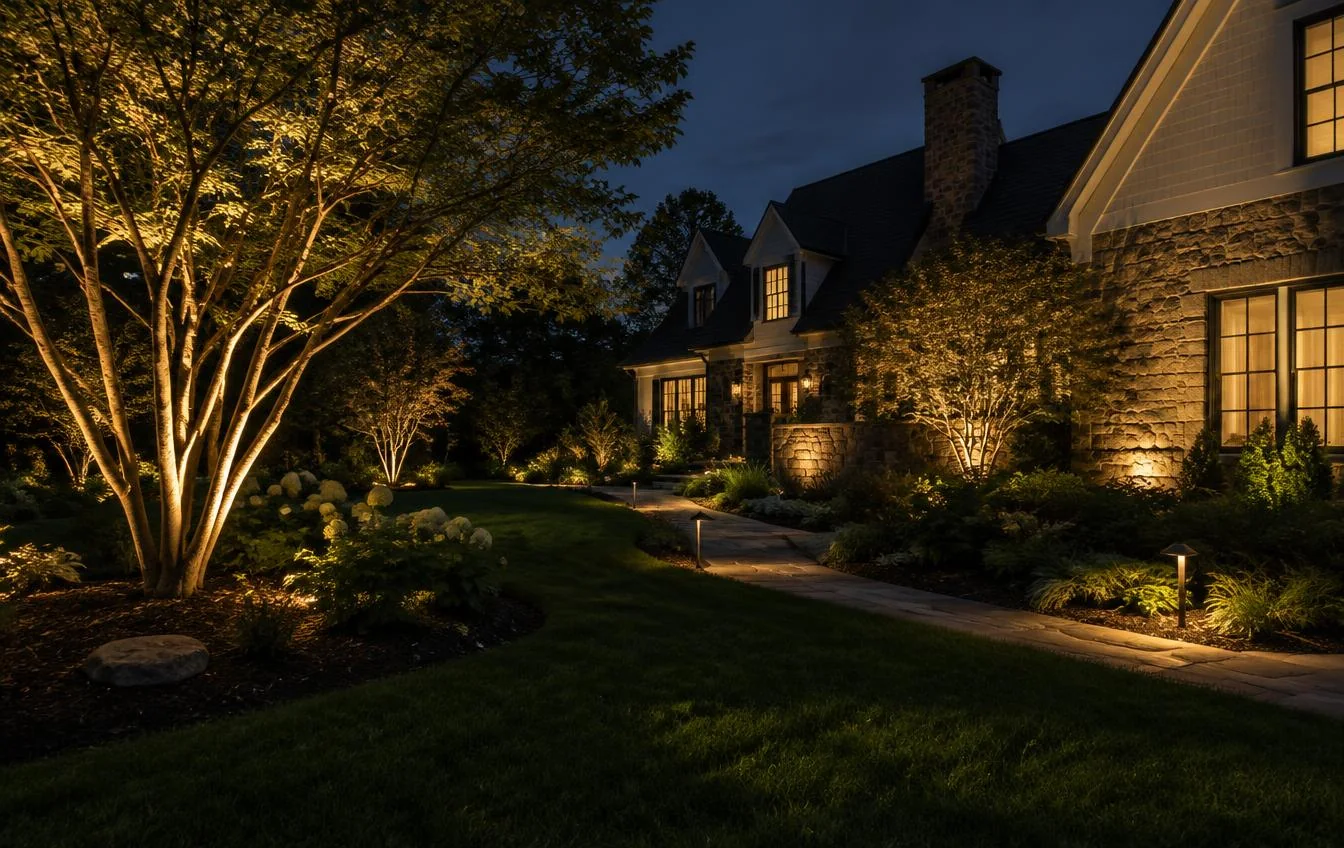
Why you see dots instead of a house
Your eye sets its exposure for the brightest thing in view.
Think about how a camera behaves when you point it at a window. It exposes for the bright glass, and the room around the window goes black, even though the room is still there. Your eye does the same thing, and it does it automatically: the pupil closes down for the brightest point in the scene and everything dimmer falls away.
A path light that throws light sideways at eye level is that bright window. Put eight of them along a driveway and your eye is exposing for eight bright windows, so the house, the trees and the planting all drop into the dark. The light output never reached the things you wanted to see — it reached your pupils instead.
The same fixtures set lower, aimed down at the walking surface and spaced unevenly reverse the effect. Now you see pools of light on the pavement and the sources disappear. The tools for this are shields, glare guards, deeper-set lenses, honest aiming, and using fewer fixtures than the first instinct calls for. A few things lit well reads as considered. Everything lit evenly reads as a parking lot, and a parking lot is bright without being pleasant.
Uplighting and wall washing are two different jobs
One builds shape. The other builds a background.
Uplighting means putting a fixture at the base of something and throwing light up through it. On a tree it picks out the trunk, reveals the structure of the branches, and makes the canopy glow from below. Its job is depth: it gives a flat dark yard layers you can read from the driveway.
Wall washing has the opposite intention. It spreads light across a surface evenly so the surface reads as a plane — a stucco façade, a stone retaining wall, a garden wall behind a bed. Its job is calm, and it gives the lit trees something to sit against. Grazing is the near relative: the light is set close in and raked along the surface, which pulls texture out of brick, stone or shingle by lighting the edges of it.
Mixing up the two jobs produces the two failures we are most often called about. An uplight aimed at a flat wall leaves a hot triangle on the siding, because there is no form there for the beam to find. A tree washed evenly loses the branch structure that made it worth lighting. What a fixture is for is what decides how it gets aimed.
What color temperature does to brick, stone and planting
Color decides whether the house looks like itself after dark.
Lamp color is described in Kelvin, a number where lower values look warm, like a filament or a candle, and higher values look cool and blue-white. On a house, warmer light is nearly always the better call. It keeps brick looking like brick rather than a washed gray-pink, it keeps stone reading as stone, and it holds wood and warm siding close to how they look in daylight.
Cool light does something specific to planting, and it is worth knowing before you choose. It drains the warmth out of green, so a hedge or a lawn under cool light goes gray-blue and slightly dead. There are places where cooler light is the right choice on purpose, usually in water or on a surface meant to look crisp, but as a default across a whole yard it makes a house look like a commercial property at midnight.
Consistency carries as much weight as the color itself. Two neighboring uplights at different color temperatures read as a mistake even to someone who could not say why. Which color options a given fixture or lamp family offers depends on the product line, and the manufacturer's current documentation is the place to settle that — at selection, rather than after installation.
Glare, checked from the windows
Lighting gets approved from the driveway and lived with from the bedroom.
An uplight at the base of a tree can look right from the street and be a bright source pointed straight at the glass of the room directly above it. The people aiming fixtures are standing in the yard, and nobody sleeps in the yard, so that view never gets checked unless someone goes inside and checks it.
Anywhere the source is visible from indoors — any window on the lit side, the second floor included — the fixture needs shielding, re-aiming or less output. The same holds for the light that lands next door, because a fixture throwing light into someone else's bedroom window is the fastest way to turn a lighting project into a conversation with a neighbor.
Street-facing lighting deserves the check from the road. A fixture putting light into the eyes of a driver coming up the street is both unpleasant and a hazard. The correction is aiming it down, aiming it away, or moving it. Outdoor lighting is also an area with local requirements that vary by municipality, covering things like brightness, shielding, direction and hours of operation. Smart Tek checks before mounting anything outside, and the village is the authority on what currently applies at a given address.
Plants grow, so aiming is maintenance
A system aimed at a young tree is aimed at nothing in a few years.
This is the part that rarely gets planned for. An uplight placed under a small tree is aimed at the canopy that existed on installation day. Once the canopy climbs above the beam, the fixture is lighting bare trunk and the underside of nothing. A fixture tucked behind a new shrub ends up inside a mature one, lighting leaves from two inches away.
The rest of the list is mechanical. Fixtures get buried by mulch, swallowed by beds, clipped by mowers and lifted by roots. Cable gets cut by a shovel. Trees lean. Beds get redesigned. None of that is a failure of the installation; it is a yard behaving like a yard.
So the adjustment gets planned in rather than hoped against. Leaving slack in the wire at each fixture means something can be moved later without a splice. Re-aiming belongs to ownership rather than to repair — roughly a once-a-year rhythm — and it folds into the same visit as the other seasonal checks outside. A system aimed once and never touched again slowly stops being the thing you paid for.
On at dusk, off at bedtime
A schedule beats both leaving it on and remembering to do it yourself.
Dusk moves by hours between June and December here, so a fixed on-time is wrong for most of the year. Lighting should come on relative to sunset, which a controller calculates from your location and the date, and then go off at a time that suits your house. Not at dawn.
Leaving landscape lighting on all night costs money, shortens lamp life, and produces most of the light that bothers the neighbors, because at two in the morning yours is the only light on the street. On at dusk, off around the time the house goes to bed, with a smaller group of path and entry lights available later for someone coming home, covers nearly every real need.
Scenes are what make that livable. One setting for the whole yard when the house is full, a smaller one for an ordinary evening, a minimal one late at night. Smart Tek is a direct dealer for Lutron, and a keypad or a timeclock turns scenes into something the family uses without reaching for a phone.
FAQ
FAQs
Because you can see the sources. Evenly spaced path lights throwing light sideways at eye level read as a row of dots, and your eye exposes for those points, so the rest of the yard goes dark by comparison. The correction is almost always shielding and aiming rather than more fixtures, which is why the fixtures already in the ground are usually the ones that end up doing the job.
Generally no. All-night operation costs more, shortens lamp life, and produces most of the light that bothers neighbors, since late at night yours is the only light on the street. On at dusk and off at a set time, with a few entry or path lights available later, covers almost every practical need.
Warmer light is the safer default for most houses: it keeps brick, stone and wood looking like themselves and keeps planting green rather than gray. Keeping the color consistent across the yard matters as much as which color you pick, because a mismatch between two neighboring fixtures is obvious at night. What any particular fixture offers depends on its product line.
Yes, and that is normal rather than a defect. Plants grow past the beam, mulch buries fixtures, mowers knock them and roots shift them. Slack left at each fixture plus a re-aim once a year keeps a system looking the way it did the week it went in.
So the real choice is not between more light and better fixtures. It is whether the light is allowed to reach the house, the trees and the path instead of the eye — and that gets decided by shielding and aiming, before anything new gets bought.
Plan landscape lighting and control
For fixture placement, aiming and schedules, see Lighting & Shade Control. For a complete outdoor plan, see Outdoor Entertainment.
Our town guides for Water Mill and Remsenburg cover landscape lighting and outdoor audio.
Talk through the problem
Call 631-656-9180, Mon–Fri 8 AM–6 PM and Sat 9 AM–1 PM, or tell us what is happening through the contact form. We serve Long Island, Manhattan and the Hamptons.