
Why Turning It Up Doesn't Fix Outdoor Sound
Outdoor sound coverage is a volume problem. It is not, and the volume knob is the wrong instrument for it entirely.
The belief is reasonable on its face. The far corner of the yard is too quiet, the speakers are near the house, so you turn them up until the far corner sounds right. Anyone would try that. The trouble is what happens on the way out there. Long before the far end gets to a decent level, the patio has gone past comfortable and into loud, and the people sitting closest to a speaker are now talking over music that was supposed to be behind them.
That is not a taste problem or a brand problem. It is geometry, and it does not negotiate. A yard is one of the least forgiving spaces there is to put sound into, and understanding why changes what you ask for.
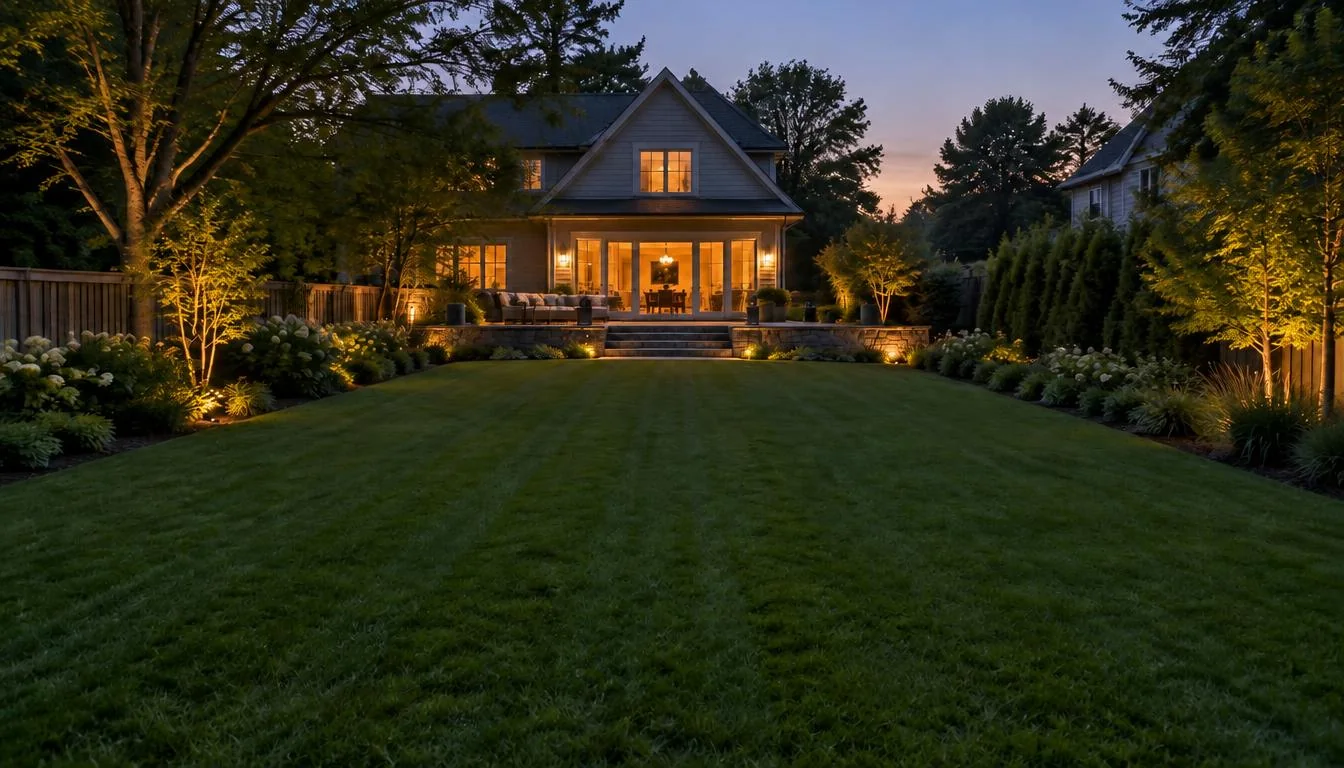
Sound thins out faster than people expect
A speaker radiates into open air, and the energy it puts out spreads over a sphere that grows with the square of the distance. Double the distance and that same energy is smeared over four times the area. The standard way acousticians write this for a point source in free field is 6 dB per doubling of distance: twice as far away is 6 dB quieter, four times as far is 12 dB down.
Six decibels does not sound like much written down. In the yard it is the difference between music you can follow and music you can only tell is playing. And the falloff is steepest where you least want it — right in the first stretch past the speaker, not out at the property line.
So consider what the volume knob is actually being asked to do. If the pergola is four times as far from the speaker as the patio table, you have to put 12 dB more into the system to bring the pergola up to where the table was. The table does not stay where it was. It comes up by the same 12 dB. You cannot raise one end without raising the other, because it is one source feeding both.
A yard gives you nothing back
Indoors, a speaker gets help. The ceiling returns energy, the walls return energy, corners load up the bass, and the room keeps a reverberant field alive that fills in behind the direct sound. It is why a modest pair of speakers can make a living room feel full: the surfaces are doing a great deal of the work. When those reflections get out of hand you hear it as echo, which is the subject of [why does my movie room echo](/blog/why-does-my-movie-room-echo).
Step outside and all of that is gone. No ceiling. No side walls. No corners. Grass and plant beds absorb rather than reflect. Whatever leaves the speaker keeps going until it runs out, and almost none of it comes back to you.
That is the whole difference. Indoors you are hearing direct sound plus a lot of reinforcement. Outdoors you are hearing direct sound and essentially nothing else. The speaker is working alone, and the falloff is close to the raw textbook case rather than softened by a room.
This is also why the familiar upgrade instinct misses. A better speaker is still a speaker, and it still obeys the same spreading law. Same reason a better speaker does not rescue a bad room indoors, which is its own subject in [will better speakers fix a bad room](/blog/will-better-speakers-fix-a-bad-room). The problem is not the quality of the source. It is that there is one of it, and the yard is large.
What loud enough at the far end actually costs
Push one pair hard enough to cover a whole property and three things happen at once, none of them good.
The near field becomes unpleasant. Conversation at the table stops being possible at normal effort, which is the opposite of what outdoor audio is for. Nobody asks for music in the yard so they can shout over it.
The speaker starts working outside its comfortable range. Driven near its limits, any speaker gets harder and more compressed sounding, bass thins out first because that is where the demand for cone movement is greatest, and the character of the thing changes for the worse. You are hearing strain, not scale.
And the sound stops being yours. A single loud source throws energy well past the property line, which is how a yard system turns into a conversation with the neighbors. That side of it has its own article in [outdoor audio zones and neighbors](/blog/outdoor-audio-zones-and-neighbors).
Where the volume knob genuinely belongs
Here is the ground that has to be conceded, because refusing it would be dishonest.
Within one zone, volume matters a great deal. Once a given area has enough sources placed sensibly, the knob is exactly the right tool for setting how that area feels — background during dinner, up a bit when the party fills in, down when it is just two people reading. Level is a real control. It is just a control over intensity, not over reach.
And a genuinely capable pair can absolutely cover a small terrace. A compact patio, people seated within a reasonable distance of both speakers, nothing much further out expected to be covered — two good speakers do that job well and there is no reason to complicate it. The argument here is not that more boxes are always better. It is that volume cannot substitute for distance, and a quarter-acre of lawn is a distance problem.
More sources, lower level
The fix for coverage is not a bigger push from one place. It is more places to push from, each one working easily.
Spread several speakers through the areas people actually use and no listener is ever far from one. Each speaker only has to cover its own neighborhood, so each runs at a modest level, well inside its range, where it sounds relaxed instead of strained. The falloff that defeated the single pair now works in your favor: a speaker's job ends before the next one's begins, and the level stays roughly flat as you walk from the patio to the pergola because you are never walking away from the whole system, only away from one part of it.
This is the quiet reason a well-designed yard system is often less obtrusive than a poor one, not more. To reach the same far corner, six speakers running gently put less total energy into the air than two speakers straining to do it alone, and far less of it crosses the property line. Low and even beats loud and uneven, every time.
Where those sources go is its own discipline — seating, hardscape, planting, how the sound carries across water or a flat lawn. That is the subject of [where outdoor speakers should go](/blog/where-outdoor-speakers-should-go), and it is a design question rather than a shopping question. The wiring and power to reach those positions is work that happens underground and in walls, which is ours, not the homeowner's. [Outdoor entertainment](/services/outdoor-entertainment) is where we lay out how we approach it.
And a point where adding speakers stops helping
More sources is not an unlimited answer, and treating it as one is the opposite mistake.
Past a certain density the speakers are no longer solving a coverage gap, because there is no gap left — the areas people use are all within easy reach of something. Additional boxes then only add cost, more wire, more places to go wrong years later, and more overlap. Overlap has its own penalty: in the zone between two sources you are hearing both, slightly offset in time, and too much of that smears the sound rather than strengthening it.
The number of sources a property wants is set by where people sit, stand and walk, not by its square footage and not by how many speakers will fit. A long narrow yard with one gathering spot wants very little. A property with a patio, a pool, a dining area and a path between them wants a handful, grouped into zones that turn on independently.
So the shape of it is simple. If the far end of the yard is too quiet, the system does not need more volume. It needs another speaker out there, running gently.
FAQ
FAQs
Usually the opposite. Each speaker only has to cover the ground near it, so each runs at a modest level. The total energy in the air is lower than what one strained pair produces trying to reach the same far corner, and much less of it leaves the property.
Because indoors the room is helping. Ceiling, walls and corners return energy and keep a reverberant field going behind the direct sound. A yard returns almost nothing, so you hear the speaker essentially on its own.
A capable speaker buys you some distance, but it does not change how sound spreads. The level still drops about 6 dB each time the distance doubles, so the near field stays much louder than the far field no matter how good the speaker is.
Yes — on a small terrace where everyone is seated within a reasonable distance of both speakers and nothing further out needs covering. The trouble starts when one pair is asked to serve a patio, a pool and a far lawn at once.
Plan the yard
For outdoor sound and the work around it, see Outdoor Entertainment. For speaker selection, see Audio / Video.
Talk through the problem
Call 631-656-9180, Mon–Fri 8 AM–6 PM and Sat 9 AM–1 PM, or tell us what is happening through the contact form. We serve Long Island, Manhattan and the Hamptons.