
Music through the yard without annoying neighbors
A backyard is a room with no ceiling and no back wall, which is a strange thing to put music in; nothing holds the sound, so it keeps traveling until the air wears it out. The pool sits far from the house and the patio sits against it, and one volume control is being asked to serve both. So the level goes up until the pool works, the patio conversation gets louder to compete, and the person receiving the clearest version of your afternoon is the neighbor two houses down. The speakers are not the problem here. The geometry is.
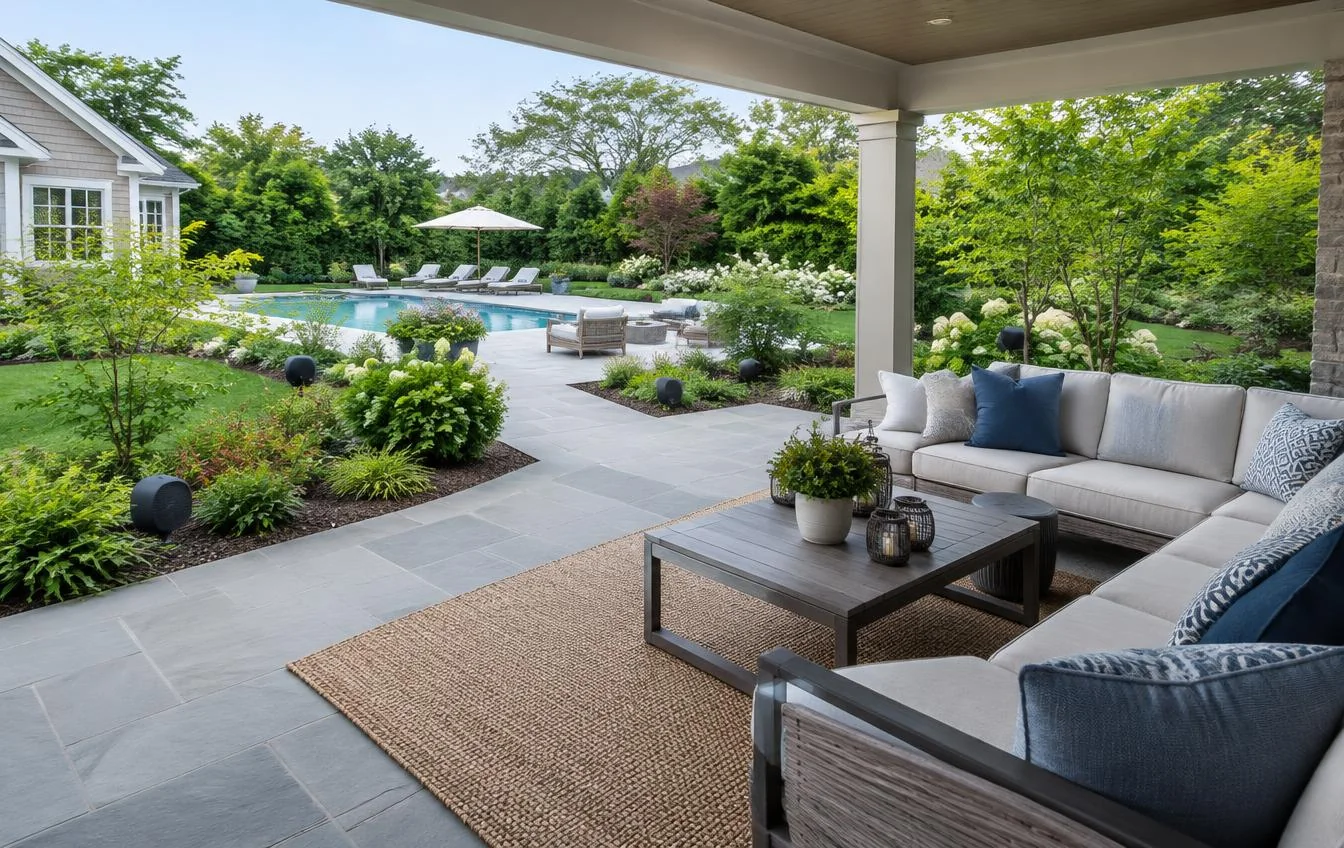
The patio and the pool are two rooms
Different distances and different activities want different levels.
A zone is a group of speakers sharing one volume and one source, which sounds like a technical detail and is really a spatial one. The patio is a close room: people sit within a few feet of each other and talk across a table. The pool is a wide room with water noise in it and bodies spread across the length of the deck. The front walk, if it has sound at all, wants almost nothing. Three rooms, three levels.
Separate them and the whole property gets quieter, because no area is being pushed past what it needs in order to serve a different one. That single decision does more for the people on either side of you than any speaker choice on the quote.
Zones also change how often the system gets used, which is the part nobody predicts. The patio alone at dinner; the pool alone on a Saturday; everything together when the house fills up. If turning on music means lighting up the entire property, it stays off.
Set it where people sit
The level that matters is the one at the chairs, not at the door.
The usual sequence is that somebody steps outside, raises the volume until it feels right standing in the doorway, and leaves it there for the rest of the day. The doorway is the one place nobody sits. A level chosen there is a level chosen for an empty position.
The level worth having is the one set down at the seating, where an ordinary conversation still works over the top of it. Outdoors, music is background whether you intended that or not, because there are no surfaces to build it into anything else. That absence of walls is also why outdoor levels nearly always need to land lower than instinct suggests.
Whatever is still followable out at the boundary is what the neighbors receive for the whole afternoon, and that is the sign the level at the chairs went past what the chairs were asking for.
Many quiet speakers, not two loud ones
Coverage is a question of how many and where, never of how hard.
Two speakers on the back wall of the house, aimed across a yard, is the most common cause of loud outdoor audio. It is a lighting problem in audio form: one source, one direction, everything near it overlit and everything far from it dark. To make the far end work you have to shout at the near end, and the near end is where the trip to the fence begins.
Spread more, smaller speakers through the space and each one works gently. The level evens out across the yard, nobody sits in front of something shouting, and the total energy leaving your property drops. Landscape speakers set into planting beds, in-ceiling speakers in a porch roof, small speakers along a pool deck — all of them doing a little instead of two of them doing everything.
Aim is the other half, and it is free. Speakers turned back toward the house, or inward across the yard, keep sound on your side of the line. Speakers turned outward from the house, facing the fence, deliver it. Same hardware, same volume, opposite result.
What arrives at the fence first
Bass travels, hard surfaces reflect, and water carries.
High frequencies lose energy quickly in open air, get absorbed by planting, and are cut down and bent off course by a fence. Low frequencies do none of those things. Bass passes through a hedge, moves around a fence and crosses a property line, which is why the only part of your music a neighbor can usually hear is the bottom of it. A subwoofer out in the yard can be a problem at a level that feels modest at the chairs.
Hard flat material sends sound where you did not point it. A stone patio, a pool deck, the side wall of a pool house, the stucco face of the next house over: all reflectors. Water reflects some of it, though around a pool the stone deck is doing more of that work than the water, so a system around a pool reaches farther than the same system on a lawn, and a property backing onto open water reaches farther still, with nothing in the way to absorb anything.
Planting does less than people hope. A row of arborvitae takes some of the top end off and leaves the bass untouched, so your music arrives at the fence muffled rather than quieter. Level and placement do the real work; the hedge is scenery.
Control belongs where people are standing
Whatever is nearest gets used; everything else gets ignored.
If the only volume control is a panel in the kitchen, the level gets set once a day and that is the end of it. With control at the patio door, in the pool house and on the phones, levels get nudged all afternoon as people move between areas, which means the system spends most of its life quieter than it otherwise would.
Phones handle most of this now, on the condition that your Wi-Fi genuinely reaches the whole yard. That condition is not automatic. A fair amount of outdoor audio frustration turns out to be network coverage fading at the pool while an app spins, and getting coverage out to where the speakers live is part of designing the system rather than a separate errand.
Smart Tek is a direct dealer for Sonos, which is where many of these systems land, because per-zone volume is the entire point of the structure. The brand matters less than the principle: a person standing at the pool should be able to turn down the pool without walking inside.
Stand at the property line
Two minutes at the fence tells you what no specification will.
The level at the fence is never the level at the chairs, and the difference is not a simple subtraction. Distance takes the top of the music off faster than the bottom, so what survives the trip is the part that carries rather than the part that sounded balanced in the seat. A setting that is conversational at the table can arrive at the sidewalk as a followable bass line with the melody missing, and that is the version a neighbor spends the afternoon with.
The hour changes it again. In the afternoon there are mowers and traffic for the music to sit under. By late evening that floor is gone, and the same setting is far more audible than it was, not because it travels any farther but because there is nothing left for it to hide under. That is the argument for a lower evening preset.
Outdoor sound is also an area where local requirements apply, and they vary by municipality, including rules on amplified sound and the hours it may run. Those hours are set by the village, not by the system, and they are not the same from one town to the next. Smart Tek checks the current requirements before mounting anything outside.
FAQ
FAQs
No number fits every yard, because it follows from the size of each area, what is in it and where people actually sit. The principle holds everywhere: more speakers at low level beat fewer speakers pushed hard. A walk-through that marks the seating areas and the distances between them produces a real count.
You can have one, and it is the component most likely to reach a neighbor, since low frequencies pass through the hedges and fences that stop everything else. It belongs low in the mix and placed near the seating rather than out toward a boundary. Plenty of yards sound better without one than with one set too high.
Some of it, yes; the goal is that what reaches them is not followable. What arrives at the boundary is mostly the bottom end of the music, and after dark the same level stands out far more, because the background noise it had been hiding under is gone.
Generally yes, in some form, and they vary by municipality, often covering amplified sound and the hours it applies to. We check the current requirements before mounting anything outside.
In a finished yard the zoning and the aim of what is already installed are still yours to change, while the conduit under the hardscape closed the day the patio was poured, which is why speakers out near the seating are cheapest to decide before that pour.
Plan outdoor audio zones
For zoned outdoor speakers and control, see Outdoor Entertainment. For whole-home audio, see Audio / Video Systems.
Our town guides for Port Washington and Lido Beach cover outdoor listening near the water.
Talk through the problem
Call 631-656-9180, Mon–Fri 8 AM–6 PM and Sat 9 AM–1 PM, or tell us what is happening through the contact form. We serve Long Island, Manhattan and the Hamptons.