
Watching TV outside, and why most outdoor TVs fail
The post is drilled, the mount is up, and the set hanging on it came off a bedroom wall. Nobody stood out there at four in the afternoon first. We get called for this one every summer. The TV is almost never the part that went wrong. The spot was.
You are fighting the sky, not a lamp
Indoors a screen beats a table lamp. Outside it has to beat daylight.
Daylight runs orders of magnitude brighter than a lit room. Your eye locks onto the brightest thing in view, and outside that thing is the sky, the lawn, the pool deck. A screen that looked bright on a showroom shelf reads gray on an open deck at two in the afternoon.
Two things decide whether you can follow the puck. How bright the panel gets. How well the glass rejects light landing on its face. Size and resolution come after both. Sets built for outdoor use are engineered around that fight, and how far any one model goes depends on the set. The manufacturer's current documentation is where that answer lives.
The order runs like this. Open sun needs more brightness than a solid roof. A solid roof needs more than a room. So the spot comes first and the set gets chosen for the light that falls on it. Backwards costs money.
An indoor set under a roof is still an indoor set
A roof stops rain. It does not stop outside.
The job we get asked for most is a regular TV under a covered porch or a pergola. The reasoning is that it never gets rained on. Sometimes a set like that runs two seasons. Often it does not.
An indoor set is built for a room that stays near room temperature, with indoor humidity and nothing living in it. A covered porch here swings from freezing to hot, goes damp every night, takes blown spray off a nor'easter from every angle, and fills with pollen in May. The case is not sealed. The vents are open. Nothing in the design asked for any of that.
There is a second piece, and it bites later. Mounting an indoor set outdoors generally falls outside what the manufacturer intended, and that can affect a warranty claim. Nothing goes to a bench here — we are not a repair shop and we do no repairs in-house — so when a set fails the only road open is the manufacturer's warranty claim, and we work that claim with you on the manufacturer's terms. Put the set somewhere the manufacturer never meant it to go and that road gets harder.
Pick the wall by the hour
Where the sun sits when you actually watch.
Washout and glare are two different failures. Washout is daylight on the whole scene, flattening the picture. Glare is a hard reflection of the sun, the sky or a pale surface bouncing off the glass into your eyes. Choosing the wall fixes a good share of both.
Glare arrives from behind the viewer. Whatever sits behind the chair is what the glass hands back, and a white garage wall, a pale fence or the surface of a pool throws as much of it as the sun does. The wall gets chosen by the hour the set actually gets used, because late afternoon with the kids, evening for the ballgame and midday on a Saturday each put the sun somewhere different.
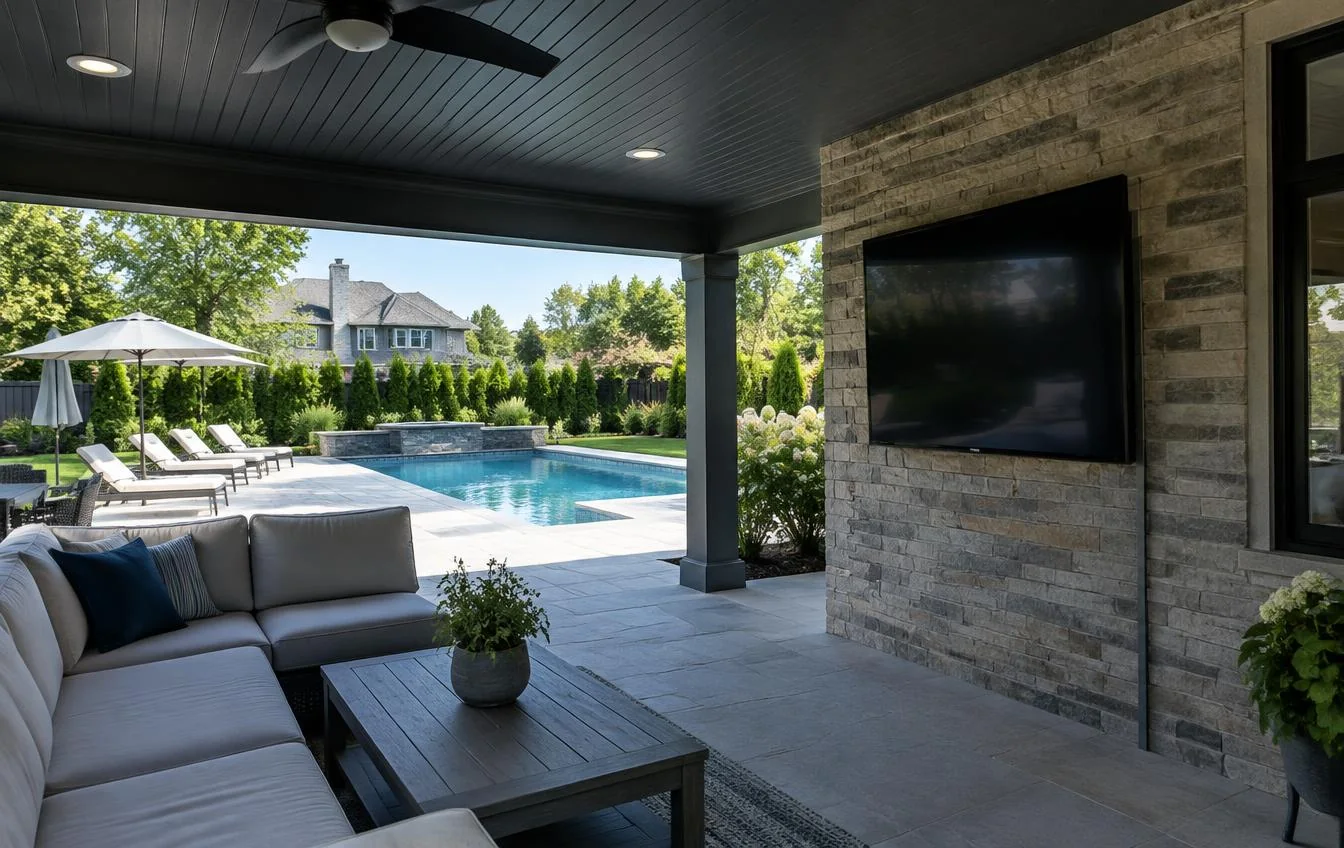
Overhead cover earns its keep when it shades the face of the screen and not only the top of it. A deep roof does it. A solid pergola cover does it. An awning does it. A slatted pergola stripes the picture for part of the day and then stops, which is worse than no cover, because you cannot plan around it.
What we find inside a set that was not built for this
The failures start small and quiet.
Open up a set that died outdoors and the damage is rarely dramatic. Moisture that condensed inside the panel overnight and left a cloudy patch. Corrosion on an HDMI contact, so the input drops out and comes back. Ants or wasps that moved into the warm back of the chassis and shorted something on the board. Pollen and dust packed into the vents until the set cooked itself.
Sets made for outdoor installation take that on with sealed enclosures, gasketed openings, filtered or managed venting, and finishes picked for weather. How far a given model goes, and what conditions it is designed to be installed in, depends on the product. The point is that somebody designed for the problem at all.
The middle road is a weather enclosure around an indoor set. Those exist and they can work. They also add heat, condensation and an access problem. Three questions decide whether a particular one is any good: how it vents, how the TV comes out of it, and what happens inside it in July.
Anything hung on the outside of a house also has to land in something that holds it in wind, and get flashed so water cannot track in behind it. Smart Tek checks what is allowed on an exterior wall before anything gets mounted outside.
Power and signal to a spot with neither
The set is the easy part. Getting to it is the work.
Most outdoor TV locations start with no outlet and no cable. Both get solved properly or not at all. Outdoor power takes weather-rated boxes and covers and the right protection on the circuit, and an electrician does that piece. It is often the biggest line outside the set itself.
Signal has more paths than people expect. Put the sources outside with the TV and you have another box living in the weather. Leave them indoors in a rack and send video out, and the sensitive gear stays in conditioned space. Long copper HDMI gets unreliable past a certain length, so the usual answers are fiber HDMI or video over the network. Either way it is a cable that needs a route, and that route is far cheaper before the siding and the decking close up.
Control belongs in the plan early. A set outside with no Wi-Fi in the yard and a handheld remote that lives on a wet table is a daily annoyance. Coverage that actually reaches the patio, and a control method that works with wet hands, belong in the job. Sony is one of the lines we carry as a direct dealer, and the set is still the smallest decision on this list.
What a Long Island winter does
Cold is survivable. Water that freezes is not.
Nobody watches the patio TV in January, so the question is what happens from November to April. A set built for outdoor installation usually stays where it is and stays powered, because a running set sits slightly above ambient and that discourages condensation inside it. What your particular set is rated for over a winter depends on the product.
Cold is not what kills gear here. Water sitting somewhere it cannot drain from, then freezing and pushing, is what kills it. The bottom lip of a mount. An unsealed wall plate. A connector facing up instead of down. A low spot in a conduit. A winter-proof install comes down to giving water somewhere to go.
Covers cut both ways. A cover thrown over a cold set traps the moisture already inside it against the screen.
FAQ
FAQs
People do, and some get a few seasons out of it. What we find on the ones that quit is condensation inside the panel, corrosion on the connections and insects in the chassis, none of which care that the rain never touched it. A fully enclosed, heated porch is a different question.
Depends on how much light lands on the face of the screen and how bright the set gets, and brightness varies by product. Open sun asks for far more than a solid roof. The spot settles this before the set does, and what sits behind the chair counts as much as what is overhead.
The manufacturer's warranty claim is the path, and we open it and work it through with you. What that warranty covers, and for how long, is the manufacturer's call rather than ours, and a set installed the way its maker intended stands in a better position on that claim.
Requirements for anything attached to the outside of a house vary village to village, and so do rules on structures and exterior changes. Smart Tek checks what applies before anything gets mounted outside.
What we find inside the sets that die out there reads the same every time: a cloudy patch behind the glass, a green HDMI contact, a nest in the warm end of the chassis. The spot decided all three of those long before the set did.
Plan an outdoor TV location
For outdoor displays, sound and control, see Outdoor Entertainment. For indoor sources and video distribution, see Audio / Video Systems.
Our town guides for Centerport and Oyster Bay cover outdoor TV and audio near the water.
Talk through the problem
Call 631-656-9180, Mon–Fri 8 AM–6 PM and Sat 9 AM–1 PM, or tell us what is happening through the contact form. We serve Long Island, Manhattan and the Hamptons.