
Outdoor gear before winter, and again in spring
Everything on the fall list costs time rather than money. A few outdoor covers closed. A connector turned to face down. An armload of portable gear carried inside. The cushions go to the garage after the last cookout in October, and the TV, the speakers, the cameras and the lighting stay mounted where they are straight through January. What the skipped walk costs gets paid in a different currency on the first warm Saturday in April, when something does not come back on. Almost nothing outside fails during a storm; it fails quietly over the winter, and the failure is found at the worst possible moment.
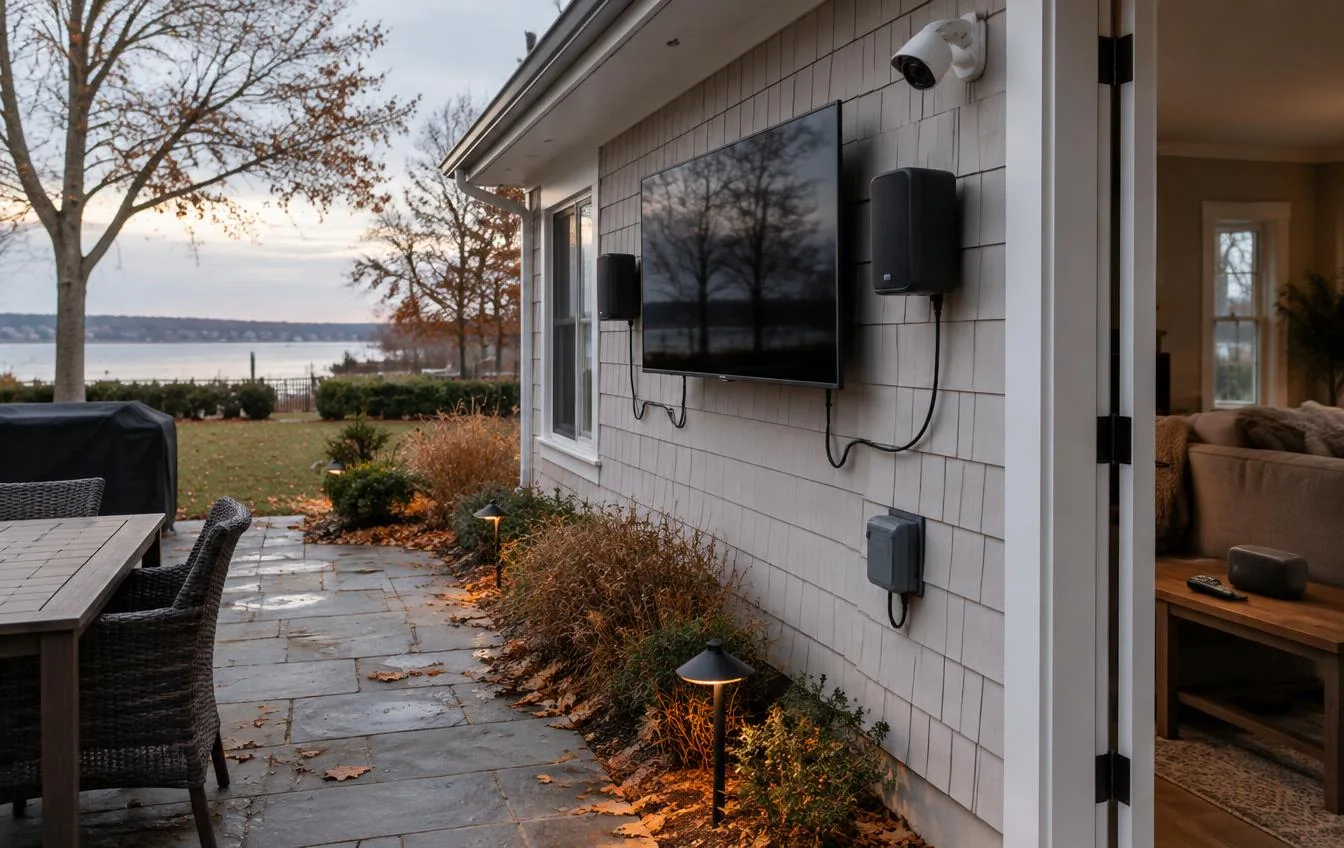
Sort the gear into three piles
What stays out, what comes in, and what never belonged out there.
First pile: equipment designed to be installed outdoors and left there. That generally covers outdoor-rated speakers, surveillance cameras, landscape lighting and televisions built for outdoor installation, though what any specific product is designed for depends on the product and its documentation.
Second pile: portable items with no business overwintering outside. Portable speakers, streaming sticks, remotes, battery packs, anything with a USB port on it. This is where most of the annual loss happens, and it is nearly all small things with batteries in them — a remote in a deck box, a portable speaker on a pool house shelf, a camera battery in an unheated shed. Cold shortens battery life, and a cold battery that gets damp corrodes and leaks. That pile is the cheapest item on either list, which is why it comes in first.
Third pile: equipment that was never meant to be out there in the first place, the common case being an indoor television under a pergola. The straight answer is to bring it in for the winter. It is inconvenient, and it is still correct, because a winter outdoors is precisely the condition that set is not built for.
Water, and the places it collects
Cold on its own is survivable. Water that freezes is what breaks things.
Water that can sit somewhere without draining is the whole mechanism, and it collects in a short list of places. In rough order of how often it turns up: the bottom lip of a TV mount, an outdoor receptacle with the cover left open, a wall plate that was never sealed along its top edge, a junction box sitting flat on a deck, a connector facing upward, and a low spot in a conduit run. Each one collects water, which freezes, expands, and pushes something apart.
The one nobody checks is the drip loop. Any cable entering a wall or a box should sag below the entry point first, so water running down the cable falls off instead of being led inside. It costs almost nothing at installation and it prevents a specific, repeatable failure. Adding one later is still cheap. Replacing the box the water got into is not.
Salt air, if you are near the water
Closer to the water means faster corrosion on everything metal.
Near the Sound, on the bays, or out on the East End, salt in the air works on hardware all year and works faster during winter storms. It goes after mount hardware, screws, speaker grilles, enclosure seams, and — the one that causes the strangest symptoms — the metal contact surfaces inside connectors. A connection that looks sound from the outside can be corroded enough inside to drop a signal intermittently, which reads as a software problem and is not one.
The cheap measures are rinsing salt spray off speaker grilles and camera housings with fresh water after a storm, and dielectric grease on outdoor connections to slow corrosion at the contacts. The expensive measure is stainless hardware on anything structural, and near the water it is worth the cost. None of this stops corrosion; it buys years.
Near-water installations also want inspection more often than inland ones. Corrosion simply runs faster near the water, so a mount that is still sound inland can be visibly rusting on the beach side. "It still works" is not the standard here. The standard is whether the fastener is still holding what it was specified to hold, and that is judged by looking at it before winter rather than after something lets go.
What comes off power, and what stays on
Leave the installed systems running. Pull the seasonal extras.
The instinct is to shut everything down to save money, and for outdoor-rated equipment that is usually the wrong move. Equipment that is running sits slightly above ambient temperature, and that small amount of warmth discourages condensation inside the enclosure. Cameras are worth recording through the winter in any case, because an empty pool house in February is exactly when the footage is useful. Outdoor networking gear stays up for both reasons.
What comes off power is anything seasonal or portable, plus anything whose only job is summer. If a pool-area rack serves only the pool, powering it down is reasonable.
Whatever gets switched off is worth a record. Every spring somebody spends a Saturday chasing a dead zone that turns out to be a breaker thrown in November on purpose, and the undocumented shut-off is the cheapest failure on either list to have avoided.
Spring: test it, do not assume it
Last summer's settings are not this summer's starting point.
What a dormant season leaves behind shows up in a predictable order. Power first: something that was switched off in November and never switched back is the most common single finding of the spring. Then hardware, because fasteners rust and loosen over a winter when nothing is moving them. Then surfaces: corrosion, mold, nests and spider webs on grilles and lenses, a web across a camera lens being the most common reason a camera suddenly triggers all night.
Then aim. Things move. Cameras drift, particularly on a wood post that has been through freeze and thaw. Landscape fixtures get shifted by frost, roots and plows. And then coverage, which is the one that surprises people: Wi-Fi that reached the patio in March can struggle in June, because leaves and water absorb wireless signal and the trees, umbrellas and furniture are all back. Summer is the harder test, not the easier one.
Last, the things that depend on time and accounts. Lighting schedules tied to sunset get verified after a clock change. Streaming services sometimes want a sign-in again. Volume levels may still be sitting where somebody left them on the final night of last season. A check beforehand beats a yard full of people standing around while someone troubleshoots.
A half-year system needs a plan for both halves
Two visits, two short lists, nothing discovered at the worst moment.
Indoor equipment lives a steady life, so outdoor equipment gets treated the same way, and it is not the same. An outdoor system has a working season and a dormant season, and each asks for something different. The dormant season asks for water managed, portable items brought in, and a record of what was switched off. The working season asks for a test before anyone depends on it.
Late October or early November for the close-down, late March or April for the start-up, is about right for Long Island. Where there is a service arrangement in place, this is the kind of work that fits a scheduled visit, because it is predictable and it is the same list each year with small additions.
Two standing items belong on both lists. Anything re-mounted, relocated or added on the outside of the house is subject to local requirements that vary by municipality; Smart Tek checks before mounting anything outside. And if something did not survive the winter, we help you open a manufacturer warranty claim and work it through — Smart Tek does no repairs in-house and is not a repair shop, so nothing goes back to a bench here, and what the manufacturer's warranty provides is set by the manufacturer.
FAQ
FAQs
Speakers designed and installed for outdoor use are generally meant to stay where they are, though what any given model is built for depends on the product. What shortens their life is wet leaves and pine needles held against the hardware for months, salt in the air if you are near the water, and water sitting in the mount or running into the cable entry. Portable speakers are a different pile and have no business out there over a winter.
Usually the opposite. Leave outdoor cameras and outdoor networking gear powered, because the small amount of self-generated warmth discourages condensation inside the housing and because winter is when an empty pool house or a side yard is worth seeing. Only seasonal and portable equipment is worth pulling power from, and whatever gets switched off is worth a record.
A cover over a cold, damp set traps moisture against the screen, so it can do more harm than none at all. A cover that breathes, fitted over a set that is dry and ideally a little warm, is the version that helps; a sealed bag over a damp set is the version that does damage. For an indoor TV that has been living outside under cover, the better answer is to bring it in.
Leaves and water absorb wireless signal, so a yard that covered fine with bare trees in March can have weak spots in June once everything has filled in and the umbrellas and furniture are back out. That is the reason coverage gets retested at the start of the season rather than assumed from last year's result.
Everything found in April was assembled in November: water left somewhere it could sit, a battery left out in the cold, a circuit switched off and never written down. A dormant season is not an idle one, and that is the whole reason the spring list exists at all.
Plan seasonal outdoor system checks
For outdoor audio, video and lighting, see Outdoor Entertainment. For an existing system that needs a seasonal check, see Service & Troubleshooting.
Our town guides for Montauk and Shelter Island cover exterior equipment and seasonal houses.
Talk through the problem
Call 631-656-9180, Mon–Fri 8 AM–6 PM and Sat 9 AM–1 PM, or tell us what is happening through the contact form. We serve Long Island, Manhattan and the Hamptons.