
Two ends of outdoor audio, and no middle
A loudspeaker loses things in a fixed order when it moves from a room to a yard, and the order explains more than the speaker does.
The ceiling goes first. Indoors, it is the surface doing the most work, returning energy down onto the seats and holding the level up as somebody walks across the room. Next the walls go, and with them the side reflections that [make a furnished room sound like a space instead of a box](/blog/why-does-my-movie-room-echo). Then the corners go, which is where a cabinet gets most of its help in the bottom octaves: a speaker standing in a room is reinforced by that room before anyone touches a volume control. Last to go is the floor, or rather the floor stops being hard. Lawn absorbs. Mulch absorbs. Planting absorbs.
What is left is a speaker in open air with nothing behind it, nothing beside it and nothing underneath it. Every bit of what a listener hears arrived straight from the cabinet, unreinforced, and it falls off with distance at the rate open air dictates. Indoors a room is an amplifier nobody paid for. Outdoors there is no such thing, and the hardware has to produce everything that reaches a chair.
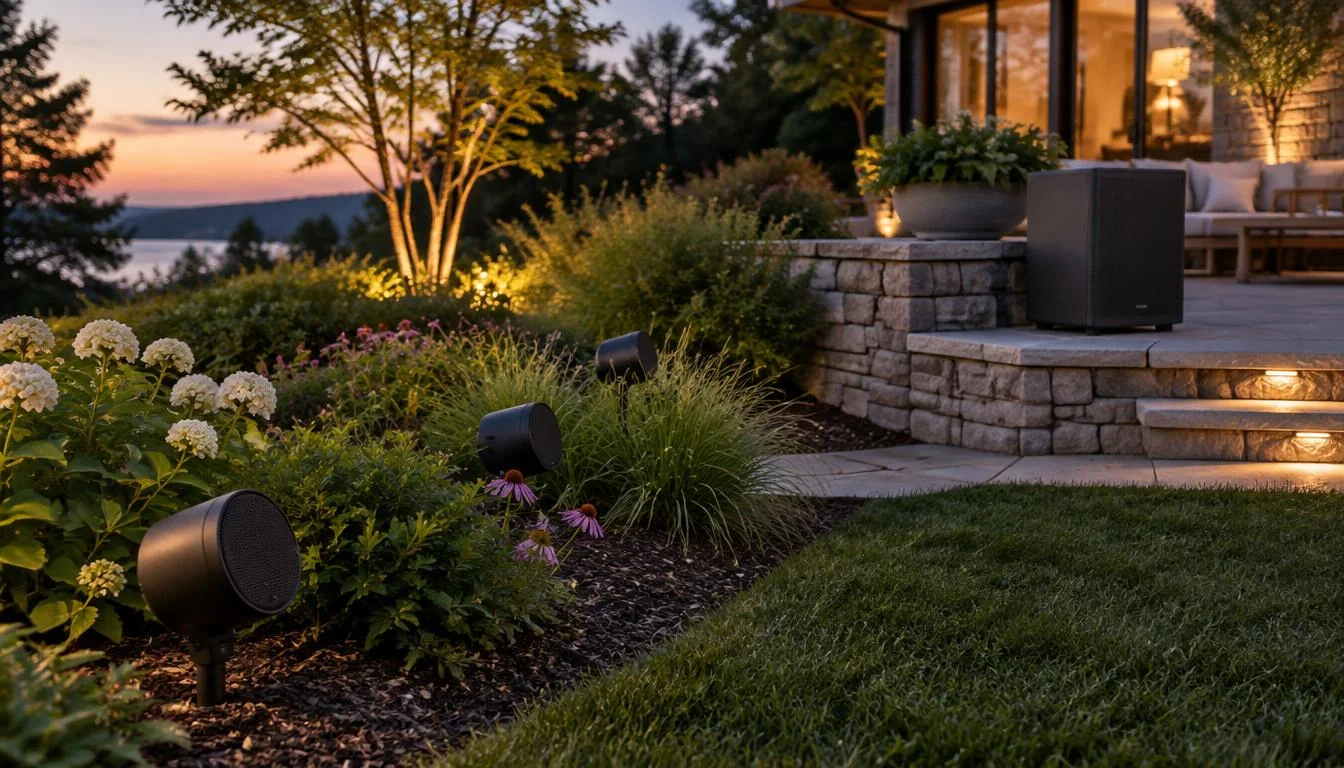
That single fact pushes outdoor audio toward two ends and leaves the middle thin. One end spreads the work across many small sources placed close to people, so no one source has to be loud; that is the [coverage approach, and it is the right answer on most properties](/blog/outdoor-audio-zones-and-neighbors). The other end does the opposite. It accepts that the hardware must do all the work and buys hardware capable of doing it: very few speakers, genuinely large ones, hidden in the planting.
Why the middle is the weak place to stand
A conventional pair of box speakers on the back of the house is the middle, and the middle fails at both jobs at once. Two sources are not enough to cover a property, so the level climbs until the far end can hear it and the near seating is sitting in front of a speaker rather than listening to one. And a cabinet sized to mount under a soffit is not a cabinet that can throw usable output across a pool deck, because there is no room helping it and nothing to make up the difference.
That pair is a correct specification for a deck or a covered porch, where the listening area is a few strides across. Asked to serve the pool, the lawn and the far end of the yard as well, it is one zone doing the work of four.
What a speaker has to be to work from a planting bed
With the coverage approach off the table, the requirements get blunt. Output has to come from radiating area and cabinet volume, because nothing else is available: larger drivers, more of them, enclosures with real internal volume behind them, and amplification sized to drive all of it rather than a channel borrowed off a receiver. That is why these things are towers: driver area has to go somewhere, and standing it upright is how that much of it fits into something narrow enough to live in a bed.
Directivity is the second requirement and the less obvious one. Directivity is just where a speaker throws its output and where it does not. A speaker designed for this work is built to aim a defined pattern at the seating and keep the rest of it off the surroundings, which matters for sound quality and matters at least as much for [where the sound stops being yours and starts being the property next door's](/blog/outdoor-audio-zones-and-neighbors). Coverage patterns are published by the manufacturer for the specific model, and the current documentation is where that lives rather than any rule of thumb.
Then there is living outside permanently. Sealed enclosures, hardware chosen for salt air, finishes that hold up under direct sun, and cable entries that stay sealed through [the freeze and thaw cycle that quietly opens up a weatherproof joint over a winter](/blog/outdoor-systems-winter-and-spring). Nothing in this category comes back to a shop if a driver lets go; a failure outdoors is a manufacturer warranty conversation, and what the warranty provides is the manufacturer's to decide.
James makes outdoor reference towers of this kind, reference meaning hardware specified around output and detail rather than around discretion or cost. Sonance makes the satellite garden systems that sit at the other end of the same question. Both are products we install.
Hiding it is part of the specification
The appeal of this approach is that nothing shows. A tower goes into a bed, gets screened by shrubs, and the music appears to come from the landscape. That is a real result and it is also where these installations go wrong, because the screening and the output are competing for the same space.
Planting in front of a speaker is a surface, and a surface in the way changes what arrives at the seating. Planting also grows. A bed that screens a cabinet neatly at install can be covering half of it in a few seasons, which makes the landscape plan part of the audio plan rather than a separate trade's business. Service access is the other half: a cabinet that lives permanently in a bed still has to be reachable without taking the bed apart.
Underneath all of it is wire. The amplification for a system like this does not live in the planting; it lives inside, in a rack, with ventilation and power, and [whether each zone gets its own amplification or shares it is a design decision rather than a detail](/blog/receiver-or-amplifier). The run from there to the beds has to get past whatever is between them, and what is between them is decided by the hardscape, the irrigation and the pool deck, in that order, usually before anybody has said the word speaker out loud.
What tier of project is this?
Well above a conventional outdoor system, and not by a small margin. A reference pair with the amplification it requires, installed, is a five-figure line on a proposal and not at the bottom of that range. The satellite approach with a subwoofer is the sensible middle of outdoor audio by cost as well as by design; this is a different conversation entirely.
Some of that is the hardware and some of it is everything around the hardware. Amplification counts as part of the system here rather than as an accessory, and the wire paths are a construction item with their own cost. The same pattern shows up indoors at the top of architectural audio, where [a speaker reduced to a few inches of opening in a finished ceiling](/blog/the-smallest-opening-in-the-ceiling) runs multiples of a visible speaker with comparable output. Performance is one line on the proposal and hiding it is another.
Who each end is actually for
Most properties want the coverage end, and they want it for honest reasons. Music in a yard is usually background to something else — people in a pool, a table being set, a grill going. Background sound wants to be everywhere and unnoticed, and many small sources at a low level do that more evenly than a few large ones can.
The reference end is for the person unwilling to give up either quality or volume. That is the framing that actually sorts the two, and it is narrower than it sounds. What it describes is an outdoor space treated as a place where somebody actually listens, with detail intact at a level that fills a property, which is a different brief from background music played loud. If sacrificing one of the two is acceptable, the coverage approach wins on cost and on evenness. If neither is acceptable, there is only one answer, and it is specified that way from the start or not at all.
Properties where that makes sense tend to share a profile. The outdoor space is a primary room rather than an overflow room. The scale is large enough that a satellite run would be working hard to cover it. And the rest of the house was built to a standard the yard is expected to match, which is what makes the number on the proposal a proportion rather than a shock.
What the order of the work decides
Worth noticing which decisions in that sequence are reversible and which are not. Speaker models change; a cabinet can be swapped years later for a better one. Driver technology improves. Amplification gets replaced.
What does not get replaced is the path. Conduit, sleeves under hardscape, the chase from the rack to the beds, the power at the rack and the space around it — those are poured, planted and paved over once. A property finished without them has not postponed the decision between the two ends of outdoor audio. It has made it, in favor of whatever can still be reached, and the bill for reversing that arrives as site work rather than as equipment.
FAQ
FAQs
Sometimes, and the hardware is rarely what decides it. What decides it is whether a usable path exists from the rack to the beds, and whether there is somewhere inside with the power and ventilation for the amplification. On a property where the hardscape, the irrigation and the pool deck went in without that path, the work is site work before it is audio work, and that is where the cost moves.
Further than a conventional pair, and with far more left in reserve at the far end, because output and directivity are what the category is built around. But output and even coverage are still two different purchases. A large property with seating scattered across it can be well served in the areas the pattern reaches and noticeably thinner in the ones it does not, which is the trade the coverage approach exists to avoid.
Not usefully. The two approaches differ in amplification, in zone structure and in where the wire has to go, so moving from one to the other replaces most of what is in the ground rather than adding to it. They are better understood as two answers to the same question, chosen once.
That is the intent, and it mostly holds, because the cabinets are built to be read as part of the landscape rather than as equipment mounted on a house. What moves over time is the planting itself: a bed that screens a tower cleanly the first season is a different bed in a few years, which is why the landscape plan and the audio plan belong on the same table.
Plan the yard
For outdoor sound and the work around it, see Outdoor Entertainment. For speakers and room-to-room listening, see Audio / Video.
Talk through the problem
Call 631-656-9180, Mon–Fri 8 AM–6 PM and Sat 9 AM–1 PM, or tell us what is happening through the contact form. We serve Long Island, Manhattan and the Hamptons.