
The house that is never empty
Someone asked us once what changes when you put cameras in a house where nobody ever leaves.
It's a better question than it sounds, and the honest answer is that the cameras are the least of it.
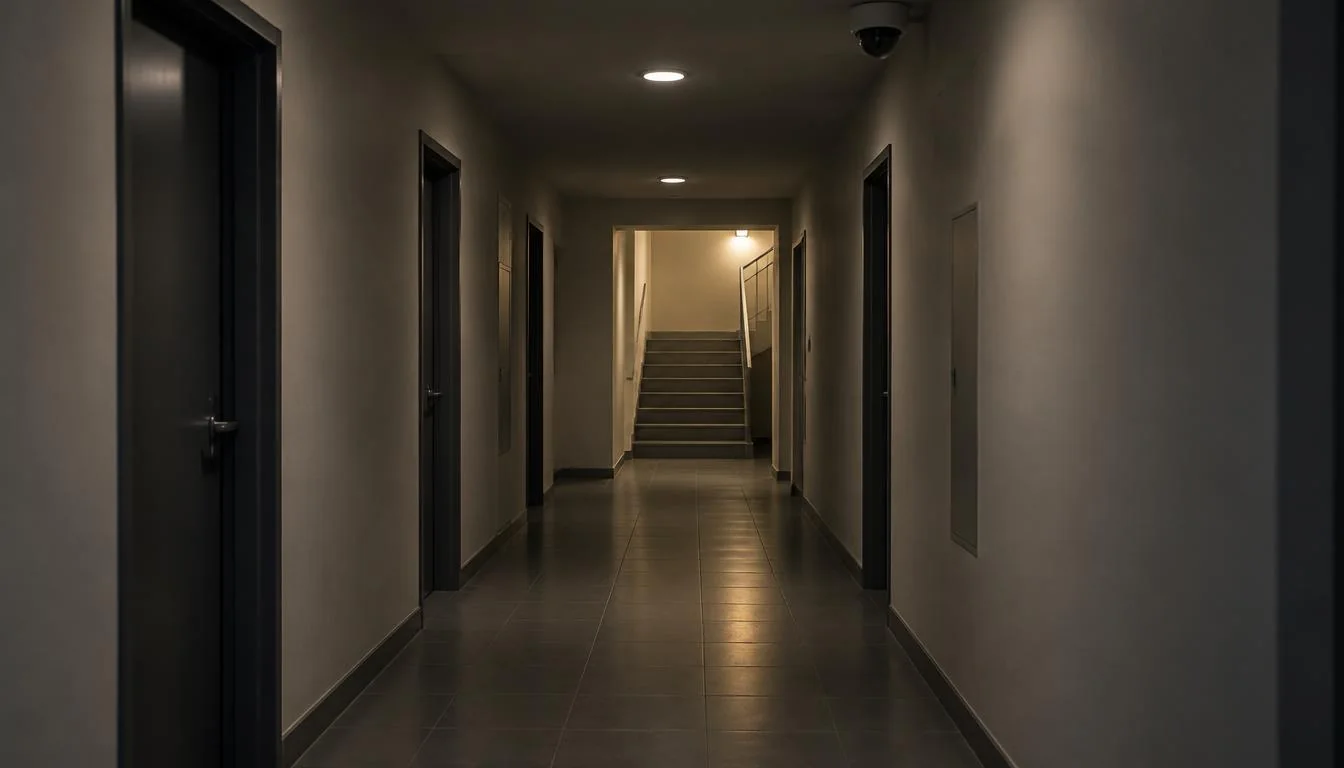
Most residential work assumes an empty house
Almost everything about the way this trade operates rests on one quiet assumption: that for some portion of the day, the house is yours.
That's when the ladders go up. That's when a ceiling comes open and stays open for three hours. It's why a crew can run a line through a hallway and not have to care that the hallway is a hallway. The family is at work and at school, and the building is briefly just a building.
Take that away and the job is different all the way down.
A building with staff on duty has no quiet hours
The houses United Veterans Beacon House runs are staffed around the clock. Not checked on. Staffed. There is always somebody on shift, always somebody asleep down the hall, and always somebody for whom this particular Tuesday evening is not a good one.
It helps to stop thinking of it as a house and start thinking of it as something closer to a small inn that never closes. You don't get the building. You get one room at a time, in a window somebody gave you, and you give it back when you said you would.
That sounds like a scheduling note. It isn't. It's the whole design constraint. Where a device goes stops being a question about the shortest cable route and becomes a question about which rooms you can be in, when, and for how long. Work that can be done in one pass gets done in one pass, because a second visit costs the house more than it costs us.
The footage answers a different question
In a family home, recorded video is almost always about an absence. Something happened while we were out, and we'd like to know what. The whole value sits in the gap between leaving and coming back.
A house that is never empty has no gap. There was always someone there. So the record isn't filling in a blank — it's a reference for the people who are responsible for the building. A question comes up about who was where and when. There's a dispute between two accounts of the same evening. Somebody needs to confirm that a door that should have been shut was shut.
That's a different job for a camera, and it changes what a useful one looks like. Coverage that catches a face at a doorway matters more than coverage that sweeps a wide yard. Reliable time stamps matter more than resolution past a point. Footage that's still there in two weeks matters more than footage that looks beautiful for two days.
The organization reviews it, not us
This is worth saying plainly, because people assume otherwise.
We put the equipment in and we keep it working. We also set up the central point where Beacon House's own team can sit down and review footage across the homes. But it's their team doing the reviewing. The people who run those programs are the ones who look at it, decide what matters, and act on it. We're the ones who make sure the picture is there when they go looking for it.
Any arrangement where the installer becomes the audience for a building full of residents would be the wrong arrangement, and nobody in this kind of work asks for it.
The rules aren't the installer's to write
Each facility has its own requirements about what can be covered and what can't, and those requirements come from the people running the program and the agencies they answer to — not from us, and not from whatever the hardware is capable of.
Exterior approaches and entrances, generally yes. Shared and common areas, depending. Plenty of other places, no, and not negotiable. The right answer to "could you also get a view of..." is frequently no, and it isn't our no to overturn.
An installer who treats a camera count as a score to run up is the wrong installer for this work. The spec is a floor and a ceiling at the same time, and the ceiling is the part that protects the people living there.
What the buildings taught us
The strange thing about the houses that are never empty is that they're the jobs where the equipment matters least.
The hardware is ordinary. What isn't ordinary is everything around it: the sequencing, the restraint, the fact that the room you're standing in is somebody's bedroom and the person it belongs to is sitting in the kitchen waiting for you to finish. Most of our work happens in houses that stand empty half the day. These don't, and it changes nearly everything except the wire.
FAQ
FAQs
Yes. Alongside residential work we've spent close to a decade on the houses United Veterans Beacon House operates, and we work with other nonprofit and institutional organizations on Long Island.
The organization's own team. Smart Tek installs and maintains the equipment and sets up the point where their staff review it; the reviewing is theirs.
The facility's own requirements and the agencies it answers to. Those rules are set by the people running the program, not by the installer and not by what the equipment could technically cover.
The equipment overlaps. The planning doesn't. A building occupied around the clock has no empty window to work in, so the sequencing, the room-by-room access and the number of visits all change.
See the work
For camera work and the cabling behind it, see Surveillance Systems. For work in occupied buildings, see Commercial. The organizations we work with are listed on Community.
Talk through the problem
Call 631-656-9180, Mon–Fri 8 AM–6 PM and Sat 9 AM–1 PM, or tell us what is happening through the contact form. We serve Long Island, Manhattan and the Hamptons.