
Walking into someone else's install
The ceiling tile comes down. Hold it sideways, work it past the grid, set it on a chair.
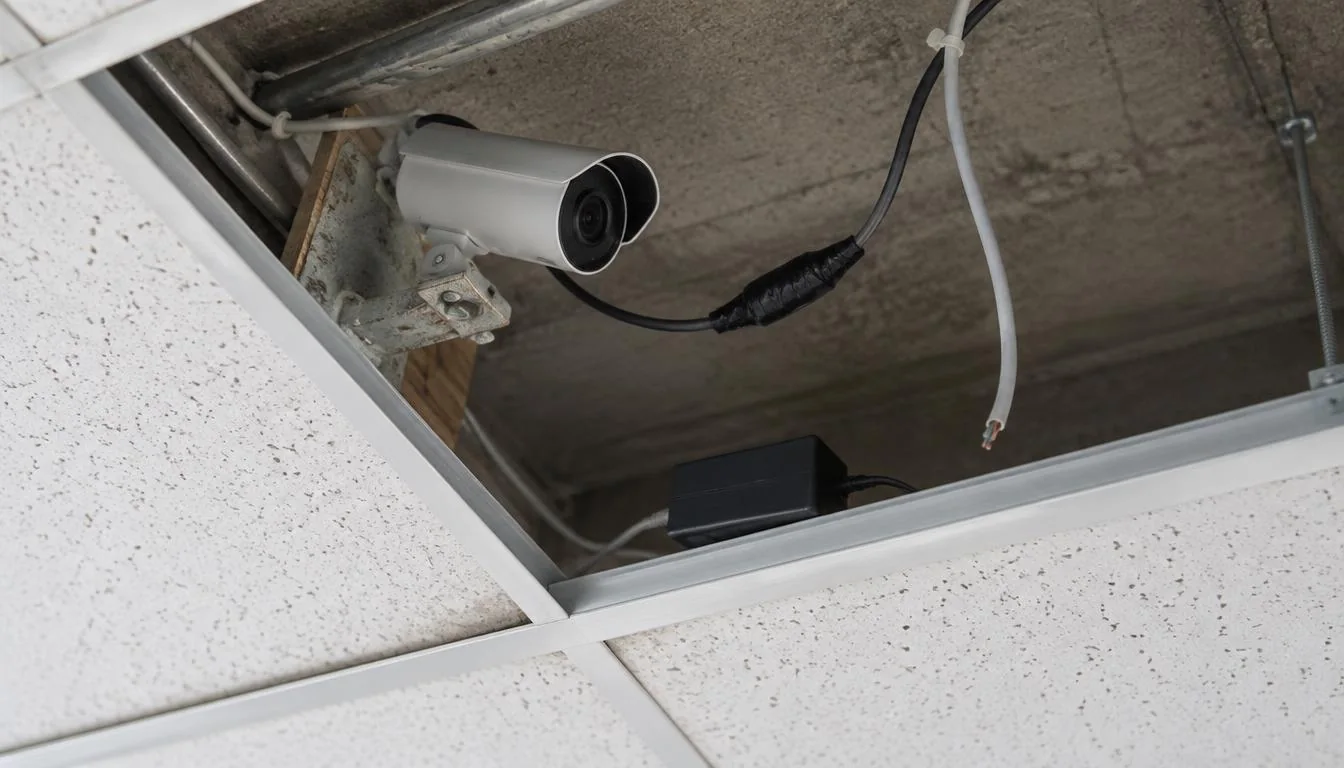
Up there: a camera hanging off a bracket built for a different camera. One cable, spliced twice, both splices taped rather than terminated. A second cable, cut clean and abandoned, going nowhere anybody remembers. A power supply resting on the tile grid itself, which is not a shelf.
None of that is unusual. That's the point.
Every inherited system is a stack of decisions
Walk into a facility that's been running fifteen or twenty years and you aren't looking at an installation. You're looking at four or five of them, layered.
Somebody put the first one in. It worked. Five years on, a different outfit added three cameras to cover a new entrance, and they did it the cheapest way that would pass. Then a storm took out a run and somebody repaired it at two in the morning with whatever was in the van. Then the manufacturer stopped making the recorder and the replacement wouldn't talk to half the cameras, so three of them got swapped and four of them didn't.
Read it in order and the whole history is legible. Read it as one system and it makes no sense at all.
The first visit is mostly reading
New installers want to start pulling things out. That instinct is wrong and it costs money.
Trace first. Find out what feeds what. Find out which runs are live and which are ghosts. Open the recorder and see what's actually recording, because a camera with a green light on it is not the same thing as a camera whose footage anybody could retrieve next Thursday.
Half of what looks like a mistake turns out to have had a reason. A camera aimed at what appears to be a blank wall was aimed at a door that got drywalled over in 2019. A cable taking an absurd route around three sides of a room was going around a beam you can't see. Pull it out before you understand it and you've bought yourself a problem you created.
Some of it is a dead end
We've spent an hour on a run that turned out to be a decommissioned phone line. We've traced a conduit to a junction box behind a cabinet that was built in place and can't be moved without a carpenter.
We've also guessed wrong about why something was done, said so out loud, and found out the original guy had been working around a condition we hadn't found yet. That happens. It should make you slower, not more confident.
What you write down after a first visit is not a plan. It's a map with holes in it, and the holes are labeled.
When the building has its own technology team
This is the part that changes the job most, and it changes it for the better.
IGHL has run group homes and programs on Long Island since 1978, and they have their own networking and technology staff. When we reinstall or upgrade surveillance across their facilities, we're not walking in as the authority on the building. They know their network. They know which closet matters and which switch is already at capacity and what happened the last time somebody touched the wrong thing.
So the work goes differently. You bring what you know about cameras and runs and mounting. They bring what they know about their own infrastructure and their own sites. Decisions get made in a conversation rather than in a proposal. When you're wrong, somebody in the room knows it immediately, which is faster and cheaper than finding out in six months.
An installer who needs to be the smartest person in the building struggles with that arrangement. It's genuinely the easier way to work.
Why the ugly ceiling is not the villain
It's tempting to look up at that spliced cable and the power supply on the tile grid and assume somebody was lazy.
Usually somebody was out of money, or out of time, or fixing something at an hour when nobody sensible is working. The organizations we do this kind of work for spend their budget on the people they serve, which is the correct order of operations, and the building gets what's left over.
That's the real reason the first visit is reading rather than demolition. The stack above the ceiling isn't a record of carelessness. It's a record of a building that kept running on whatever it had.
FAQ
FAQs
Yes. A good deal of our commercial and institutional work is reinstalling or upgrading equipment somebody else put in, including across IGHL's facilities.
Because tracing what's already there is what prevents expensive mistakes. Half of what looks wrong in an inherited system had a reason, and finding the reason is cheaper than undoing a removal.
Sometimes, depending on how they connect and what the new recorder supports. It's a question that gets answered by looking, not in advance.
Side by side. They hold the knowledge of their own network and sites; we bring the camera, cabling and mounting side. The decisions get made together, and it's a faster way to work than either side guessing.
See the work
For camera work and the cabling behind it, see Surveillance Systems. For facility and multi-site work, see Commercial. The organizations we work with are listed on Community.
Talk through the problem
Call 631-656-9180, Mon–Fri 8 AM–6 PM and Sat 9 AM–1 PM, or tell us what is happening through the contact form. We serve Long Island, Manhattan and the Hamptons.