
The hundred switches problem
A hundred smart switches is a smart house. It is a hundred switches.
Every one of them can be told what to do. Nothing in the house can be told what anybody wants. Those are two separate capabilities, and only the first one usually gets paid for.
The symptom is familiar to people who already spent the money. The lights all work. They all dim. They can all be reached from a phone in an airport. And the evening still involves a lap of the first floor pressing things, or a slower version of the same lap performed with a thumb, through a list of device names somebody typed two years ago and never thought about again.
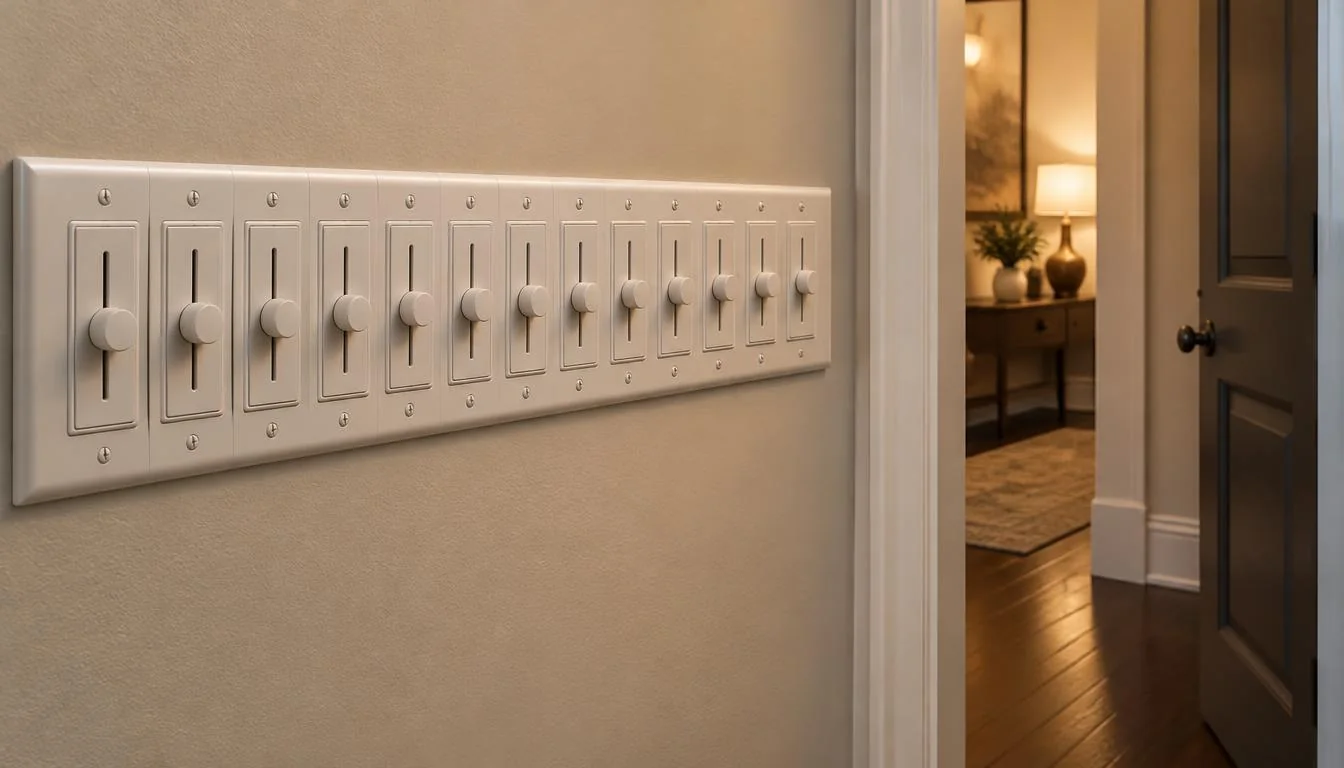
What a smart switch actually buys
A switch becomes smart when it can be addressed — when something other than a finger on the paddle can tell it to go to a level, and can be told what level it is sitting at. That is a real capability and it is the raw material for everything better. Ordinary switches cannot be assembled into a house that behaves as one thing, because there is nothing in them to send a command to.
So the switches were not a mistake. They are the prerequisite.
The trouble is arithmetic. Addressability is a property of each individual load, so buying more of it produces more individual things to address. A house with a switch on every wall now has a switch on every wall and a matching entry in an app. The count did not go down. It went up, and then it got a second copy.
Where the work went
Nobody notices this with one lamp. It becomes obvious across a whole floor.
A switch on a wall has three properties people rarely bother to name, because they are invisible until they are gone. It is always in the same place, so the hand finds it without the eyes. It takes no time to retrieve; there is nothing to unlock and nothing to load. And anybody can work it — a guest, a cleaner, a kid, a grandparent, whoever is watching the house for the weekend.
A list on a phone gives up all three. The control is wherever the list decides to put it today. It cannot be reached without unlocking something and waiting for it. And it belongs to whoever set it up, which is why the phone-run house is almost always the house where one person has become the help desk. That last property accounts for a good share of what we get called about.
The translation problem
Nobody standing in a kitchen at the end of a day wants the pendants at a particular percentage. They want dinner. Dinner is a sentence about a whole room — several loads, at particular levels, in a relationship to each other that somebody worked out once and would rather not work out again.
A list of devices cannot hold a sentence like that. It holds devices. Scrolling is the work of translating an intention into individual instructions, one load at a time, performed fresh every single evening by a person who has to remember what the right answer was.
The house with no memory
Here is the mechanism stated as plainly as it goes.
In a hundred-switch house, every switch remembers exactly one thing: where it was left. That is the entire memory of the system. There is no place anywhere in that house where the sentence this is what the kitchen looks like at dinner is written down. It lives in the head of whoever set the levels last. It gets rebuilt by hand every night, and it comes out a little different every night, because people are not repeatable.
A scene is where that sentence gets written down — a stored state, named: these loads, these levels, together. One instruction rather than many, which matters for reasons past saving effort. It arrives as one event, so a room changes as a single thing instead of rippling light by light. It produces the same result tonight that it produced last Tuesday, rather than whatever happened to be left behind. And when it is wrong, it is wrong in one place, so it gets corrected once.
Entertainment, Goodnight, Away
One button marked Entertainment. One marked Goodnight. One marked Away. Set against a hundred individually smart switches, the comparison is not close, and the reason is not convenience. It is that three names can describe a house and a hundred device entries cannot.
What those three have in common is that each is a statement about the house at a moment, rather than a statement about a device. They are also finite. A household can hold three things in its head. It cannot hold a hundred, and the hundred do not get held — which is why the hundred-switch house nearly always collapses down to the handful of switches people actually touch, at whatever levels those happen to produce.
The collapse happens whether anyone designed it or not. The only open question in that house is whether the handful were chosen.
The gap between wanting this and living in it
In research The Harris Poll conducted for Lutron, fielded September 2025 among 511 affluent US homeowners, 42% said they were interested in preset lighting scenes while 9% were using them. [NEEDS FIGURE: public URL for the Lutron / The Harris Poll 2026 Trend Report PDF]
The interest is there. What is missing sits somewhere between wanting the one-button house and living in one, and in the field it is nearly always the same thing. The switches got bought. The layer that gives them a collective name never did, usually because nothing about buying a smart switch suggests that a second step exists.
Smart Tek is a direct dealer for Lutron, Sonos and Sony. Lighting control is the oldest and least glamorous place this particular problem gets solved, and Lutron keypads are what we put on walls to solve it; [what the buttons on one of those keypads ought to do](/blog/lutron-keypads-what-the-buttons-should-do) is its own conversation, and a longer one than most people expect.
What the phone is still the right tool for
None of this is an argument against the app. It is an argument about which job the app is good at.
It is the right tool for something done rarely, from far away, with time to look at a screen: the light left on while the family is away, the [shade that needs to come down](/blog/motorized-shades-questions-before-measuring) in a room nobody is standing in, the camera you want to see from a parking lot.
It is the wrong tool for something done every evening, standing in the room, with both hands full. Two different jobs got collapsed into one object because the object was free and came in the box with the switch.
What a hundred smart switches buys
It buys individual control of every light in the house. That is real, it is a legitimate purchase, and it has to exist before anything better can be built on top of it. The money was not wasted.
What it does not buy is a house that can be told what the household wants, because nothing in it was ever given a name for that. A hundred addressable loads is a vocabulary with no sentences in it. Every switch in the place can answer a question. Nobody has asked one.
FAQ
FAQs
Usually not all of them, and anybody who says otherwise before seeing the house is selling. What decides it is whether a given load can be commanded by something other than its own switch. The ones that can become part of a named state; the ones that cannot [stay islands](/blog/why-smart-devices-dont-work-together).
Less than they are learning now. A control that sits in one place and does the same thing every time gets worked on the first try by a guest, a grandparent or a babysitter, with nothing to install and no account anybody has to be added to. The learning burden belongs to the app, where the control moves around and the device names were chosen by whichever person in the household set it up.
Sometimes, and it depends entirely on what is already there and what is in the wall behind it. That is a site survey answer rather than an article answer, and anybody giving a different one over the phone is guessing.
Smart Tek does no repairs in-house and nothing goes out to a bench; when a product is covered we assist with the manufacturer's claim, and what the manufacturer provides is what the customer gets. Far more often, though, the product is fine. A scene that quit is usually a configuration or network question, and it gets diagnosed as one.
Plan the control
For keypads, dimming and scene work, see Lighting & Shade Control. For tying rooms and systems together, see Smart Home Integration.
Talk through the problem
Call 631-656-9180, Mon–Fri 8 AM–6 PM and Sat 9 AM–1 PM, or tell us what is happening through the contact form. We serve Long Island, Manhattan and the Hamptons.