
Why your smart home devices don't work together
The reason your smart home does not behave like one system is that you bought the wrong brands.
No. Brand has almost nothing to do with it. Swap every device for the equivalent from a different maker and you will change which icons are on your phone, and nothing else.
Here is what actually happened. Every smart device sold at retail is built to work alone. It ships with its own app, it asks for its own account, and it is designed to be satisfying out of the box without needing one other thing in your house. That is good product design. It is also exactly why a pile of them never adds up.
Buy them one problem at a time over several years — a camera, then a thermostat when the old one died, then a kitchen speaker, then a lock — and you own several separate systems that share an address.
Nothing in that list is coordinating. Nothing was ever chosen to.
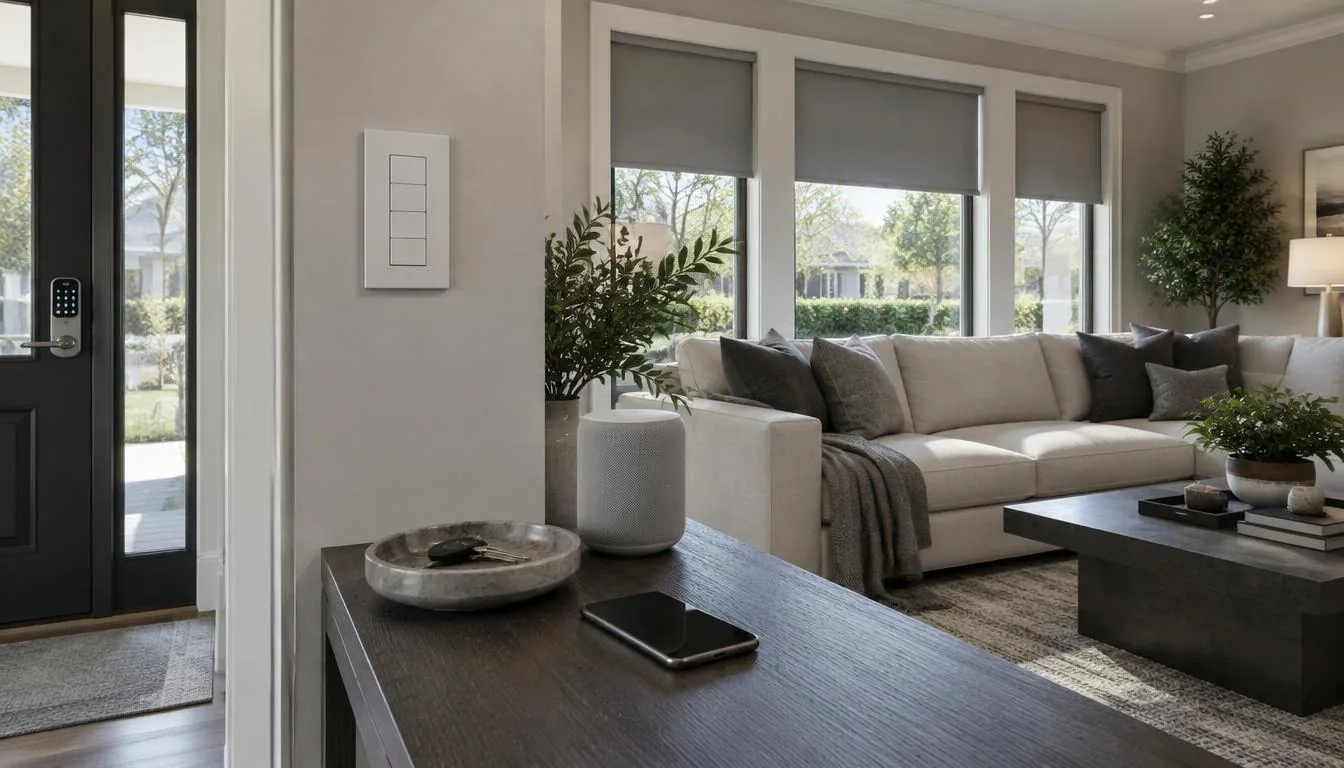
Integration is a layer, not a feature
Real integration means one thing in the house holds the rules.
One event — a button press, a time of day, a door opening, the last person leaving — and the shades move, the lights change, the music stops, the cameras change mode, the locks engage. That logic sits in one place. Not spread across five apps with five schedules.
For a device to take part, two things have to be true. It has to expose a way for something other than its own app to control it and to report its own state. And that pathway has to be stable enough to build on.
A device that can be commanded by something other than its own app is a candidate. A device that cannot is a dead end. Being excellent at its own job does not change that.
Lighting keypads, shade motors and locks are where this matters most, because those are the things you want reacting to events instead of waiting for a phone. The phone should be the backup way to run the house.
Two kinds of dead end
The first is simple. The device's only interface is its own app. There is nothing to connect to. It will keep working alone forever and it will never be part of a scene. Live with it as an island or replace it. There is no third option, and no hub creates one.
The second is worse because it looks like success. Plenty of devices integrate only through the maker's cloud account, which means the connection exists at that company's discretion. Terms change. Services get retired. A company gets bought. One morning the device on your wall is perfectly healthy and the link that made it useful inside your system is gone, and nobody did anything wrong.
The filter that reduces that risk is local control — devices that can be commanded on your own network without a round trip to somebody's server. Local control also makes the house faster and keeps it working when the internet does not. It is the single most useful question to ask about a product before buying it.
When a hub is being sold rather than recommended
A hub cannot create a control pathway that a device does not have.
It can bridge devices that already expose one. That is a real and useful job. It can do nothing whatsoever for a device whose only interface is its own app, because there is no door for it to knock on. The mechanism simply is not there.
So a hub purchased before anybody has looked at what is in the house has a predictable outcome: a sixth app. That is a legitimate purchase for the right set of devices. It is not a fix for this problem, and anyone offering it as one has stopped diagnosing and started selling.
Same test applies to voice. A voice assistant is another way to issue a command, which is genuinely useful. It is not the layer that holds the logic. Put the rules in a voice platform's cloud and you have moved the problem outdoors and made your light switches dependent on your internet connection. Voice belongs on top of a system that already works without it.
What Smart Tek works with, stated exactly
Smart Tek is a direct dealer for Lutron, Sonos and Sony. Control4 and Crestron are supported and delivered through our integration partners.
That distinction matters and it gets stated plainly, because it tells you who you are dealing with on what. We would rather be clear than imply a relationship we do not have.
What gets chosen for a particular house depends on what is already there, what you want it to do, and whether the house is wired for it. The architecture conversation comes before the brand conversation. Reverse the order and you are picking products to solve a problem nobody has defined.
What to replace, and what to leave alone
The instinct is to replace everything. No.
The categories worth replacing are the ones that carry the logic and that you touch daily: lighting keypads and controls, shade motors, and the controller or processor itself. Those are the backbone. One keypad or shade motor that cannot be commanded by the system undercuts everything built around it.
The categories usually not worth touching are the appliances and the one-offs. A smart appliance, a garage opener, a lone sensor, a robot vacuum. If it works and it is content in its own app, leaving it alone is a defensible decision. Integration is not a purity test.
For anything in between, judge it by one question: how often it has to react to something else in the house. Never — leave it alone. Often — it belongs in the system.
Somebody has to own it afterward
An integrated system with nobody responsible for it degrades. Firmware arrives, services change, equipment ages, and a household that moved three devices around needs the logic adjusted. The first symptom is almost always one scene that stopped behaving.
Smart Tek does no repairs in-house and is not a repair shop. Nothing goes back to a bench. What we do is diagnose, service, reprogram and maintain the system, and assist with the manufacturer's warranty claim when a product is covered — whatever the manufacturer provides is what the customer gets. That is worth knowing before equipment gets chosen, not after.
FAQ
FAQs
Partly, and only for devices that already expose a usable control pathway. For a device whose only interface is its own app, a hub does nothing, because there is nothing for it to talk to. Buy the hub after somebody has inventoried what you own, not before.
No, and anybody who says yes without seeing the house is selling. The usual answer is that the backbone gets standardized — lighting control, shades, the controller — and the islands stay islands. We will tell you plainly which of your existing devices can participate.
They tie together the asking, not the deciding. The logic still has to live somewhere, and if that somewhere is a cloud account, simple things in your house now depend on your internet service. Useful as a layer on top. Not a substitute for the layer underneath.
Us, and we start with the system rather than the symptom, because a scene that quit is more often a network or configuration problem than a failed product. If a product has genuinely failed, we handle the manufacturer's warranty claim with you. We do not do bench repair.
Another hub buys you a bridge between the devices that already have a control pathway, and a sixth app for the ones that do not. What it cannot buy is a door into a device that was built without one.
Plan one coordinated system
Smart Home Integration Service & Troubleshooting.
Our town guides for St. James and Roslyn cover whole-house integration and existing systems.
Talk through the problem
Call 631-656-9180, Mon–Fri 8 AM–6 PM and Sat 9 AM–1 PM, or tell us what is happening through the contact form. We serve Long Island, Manhattan and the Hamptons.