
Where should all the equipment actually go?
Watch how a bad equipment location fails, in order.
It works at first. Everything is new, the installation is clean, nobody has a complaint. Then comes a stretch where one camera drops off the recorder overnight and is back by morning, and nobody reports it because it fixed itself. Then a power supply quits. Then a drive in the recorder quits. Then a service visit that should have been quick stops being quick, because the only way to reach the back of the rack is to empty the closet it is sitting in.
None of that is a product defect. That is a location, doing what the wrong location does. And it is the one decision on a project that cannot be reversed later without moving everything.
So it gets inspected like anything else: in order, worst problem first.
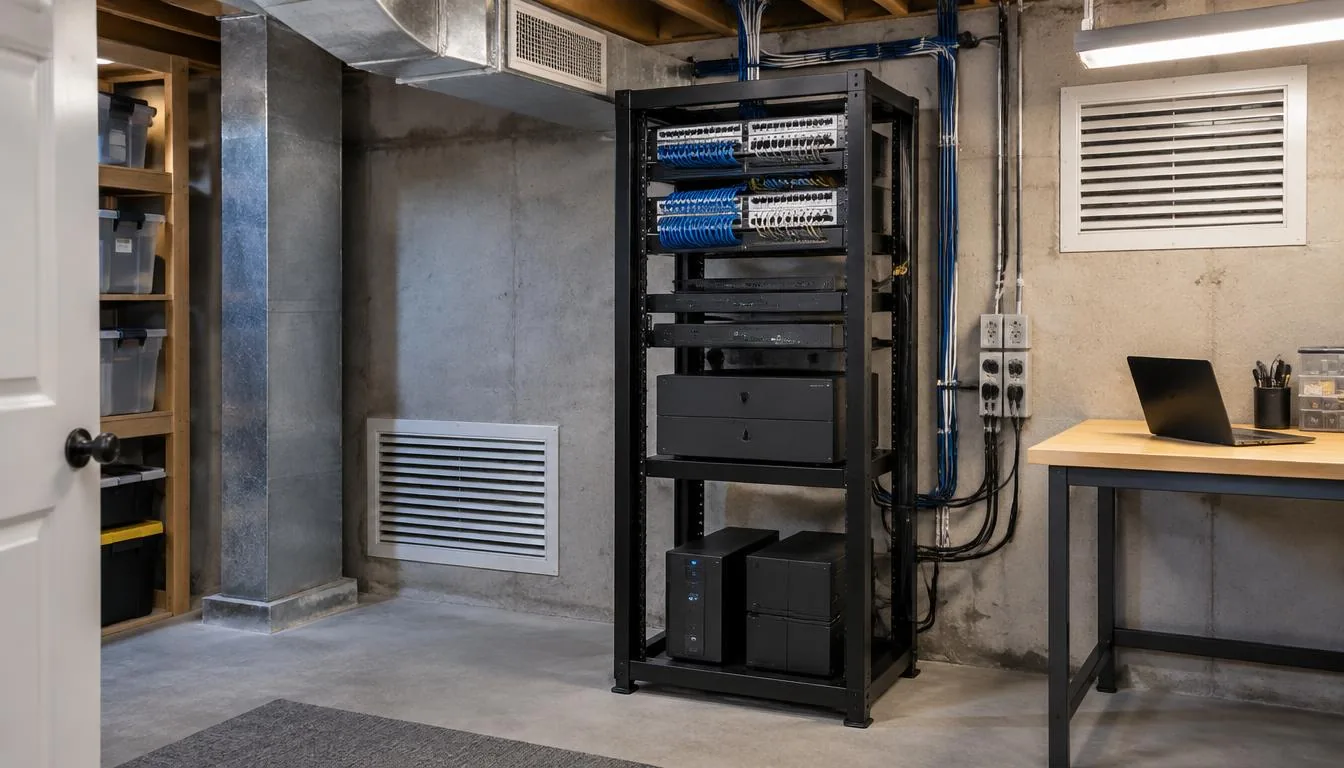
First, heat
Amplifiers, network switches, recorders and processors convert some of the electricity they draw into heat. That is not a fault. It is how they work. Put them in a sealed space with no air movement and the heat has nowhere to go, so the temperature inside the enclosure rises and stays there.
Heat is hard on power supplies, hard on hard drives, and hard on anything with a fan in it.
Ventilation is therefore part of the location, not an accessory to it. If a closet is the answer, the closet needs intake, exhaust, and somewhere for the warm air to actually end up — and that is a construction detail, handled while the room is being built rather than after.
This is also the failure that hides. Nothing shuts off on day one. Things die earlier than they should, one at a time, and nobody traces it back to the closet.
Second, distance
Every type of signal in a house has a practical distance limit. Video, audio, control and network all behave differently, and within each one the limit moves depending on the specific cable and the specific equipment on both ends.
Anybody who quotes you a flat maximum length from memory is guessing. The number that matters is the one for the actual devices in the actual house, which is why long runs get solved deliberately: the right cable for that run, equipment selected for that distance, or a rack that is not that far away in the first place.
That last option is usually the cheap one. A location that is out of the way and far from everything creates distance problems in every signal category at once.
Third, the things that are only cheap now
Dedicated power, surge protection and backup power are the same decision as the location, and they cost a fraction of what they cost later. The electrician is already on site. The walls may still be open. Where the rack lives is also where its power has to come from, and what your panel and layout allow is an electrician's call.
Backup power deserves a specific list rather than a general intention. The pieces worth keeping alive through a short outage are the network and the recorder — modem, router, switch, access points, camera recorder — because those are what keep the house usable and keep footage being written while the power is out.
Surge protection is inexpensive relative to the equipment sitting behind it. It is not a guarantee against anything, and we will not pretend otherwise. It is cheap at the start and awkward to retrofit.
The locations that hold up
A basement or utility area is the common winner. Power is usually nearby, it runs cooler than the rest of the house, there is room to work, and nobody is trying to sleep next to it.
A closet works when it was built for equipment: ventilated, on its own circuit, deep enough to get behind a rack, and not shared with anything else. A conditioned mechanical space works for the same reasons, provided it is not sharing air with something that runs hot or wet.
Central counts as much as comfortable. Shorter runs to the televisions, the access points and the cameras mean fewer distance problems to engineer around, and that shows up as a line item.
The four we get called back to
In order of how often we find them.
The bedroom closet shared with clothing is first by a wide margin. No ventilation, no dedicated circuit, fan noise a few feet from a pillow, and no way to reach the back of the equipment without unloading the shelf above it. It gets chosen because it is convenient during construction.
The uninsulated attic is second. Summer attic temperatures here are exactly the condition heat-sensitive electronics handle worst, and winter brings the opposite extreme plus condensation.
The garage is third. Both temperature extremes, dust, and near the water the added corrosion that comes with coastal humidity and salt air.
Fourth is the one nobody checks: a cavity or niche that satisfies every other requirement and leaves no working room behind the rack. It passes inspection on paper. It fails the first time somebody has to work on it.
"It still works" is not the standard
A system that runs is not the same as a system that is serviceable, and the difference shows up as labor on every future visit.
Serviceable means a person can stand in front of the equipment, pull it forward, read the labels and reach the back. It means a light that works and somewhere to plug in a laptop. It means labels on both ends of every cable. Those cost nothing at install and they are the whole difference between a system somebody can work on and a system somebody has to re-learn.
Noise is on the same list. Equipment fans, drives in a recorder and a projector are all audible. A recorder behind a media room wall is a recorder you hear during quiet scenes. The noisy things belong where nobody is listening.
FAQ
FAQs
It fits, which is why it gets proposed. It is a poor choice on heat, noise and access, and in a shared clothes closet all three apply at once. If a closet is the only option available, it needs ventilation, dedicated power and enough depth to work behind the rack — built in, not added on.
It should have dedicated power rather than sharing a run with whatever else is on it, and the specifics for your panel and layout are an electrician's determination. We coordinate on circuit location and quantity while the location is still being chosen, which is the inexpensive moment to do it.
Then distance is part of the design instead of a surprise. Every run gets measured, cable and equipment get picked for the actual lengths, and sometimes the system splits so that some equipment sits closer to what it serves. What does not happen is choosing a location first and hoping the runs cooperate.
Smart Tek does no repairs in-house and is not a repair shop. We diagnose the fault, get the right part into service, and assist with the manufacturer's warranty claim where the product is covered — whatever the manufacturer provides is what you get. A sound equipment location is part of what keeps that conversation rare.
Read the sequence backwards and the location is first in it: ventilation, dedicated power, run lengths, noise and whether anybody can reach the back of a rack are all decided inside whatever that one choice allowed. It is also the only one of them that cannot be corrected later without moving the whole system.
Plan the equipment location
For the rack location, power coordination and cable paths, see Smart Home Wiring & Pre-Wire. For the network equipment itself, see Networking & Wi-Fi.
Our town guides for Great Neck and Woodmere cover audio, video and network distribution through larger houses.
Talk through the problem
Call 631-656-9180, Mon–Fri 8 AM–6 PM and Sat 9 AM–1 PM, or tell us what is happening through the contact form. We serve Long Island, Manhattan and the Hamptons.