
What wires should go in the walls of a new house
"My builder wants to know what wires I want. What do I tell him?"
That question usually arrives the week after the framing goes up, and that is the right week for it. A house at the framing stage is a house with no secrets. Every stud bay is open, every ceiling is a decision rather than a repair, and a cable can travel from one end of the building to the other without anyone cutting anything.
Drywall ends that. Not because the wire becomes impossible, but because of how a wire actually moves through a finished wall: somebody pushes a flexible rod up a cavity they cannot see into, hoping nothing solid is in the way. The same run that took minutes in an open bay becomes a hole, a patch, a paint match and an afternoon.
So the question is worth answering carefully, one category at a time.
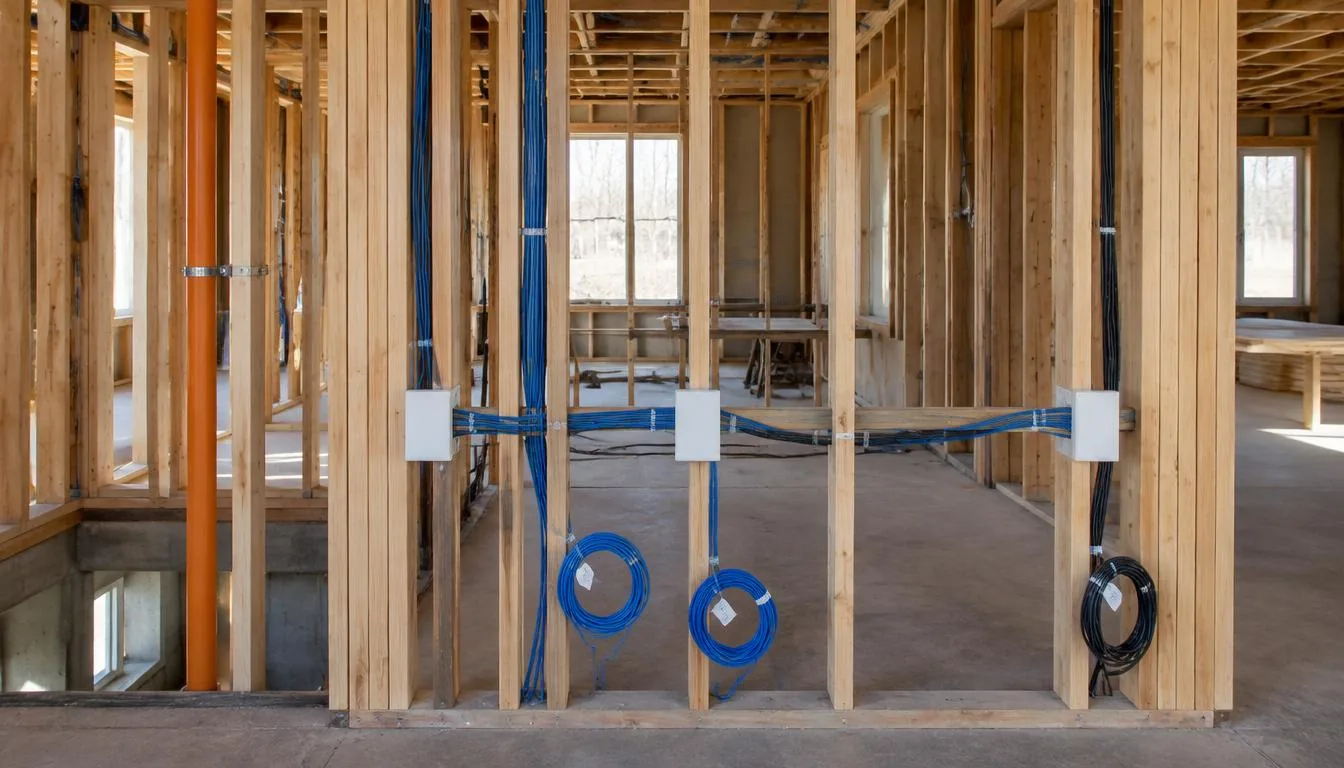
The rule, and then the reason for it
Here is the rule in one sentence. A hard-wired network connection goes anywhere a television, a wireless access point, a surveillance camera, a doorbell, a thermostat or a shade motor will ever go.
The phrase doing the work there is "will ever." Not where one is going on move-in day — where one could end up during the time you own the house. The bonus room with no television in the furniture plan gets a television. The hallway nobody thought about turns out to be where the access point belongs.
The reason this rule is cheap to follow is arithmetic. A cable coiled behind a blank wall plate costs the cable and a few minutes of labor while the walls are open. The same connection added later costs a fishing attempt, a repair and a scheduled visit. You are not buying cable. You are buying the difference between those two prices, at every wall you mark.
Every wall that gets marked is a run. That is the whole method.
The Wi-Fi runs are the ones that get left out
A wireless access point — the ceiling or wall device that actually produces the Wi-Fi signal in a room — needs a wire.
That sentence surprises people, and the surprise is understandable. The word "wireless" is right there in the name. What is wireless is the last stretch, between the access point and your phone. Everything behind the access point is wire, because the access point has to be fed data and, in most installations, power as well, and both arrive on the same cable.
Think of it the way you would think of a faucet. The faucet is where the water comes out, and nobody expects the faucet to work without a pipe behind it. An access point is a faucet for data.
This is the most common gap we find in houses that were pre-wired by someone thinking about entertainment instead of about the network. Televisions got cable. Ceilings did not. The result is a house with Wi-Fi complaints that never go away, and the complaints are specific and repeatable — the back bedroom, the far end of the second floor, the pool deck.
Where those access points belong depends on the shape of the house, what the walls are made of, where the stairs are and where people actually sit. An open floor plan and a chopped-up center-hall colonial of the same square footage do not get the same answer, which is why the locations get chosen while someone can still stand under the framing and point at a joist.
Speaker wire goes in before anyone has picked a speaker
Nobody standing in a framed house decides they will want music on the back porch years from now. That is fine. The wire goes in anyway, to every ceiling and wall that could plausibly hold a speaker, and the decision about speakers happens whenever it happens.
The wire itself is chosen for the length of the run and for what might eventually hang on the end of it, because a longer run and a more demanding speaker do not want the same cable. That is a sizing question with a real answer, and it is one of the reasons this is worth having somebody look at rather than guessing with whatever is on the truck.
A run that is left unterminated, unlabeled and off the as-built drawing — the marked-up set of plans showing where everything actually ended up, as opposed to where it was drawn — is worth very little of what it cost. It is the part that decides whether the run is still usable to anybody years later, and it costs nothing but attention.
The four rooms we end up fishing into later more than any others are the kitchen, the primary bath, the back patio and the room over the garage.
The outside of the house gets decided now too
Exterior work is the part that cannot be improvised once the house is finished, because every change means drilling through a completed wall assembly from one side or the other.
A path to each exterior corner covers the surveillance camera positions you have not chosen yet. A path to the gate covers the intercom, the keypad and the camera that end up there. A path to the pool equipment area covers music, a control point, and whatever else that end of the property grows into.
An outdoor television location needs its own decision now, and not only for the cable. An outdoor display needs power at that spot and something structural behind the siding that can actually carry the weight. Blocking behind a wall is a framing conversation, so it belongs to the carpenter's schedule, not to ours.
Exterior penetrations are where careful pre-wire separates itself from fast pre-wire. Every hole through the building envelope gets placed, sealed and flashed with the same care the siding contractor uses, because that hole is now part of the weather barrier.
There is also the question of what is allowed outside a house at all — what may be mounted, how it is attached, and what it is permitted to look like from the street. Those rules are local, they are set by your village and in many neighborhoods by an association as well, and they differ from one jurisdiction to the next. Smart Tek checks before anything gets mounted outside.
Conduit is the line item people underspend on
Conduit, in this context, is an empty plastic sleeve that carries no cable at all — only the possibility of one.
Two sleeves earn their cost in almost any house. One from the basement to the attic, which means any wire invented after your closing date can get from the bottom of the house to the top without a wall being opened. One from the house out to the gate or out to the pool, which does the same thing for the property, where the alternative is a trench.
The mechanism behind that value is worth stating plainly. Cable is bought for a generation of equipment. Signal formats change, connectors change, and a cable pulled for one device generation can age into irrelevance while sitting untouched in a wall. A sleeve has no generation. It is a hole with a smooth path through it, and it is equally useful to the next thing and the thing after that.
That is why a sleeve is worth more than extra cable in the same place. It is the only item on the list that makes a future change cheap rather than merely possible.
What is not worth pre-wiring
The opposite error is real, and it costs money quietly.
Running cable to every conceivable fixture in every conceivable location is a way to bury real money in a wall where nobody will ever find it, terminate it or use it. The runs that reliably pay off are the network runs, the speaker runs, and the exterior paths — those are the categories where you know the function even if you do not yet know the product.
Beyond that, the sleeves cover the long tail of "maybe someday." Cable goes where the purpose is already clear; a sleeve goes where access is hard; and the speculative run is the one a sleeve has already made unnecessary.
Where the cable lands matters as much as where it starts
A hundred runs that all terminate in a sealed closet with one outlet and no air movement is a hundred runs with the same problem at the far end.
The termination point — the place every cable comes home to and where the equipment lives — needs four things: power, physical space, air movement, and room for a person to get behind the equipment later. A basement or utility area usually satisfies all four. A closet designed from the start for equipment can. A finished bedroom closet shared with clothing rarely does.
That spot gets chosen while the house is framed rather than while the equipment is being delivered, because it wants to be central enough to keep the runs short, accessible enough to work in, and cool enough that the equipment is not sitting in its own heat.
Photographs of the open walls, taken before they close, plus labels at both ends of every cable, are what make the house serviceable years later by anybody, including us.
FAQ
FAQs
After framing, rough plumbing and rough electrical, and before insulation and drywall. We want to walk the house with the plans while every stud bay is still open. Getting us in for a planning walk earlier than that is better than later, because some of what we ask for — blocking behind a mounted display, a sleeve through a floor, a cool spot for the equipment — is a framing decision rather than a wiring decision.
You can. Plenty of houses do, and those are often the houses that complain about Wi-Fi permanently. Here is the mechanism: a mesh unit with no cable has to spend part of its radio capacity talking back to the other units instead of to your devices, and that cost grows with plaster, masonry, radiant barriers in the roof deck and additional floors. An access point with its own cable spends all of its capacity on you. The cable is the inexpensive half of that decision.
More locations get marked than will be used. Two candidate walls in one room costs one extra cable and a blank plate, and the wall nobody uses costs nothing further. The expensive version of this question is the one asked after the walls are painted.
Electricians run power, and most are good about coordinating with us on box locations, blocking and sleeves. Low-voltage cable has its own separation and routing requirements, and the labeling and documentation at the end matter as much as the pull itself. For the power side of any of this, including circuits at the equipment location, an electrician is the one who decides what your panel and layout allow. We would rather be in the house alongside them than inherit a bundle of unlabeled cable afterward.
Which leaves the arithmetic as the whole decision: in an open stud bay the run costs a cable and a few minutes of labor, and the same connection after the drywall costs a fishing attempt, a repair and a scheduled visit. Every wall marked at framing is a wall nobody has to open later for something that was not in the plan yet.
Plan the wiring before drywall
For structured wiring and new-construction pre-wire, see Smart Home Wiring & Pre-Wire. For wired access points and the equipment behind them, see Networking & Wi-Fi.
Our town guides for Wainscott and Massapequa cover new-construction and renovation pre-wire.
Talk through the problem
Call 631-656-9180, Mon–Fri 8 AM–6 PM and Sat 9 AM–1 PM, or tell us what is happening through the contact form. We serve Long Island, Manhattan and the Hamptons.