
What a Shade Is Actually Doing to a Room
The question comes up with fabric samples in hand, as often as any other question about shades: if I pick the five percent, does that mean five percent of the light gets in?
It is a completely reasonable thing to assume. The number is right there on the back of the sample, the samples are arranged from tight to open, and the instinct is that the percentage is a dimmer setting printed on cloth. It is not. That number describes the holes in the weave, not the light that comes through them, and the gap between those two ideas is where most shade disappointment lives.
Seen that way, the choices in a showroom stop looking like a wall of beige and start looking like four different jobs that happen to be done by the same object.
Four jobs, one piece of cloth
Shades do four things, and people shopping for them usually have one of the four in mind while assuming the other three come along for free.
Light control is how much total light enters the room. Glare control is whether a bright source is visible from where you sit. Privacy is whether somebody outside can resolve what is happening inside. Heat is how much solar energy ends up in the room as warmth.
Those are related, but they are not the same measurement, and a fabric can be excellent at one and poor at another. A dark, tight weave can cut glare beautifully and still let a surprising amount of warmth into the room. A light-colored fabric can reflect heat back out the window and then glow like a lampshade, which is a light-control success and a glare failure in the same breath. The most common mismatch we see is somebody who bought for privacy and is unhappy about glare, or bought for glare and is unhappy at night.
When a client tells us "I want shades," that sentence has not told us much yet. Which of the four is the one that actually bothers them is the first real question, and it is one of the reasons the conversation [before measuring](/blog/motorized-shades-questions-before-measuring) matters more than the fabric swatch does. Most of our [lighting and shading work](/services/lighting-shades) on Long Island, in Manhattan and out in the Hamptons starts with sorting those four apart.
Openness factor is a hole count, not a light meter
Openness factor is the percentage of the fabric's surface area that is open space between the threads. A 3% fabric is 97% yarn and 3% air. A 10% fabric is 90% yarn and 10% air. That is the entire definition.
What it tells you reliably is how much you can see through it. Openness governs view. A 10% weave gives you a usable view of the yard; a 1% weave gives you the shape of the yard and not much detail. It also governs the reverse: the tighter the weave, the harder it is for anybody to resolve detail through it in either direction.
What it does not tell you is how much light enters the room, because light does not only pass through the holes. It also passes through, scatters off and is absorbed by the yarn itself, and how much of each depends on what color that yarn is. A white 5% fabric and a charcoal 5% fabric have identical hole counts and behave noticeably differently in a room. The white one bounces light around and puts a soft, bright wash on the ceiling. The charcoal one swallows it. Both let you see out through the same 5% of open area, but one of them is also a light source and the other one is not.
The number manufacturers actually publish for total light passage is a separate figure from openness, and the two get conflated constantly, including by people selling shades. If a fabric decision rests on how dark the room will get, openness is the wrong number to be looking at.
Why a dim room can still be glaring
This is the one that surprises people most, and it is the reason "I put shades in and it is still unpleasant at three o'clock" is a sentence we hear.
Glare is not about the amount of light in a room. It is about contrast — the ratio between the brightest thing in your field of view and everything around it. Your eye adapts to an average, and anything far above that average becomes painful. A room can be dim overall and still have a window in it that is many times brighter than the wall beside it, and that window will still make you squint and still wash out a television screen.
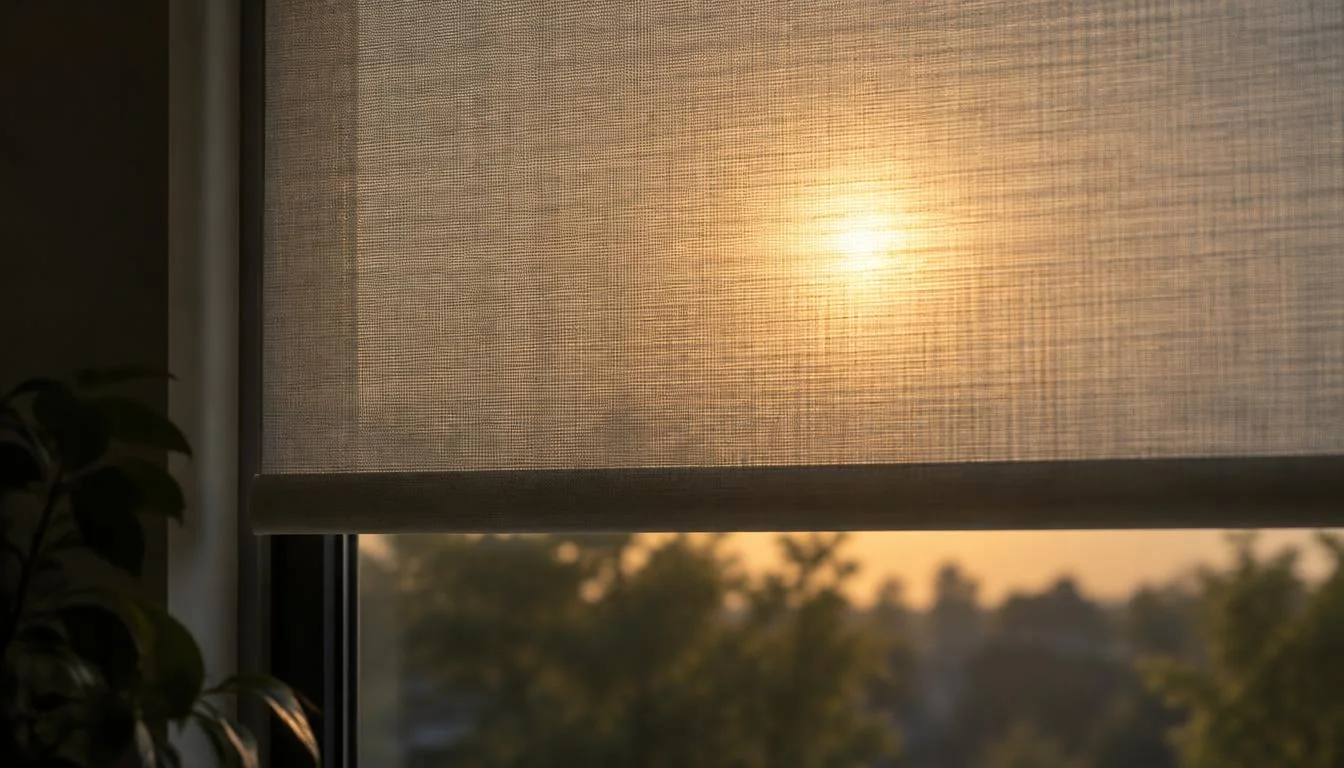
So an open-weave fabric that cuts the total light in a room by a large fraction can leave the sun itself visible as a bright disc behind the cloth, which is exactly the condition the eye objects to. The room reads dark. The window reads blinding. Nothing about it is a contradiction.
What helps is diffusing or hiding the source rather than only reducing the sum, which is why a tighter weave sometimes feels better in a west-facing room than a darker, more open one does. It is the same principle at work in exterior lighting, where [a fixture that is bright but shielded](/blog/outdoor-lighting-without-glare) is far more comfortable than a dimmer one pointed at your eyes.
The fabric that reverses itself at night
Here is the part nobody mentions in a showroom, because showrooms are open during the day.
A sheer or open-weave fabric is not a one-way material. It has no idea which side you are on. What determines whether you can see through it is which side is brighter. During the day the outdoors is far brighter than the room, so you look out easily and a person on the sidewalk sees a flat panel of cloth. After dark, the relationship flips. The room is now the bright side. The same fabric that gave you privacy all afternoon now gives a passerby a reasonably clear view of a lit interior, and gives you very little view of the yard.
This is physics, not a defect, and it catches people in rooms with large glass facing a street or a dock. It is the reason a single fabric choice frequently cannot cover a window's whole day, and the reason a bedroom or a street-facing great room often ends up with two fabrics on the same opening — an open weave for the view and a tight one for the hours after sunset. That dual arrangement has real consequences for pocket depth and bracket space, which is why it comes up early in an [existing-window retrofit](/blog/motorized-shades-existing-windows) rather than late.
Heat is a separate transaction at the glass
Light and heat arrive together and get treated as one thing, but a shade handles them differently depending on where it sits.
Solar energy comes through glass as both visible light and infrared. An interior shade intercepts that energy after it is already inside the building envelope. Some of it reflects back out through the glass, some gets absorbed by the fabric and re-radiated into the room as warmth, and the split between those two depends heavily on the color and reflectivity of the side of the fabric that faces the window. This is why fabrics with a light or metalized backing and a darker room-facing side exist. They are trying to win both arguments: reflect outward, absorb inward, keep the view, cut the heat.
An exterior shade intercepts the same energy before it ever reaches the glass, which is why exterior fabrics do more for heat than any interior fabric can. They also live outdoors, which is a different engineering problem entirely.
The practical point is that a fabric chosen purely for how a room looks may do very little for how a room feels in August, and the reverse is also true. If a south- or west-facing room is genuinely too hot, the fabric's reflectivity and its position relative to the glass are the levers, not its openness.
Blackout is a property of the whole assembly
"Blackout fabric" is a real thing — a cloth with a layer in it that passes essentially no light. What it is not is a guarantee of a dark room, because fabric is only one of the ways light gets past a shade.
Light arrives around the cloth, not only through it. There is a gap at each side between the fabric edge and the window opening. There is a gap at the bottom where the hem meets the sill. There is the space above the roller, and in a pocket installation, the slot the shade comes out of. A fully lowered blackout shade in a plain bracket mount will typically leave bright outlines around its edges, and in a bedroom at sunrise those outlines are exactly what wakes somebody up.
Getting a genuinely dark room is an assembly problem. It involves side channels that capture the fabric edge, a sill detail at the bottom, and a closed pocket or fascia at the top, and every one of those is a construction decision rather than a fabric decision. That is why the answer to "can you make this room dark" depends much more on what we are allowed to build into the opening than on which swatch gets picked, and why it is a very different conversation in a house under construction than in a finished room with trimmed windows.
Fabric is the part people shop for. The edges are the part that determines whether it worked.
Which is the shape of the whole subject, really. A shade is not a dimmer with cloth instead of a slider. It is a material with a hole count, a color, a reflectivity, a position relative to the glass, and a set of edges, and each of those five properties is doing a different job in the room. The number printed on the back of the sample describes exactly one of them. A showroom wall is not a gradient from dark to light; it is a set of trade-offs, and the one worth making depends on which of the four jobs is the one that actually bothers the person sitting in the room at four in the afternoon.
FAQ
FAQs
No. Openness factor describes the open area of the weave — 5% air, 95% yarn — and says nothing about how much light passes through the yarn itself. Fabric color and construction change total light transmission substantially at the same openness, and manufacturers publish that as a separate figure. Two fabrics with the same openness can produce visibly different room brightness.
Sometimes, but the two are measured against different conditions. Glare control is about the brightest source in your field of view during the day. Privacy, with an open weave, works during the day and reverses after dark, when the lit room becomes the brighter side. Rooms with large street-facing or water-facing glass often need two fabrics on the same opening to cover both, which affects pocket and bracket space.
Usually not. Light reaches a room around a shade as well as through it — at the two sides, under the hem, and above the roller or through a pocket slot. Blackout is a property of the whole assembly, so a genuinely dark room needs edge detailing built into the opening, not just a darker cloth.
They matter for different things. Openness governs view and resolution in both directions. Color and reflectivity govern how much light the fabric absorbs, scatters into the room, or bounces back out the window, which drives both brightness and heat. A decision about view starts with openness; a decision about glare or warmth starts with color and backing.
Plan the windows
For shade and lighting work, see Lighting & Shade Control. For tying it to the rest of the house, see Smart Home Integration.
Talk through the problem
Call 631-656-9180, Mon–Fri 8 AM–6 PM and Sat 9 AM–1 PM, or tell us what is happening through the contact form. We serve Long Island, Manhattan and the Hamptons.