
Can Motorized Shades Go on Existing Windows?
The whole question sits in one piece of hardware: the bracket that lands at the top corner of the window. If that bracket has somewhere solid to fasten, and the roller it carries has clearance to turn, the window itself does not change. So no, the windows do not have to be replaced. Nearly every motorized shade we install goes onto a window that was already there, in a house somebody is living in.
Retrofit is not the lesser version of this work. It is the work. What a finished house changes is how the shade mounts and where its power comes from — not whether it can be done at all. And the decisions that actually determine the outcome get made at the window, with a tape measure, before anything is ordered.
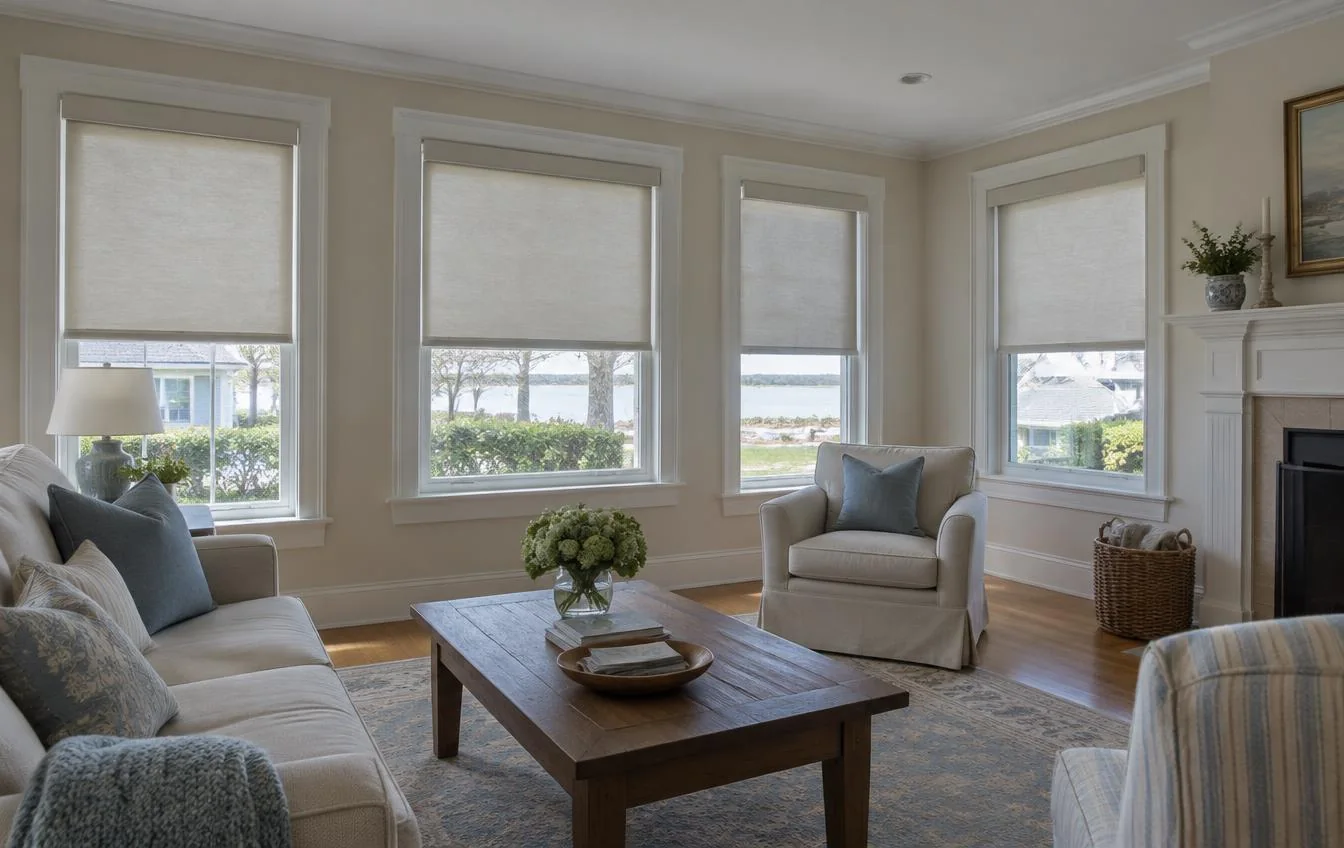
Retrofit is the normal job
Three requirements, all solvable in a finished room.
A motorized shade needs three things at a window. Somewhere to mount the headrail, which is the housing at the top holding the roller and the motor. Clearance for the fabric to hang and roll without rubbing. And power.
All three can be satisfied in a room that is already finished. The brackets land on the window frame, the trim, the jamb or the wall above. The fabric hangs where a manual shade would have hung. Power comes from a rechargeable battery, a low-voltage wire, or line power brought to the window — and which of those applies is a decision of its own, made per window.
What retrofit genuinely changes is the order of operations. In new construction, the window, the pocket and the wiring get designed together, at the same table. In a finished house the window already exists and everything else adapts to it, which is why the measurement visit comes before the proposal rather than after it.
Inside mount or outside mount
The opening decides this, not preference.
An inside-mount shade sits within the window opening, with the headrail tucked up into the frame. It reads neater, it leaves the trim visible, and it is what most people picture when they picture a shade. It also needs enough depth inside the opening to swallow the roller and headrail, and that depth is a requirement rather than a goal.
An outside mount puts the headrail on the face of the trim or on the wall above the window, with the fabric covering the whole opening. It occupies more wall, it covers trim somebody may have paid for, and it resolves nearly every clearance problem there is. It also loses less light at the edges, which becomes important further down this page.
What usually forces an outside mount is hardware. A tilt-in double-hung, where the sashes swing into the room for cleaning, needs clearance the shade would otherwise occupy. A casement needs its crank handle to complete a full turn. A lock, a latch or an operating handle standing proud of the frame needs room to clear both fabric and brackets. Shallow openings, applied stops and heavy decorative trim do the same thing by taking the depth away.
Old openings are rarely square
Which is why every window gets measured on its own.
Long Island has houses from a lot of different decades, and the older the opening, the less likely it is to be square. Walls settle, frames rack, sills sag. Two windows that look identical from across a room can differ by enough to matter. A shade ordered to one measurement and multiplied by six will be wrong on at least two of them.
So each window gets measured individually: width at more than one height, height at more than one point, depth of the opening, and the position of any hardware. That is why a measurement visit takes real time, and why we do not quote shades off a window count.
This matters more with a motorized shade than with a curtain, and the reason is mechanical. A curtain hangs from rings and absorbs a crooked opening without complaint. A motorized shade is a rigid tube running between two fixed brackets, so a quarter inch of out-of-square shows up as a hem that is not level or fabric that tracks to one side. Curtains forgive. Shades do not.
A shade is manufactured to one opening
There is no adjusting one after it arrives.
A motorized shade is built for one specific window. The tube is cut to length, the fabric is cut and welded, the motor is fitted inside, and the assembly is finished to that number. It is built to one set of dimensions, and nothing about it adjusts afterward.
Which places all the weight on the decisions made before the order goes in. Mount type, dimensions, fabric, roll direction, hem style, power method — once those are submitted, they are the shade you are getting. This is the one part of the job where moving slowly is unambiguously the cheaper path.
A dark bedroom is decided by the mount, not the fabric
Edges, channels and pockets.
Here is the mechanism, because it is the part that surprises people. An inside-mount shade has to be slightly narrower than its opening so the fabric can roll without rubbing the jambs. That leaves a small gap down both edges. At night, with a street lamp or an exterior fixture behind it, that gap reads as a bright line down each side of the window. No fabric closes it, because the fabric is not where the light is getting through.
Room darkening comes from how the shade is mounted and enclosed. An outside mount that overlaps the opening on all four sides reduces the edge gap. Side channels — tracks the fabric edges run inside of — close it further. A pocket, meaning a recess built into the ceiling or the window head, hides the headrail and closes the top. Those are construction decisions, and in a finished room some of them are not available without opening something up.
So the conversation about a dark bedroom belongs before fabric selection rather than during it. Someone who orders blackout fabric on an inside mount and expects a fully dark room has bought the wrong assembly — and because the shade was made to size, they own it.
One fabric does one job well
Glare, heat, privacy and view pull against each other.
Four different problems arrive described the same way: "I need a shade." Glare on a television or a monitor. Heat in a west-facing room in August. Privacy after dark. Keeping the view during the day. Each has a fabric that handles it well, and no single fabric handles all four, because the properties that solve one work against another.
An open-weave solar fabric keeps the view, cuts glare and reduces heat, and gives you very little privacy after dark — with lights on inside, people outside can see in. A tighter weave buys the privacy and gives up the view. A blackout fabric handles sleep and gives up both view and daylight entirely. That is the actual trade, stated plainly.
The common answer for a room that needs two of those at once is two shades at the same window: a solar shade for the day and a blackout behind or in front of it. It costs more, it takes more depth, and the mounting has to be worked out up front. For a lot of bedrooms it is still the right answer.
Lutron shades, and what gets specified
Smart Tek is a direct Lutron dealer.
Smart Tek is a direct dealer for Lutron, so Lutron shades are what we specify most, and we order and support them directly rather than through a middleman. The shading lines cover the range of jobs we see: roller shades, honeycomb shades, drapery track, and Roman styles, in both battery-powered and wired families. The battery-powered families come up most on retrofits, where running wire would mean opening a wall. The wired families get specified where wire is available and the job calls for larger shades, tighter alignment, or a particular hardware appearance.
Control is a separate decision from the shade itself. A Lutron shade can be run from a Pico keypad on a wall or in a drawer, from a hard-mounted keypad, from a remote, from a phone, or from a lighting control system it shares. A Lutron lighting system and Lutron shades on the same platform means one keypad can set lights and shades together, which matters for the whole-house version of this. For two shades in a bedroom, a keypad on the wall is usually the entire conversation.
Where the specifics live is worth naming. What each line requires for mounting depth, power and control, and which fabrics are offered in it, come from the current Lutron documentation, and we confirm those against your specific windows before anything is ordered. Those details change with product revisions, so the measurement visit is where they get pinned down rather than assumed.
FAQ
FAQs
No. Motorized shades mount to the window frame, the trim or the wall above, and existing windows of nearly any age and type can take them. The window's hardware and the depth of its opening affect whether the mount is inside or outside, which is a mounting decision rather than a window decision.
Usually not in a way worth doing. The motor, tube, brackets and fabric are engineered as one assembly, and fitting a motor into a shade not built for one tends to produce something that binds, sags or fails early. A new shade built for motorization is the straightforward path.
Those are the classic outside-mount cases. A sash that tilts into the room, or a crank that needs its full travel, requires clearance the shade would otherwise take. Mounting on the trim or the wall above keeps the window operating the way it was designed to.
Yes. The shades themselves are per-window and can be added at any time, and if a control system is going in, it is worth sizing that part for the whole house even when only one room gets shades now. What is awkward to add afterward is anything inside a wall or ceiling — wiring to a window head, or a recess built to hide a headrail — so those belong in the plan while the walls are open, even for windows that get shades years later.
So the order rests entirely on what is true at that window first: the depth of the opening, the hardware that still has to operate, and dimensions that no one can adjust once the shade is built to them. That is why the measurement decides the shade rather than confirming it, and why it happens window by window before anything is submitted.
Plan shades for existing windows
For shade measurement, mounting and control, see Lighting & Shade Control. For power and hidden pockets before walls close, see Smart Home Wiring & Pre-Wire.
Our town guides for Lloyd Harbor and Sagaponack cover motorized shades and lighting control.
Talk through the problem
Call 631-656-9180, Mon–Fri 8 AM–6 PM and Sat 9 AM–1 PM, or tell us what is happening through the contact form. We serve Long Island, Manhattan and the Hamptons.