
Do Motorized Shades Need Power in the Wall?
Shade power is the last line on most orders and the first thing that stops being changeable. Fabric can be swapped later. Mount type can be argued about at the window with a tape measure in hand. A wire that was not run before the drywall closed is not in that category. Power decides what has to happen before the walls close, what the finished window looks like, and who is standing on a ladder in three years — and by the time most projects ask the question, two of those three are already fixed.
There are three ways to power a motorized shade. Each one costs you something. None of them is the right answer in general.
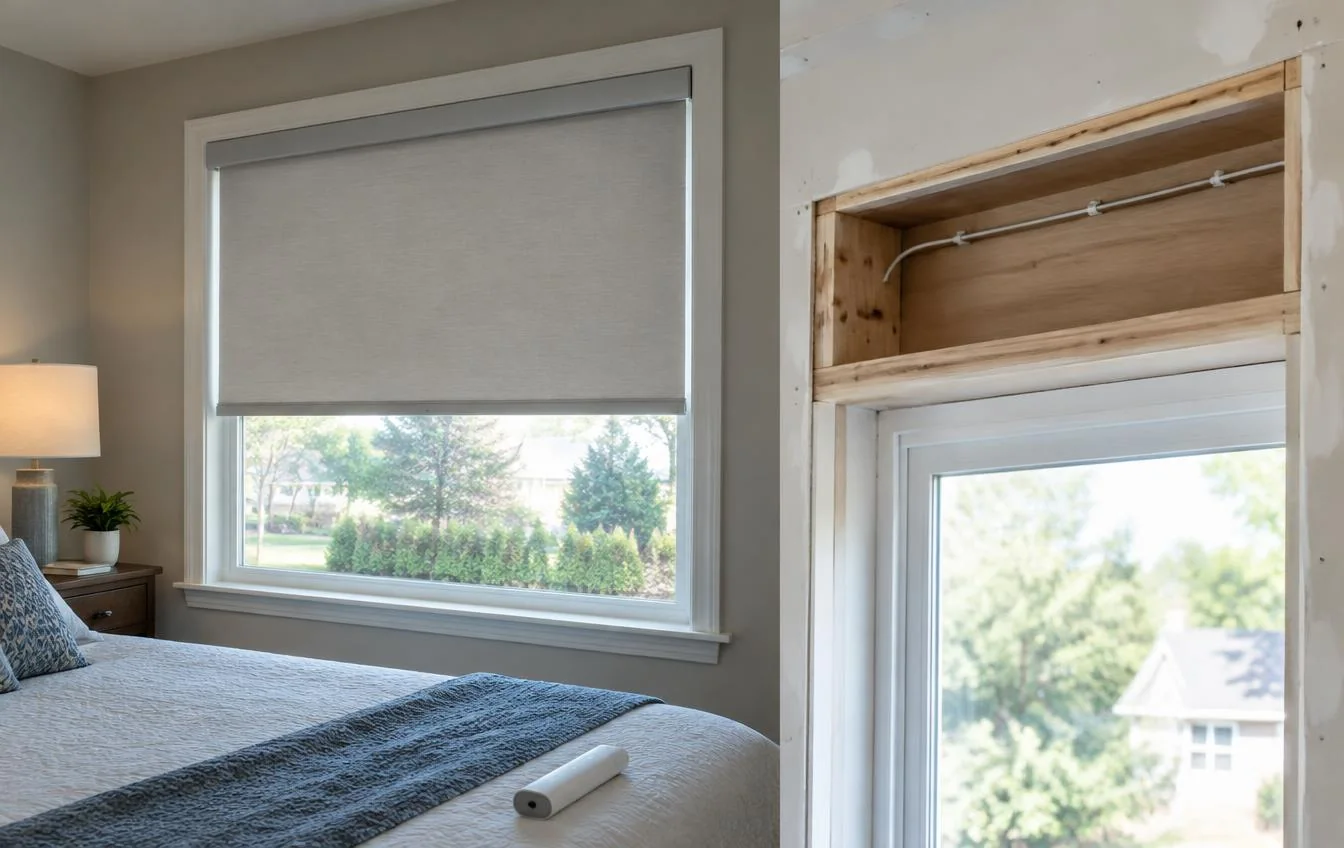
Three ways, and what each one takes from you
Battery, low-voltage wire, line power.
A rechargeable battery is the simplest. Nothing in the wall, nothing to rough in, and a shade can go up in a finished room in an afternoon. The cost is upkeep. The battery runs down and has to be recharged or swapped, at that window, forever.
A low-voltage wire to the shade head is the middle path and the one we specify most when a wall is open. A small cable runs from a power supply or control panel to each shade. The shade never needs charging and nothing shows at the window. The cost is that the wire has to get there, which means doing it before the drywall or opening something up later.
Line power at the window means an electrician brings a circuit to the window head for the shade or its supply. It is the right call for certain large shades and certain products. It is also the most involved of the three — electrical work on the same before-the-walls timing as low-voltage, and more of it.
The correct answer is per window. It depends on access, on how many shades there are, on how often they will move, and on what the specific product requires.
Nobody can quote you a battery runtime
Not honestly, not without seeing the window.
Battery life depends on how large the shade is, how heavy the fabric is, how far it travels, how many times a day it moves, and what power system that particular product uses. A small shade in a guest room moving twice a week is not in the same category as a wide heavy shade on a west wall moving repeatedly through the day on a schedule.
So we do not quote a number of months. Anyone who hands you one without asking those questions is selling, not advising.
The number that means anything is the one in the manufacturer's own current documentation for the exact product going on your window. That is what we check, and what we show you.
Automation moves this more than people expect. A shade on a sun schedule that opens, closes and adjusts through the day is working many times harder than a shade somebody taps at bedtime. The more you want the shades doing on their own, the more a wired shade earns its wire.
Look at the window, not at the spec sheet
The real cost of a battery is the ladder.
A battery shade in a bedroom is a non-event. That is a case where batteries are genuinely the right choice and wiring would be overkill. Legitimate purchase. Right problem.
A battery shade over a stairwell is a different job entirely. So is one at the top of a two-story foyer. So is one above a run of kitchen counter, one behind a fixed sofa in a built-in wall. Each of those is a ladder job, and some of them are ladder jobs needing two people or equipment.
That cost is real and it repeats. So the question gets asked window by window before anything is ordered: who goes up there, with what, and how often. Batteries on the four reachable windows and wire on the two high ones usually beats one rule applied to a whole house.
What has to be in before the drywall
Two items. Both cheap now. Both painful later.
First, a low-voltage wire to the head of every window that might ever take a wired shade. Not only the ones in the current plan. The wall is open exactly once, and the wire is inexpensive. A wire that ends up unused costs almost nothing. A wire that should have been there costs a wall repair.
Second, a pocket, if any shade is meant to be hidden. A shade pocket is a recess built into the ceiling or the window head so the rolled shade and its headrail disappear when the shade is up. It is framing and drywall work, dimensioned around the specific shade going into it, and it cannot be added to a finished ceiling without opening the ceiling. If hidden shades are the goal, that goal belongs on the table during framing.
Both follow the same principle as a sleeve under a driveway. Put the infrastructure in while access is free and let the finished choices come later. Shades can go in years after the wire does.
Two windows is fine. Twenty-two is a chore.
The count changes the answer.
A few battery shades in a house are fine. Genuinely fine — a couple of bedrooms, reachable height, an occasional recharge nobody minds. We specify that regularly and it works.
A whole house on batteries becomes a standing task. Twenty-odd shades at different heights on different charge cycles, with nobody tracking which one is due, gets ignored until something stops moving. Then it gets ignored longer. Then we get the call.
There is no fixed crossover number. It is about how many of those windows you would actually service. If most of the house is reachable and the shades move rarely, batteries carry it. If enough of them are high or blocked, the wire is the cheaper answer.
An app is not control
The test is whether it works with the internet off.
A shade that moves only when an app can reach a cloud service is a shade that stops working when your internet does. Internet goes down on Long Island for ordinary reasons — a storm, a cut line, an outage upstream. None of those should leave somebody unable to close a shade.
So local control is a requirement on every job, not a feature of one. Local control means the control and the shade talk to each other directly, or through a system inside your house, with the app layered over the top as a convenience rather than the only route in.
Schedules get the same scrutiny. A sunrise-and-sunset schedule living on somebody's server stops when the connection does. The same schedule living in the system in your house keeps running. We specify for the second case.
FAQ
FAQs
Sometimes, depending on the product. The hard part is almost never the shade. Getting a wire to the head of a finished window is the work, and that generally means opening a wall or ceiling. If a window is likely to be wired eventually, wiring it while the wall is open costs dramatically less than converting it later.
No, not by itself. A wired shade depends on the power feeding it, so when the house loses power the shade stops where it is. Shades can be put on a backup supply or a generator circuit if that matters — a planning decision, not an afterward decision.
There should not be. A low-voltage wire brought to the window head inside the wall comes out behind the headrail and is hidden by the shade. Cords appear when a wire has to be surface-run in a finished room, which is one of the compromises of adding wire after the fact.
That is a calculation, not a rule of thumb. It depends on the product, the shade sizes and the system, and it gets worked out against the full shade schedule during planning, including windows you might add later, so the supply and its location do not have to change when you do.
The asymmetry is the whole answer. The wire gets decided once, while the wall is open and it costs almost nothing; the ladder gets decided again every time the battery runs down, for as long as that shade is on that window.
Plan shade power before the walls close
For battery and wired shade options, see Lighting & Shade Control. For wiring and pockets during construction, see Smart Home Wiring & Pre-Wire.
Our town guides for Glen Head and Head of the Harbor cover shades, lighting and planning around finished rooms.
Talk through the problem
Call 631-656-9180, Mon–Fri 8 AM–6 PM and Sat 9 AM–1 PM, or tell us what is happening through the contact form. We serve Long Island, Manhattan and the Hamptons.