
Why an Empty Room Sounds Wrong
A living room with nothing in it yet — no couch, no rug, bare drywall on four walls and a ceiling, a subfloor or a fresh hardwood run with nothing on top of it — does something unmistakable to a voice. The room answers it. Not as a distinct echo, which would at least be easy to name and point at, but as a thickening of your own voice: a short ring that trails every word and laps over the beginning of the next one, so that by the time you finish a sentence the room is still working through the front of it.
People describe this in words that have nothing to do with acoustics. The room sounds hollow. It sounds cold. It sounds like a hospital corridor, or a stairwell, or a house that nobody lives in. What they are actually hearing is a room that has lost almost none of the sound energy put into it, because there is nothing in it soft enough, thick enough or irregular enough to take that energy out of the air. A finished room is quietly disposing of sound all day long. An empty one hands it all back.
The weeks when a house is framed and boarded but not yet lived in, and the stretch after one family moves out and before the next moves in, are the only times you ever hear the architecture by itself, with none of the acoustic work the furniture was quietly doing on its behalf.
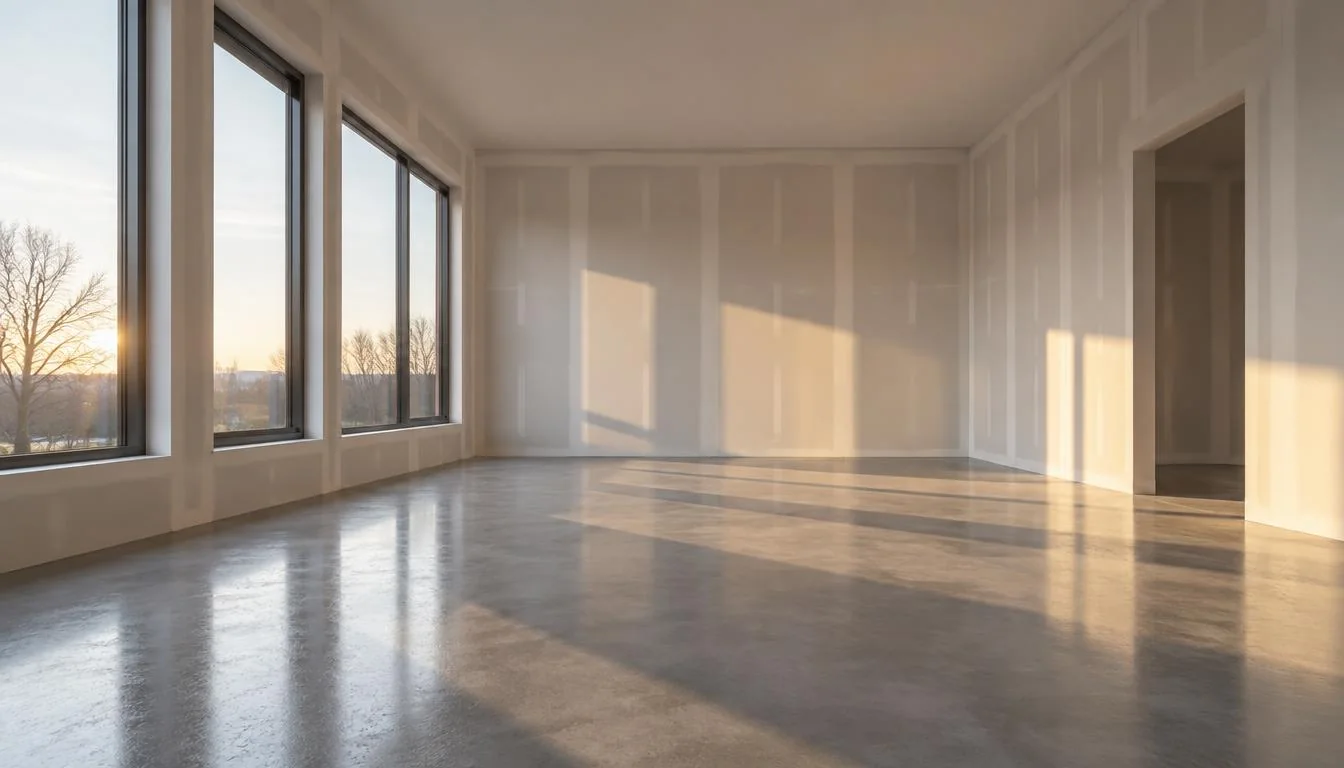
Sound does not stop when it reaches a wall
A wall does three things to sound that strikes it: reflects some of it back into the room, absorbs some of it as heat inside the material, and transmits some of it through to the other side. The proportions are set almost entirely by what the surface is made of and how thick it is. Painted drywall is a hard, light, sealed membrane, and it is very good at reflecting midrange and high frequencies — the band that carries speech and most of what makes music sound like music — straight back where it came from.
So a single hand clap in an empty room is not one event. It is one direct sound followed by a dense succession of weaker copies of itself, each one a reflection off a wall, the ceiling, the floor, a window, then a reflection of a reflection, and so on, each pass a little quieter because the surfaces are not perfect mirrors and the air itself eats a little of the high end. The sound dies out gradually rather than stopping, and the time that decay takes is a measurable property of the room called reverberation time. It is the single most useful number in architectural acoustics, and it is defined cleanly: the time it takes for sound in the room to fall by sixty decibels after the source stops.
That figure is set by two things — how big the room is, and how much absorption is in it. Volume and absorption, geometry and material. An empty room has the volume of the finished room and almost none of its absorption, which is why the decay is so much longer than it will ever be again. How much longer is set by the volume, the proportions and the total absorption actually present, which is why an acoustician measures a room rather than estimating it.
The reflections that arrive first are the ones that change the sound
Of all those hundreds of reflections, the early ones matter out of proportion to their number. A reflection that comes off a nearby wall and reaches your ears very soon after the direct sound is not heard as a separate event at all. Your hearing fuses it with the original, and the result is a single sound with a different tone and a vaguer sense of where it came from. How soon counts as soon depends on the geometry — on the extra distance that reflected path has to travel compared with the direct one — which is why the same room can smear sound in one spot and sound reasonably clear six feet away.
This is also the reason your own voice is unfamiliar in an empty room. You normally hear yourself through your jaw and skull plus a small, well-damped set of nearby reflections off furniture and bodies. Strip the furniture out and the reflections arriving back at your ears are louder, later and harder, and the voice you hear is not the one you are used to producing. The effect is strongest in rooms with two long parallel hard walls, where there is a clean path for sound to run back and forth.
Two flat, hard, parallel surfaces facing each other across a room make a very efficient trap for sound. Energy bounces between them along a path it can repeat indefinitely, losing only a little each time, and what comes back to you is a dense string of closely spaced repeats heard as a single buzzing or ringing event. Acousticians call it flutter echo, and it is most obvious in an empty hallway or a bare stairwell, where the parallel surfaces are closer together and the path between them is shorter.
The reason that geometry matters so much in a house is that the ordinary construction of a room hands it to you by default. Rooms are rectangles. Walls are parallel. Ceilings are flat and parallel to the floor. Add two hard surfaces that happen to be the same distance apart as some musically significant wavelength and you also get particular notes that hang in the room longer than their neighbors — which is the empty-room version of the problem that makes [a finished media room ring](/blog/why-does-my-movie-room-echo) and the reason a bigger speaker is usually [not the thing that fixes a difficult room](/blog/will-better-speakers-fix-a-bad-room).
Speech is the first thing to fall apart
Music survives a long decay better than talking does, which is why cathedrals were built for one and not the other. Speech carries most of its meaning in consonants, and consonants are brief, quiet and high-frequency — a fraction of the energy of the vowels around them. In a room with a long reverberation time, the tail of each loud vowel is still sounding when the next consonant arrives, and it simply covers it. The vowels come through fine, so the voice sounds loud; the consonants are buried, so the words are hard to make out. Loud and unintelligible at the same time is a very specific and very tiring experience, and it is exactly what people mean when they say they cannot hear each other in an empty kitchen.
It gets worse from there, because people respond to a noisy room by raising their voices, and raising their voices puts more energy into a room that was already failing to get rid of it. Four people in a bare open-plan kitchen talking over the ring of their own voices is a feedback loop made of architecture. The same four people in that room a year later, with a rug under the table and upholstered chairs and books on a shelf, have a normal conversation without noticing that anything changed.
What the furniture was doing all along
Furniture is working on the room in more than one way at once, and they are worth pulling apart. It absorbs: anything porous and thick lets sound into its structure and converts some of it to heat rather than returning it to the room. It covers: a rug takes the single largest uninterrupted hard surface in most rooms out of play, and the floor is the one reflection no listener can sit away from. And it scatters: an irregular wall of books, a coffered ceiling, a cabinet with depth to it, a sofa back breaking up the middle of a room all send reflections off in many directions at different times instead of returning them intact, which spreads the energy out and takes the hard edge off the decay without deadening anything.
That third job is the one people skip when they think about this, and it is the difference between a room that sounds alive and a room that sounds like a recording booth. Absorption alone, applied heavily, removes the reverberation and produces a space that feels oddly dead and slightly airless. A real room wants some reflected energy; it wants it diffuse and it wants it short. Which is also why the furnishings that help most acoustically are rarely the ones sold as acoustic products — the subject is covered in more detail in [what rugs and curtains actually do to sound](/blog/do-rugs-and-curtains-change-sound).
The choices that are still open while the room is empty
An empty room is an unusually honest preview, and a few decisions are genuinely easier while it is still in that state than they will be at any point afterward.
The hard surfaces are the first. Floor material, whether the windows get fabric or bare blinds, whether a double-height ceiling stays as a single hard plane — each of those is a large, permanent area of the room's total surface, chosen for how it looks and paid for in how the room sounds. Knowing that in advance does not mean picking carpet; it means knowing what the glass wall is going to cost you acoustically and deciding what will balance it.
The second is layout, because the position of the seating relative to the walls sets which reflections arrive early and which arrive late, and furniture placement is the cheapest acoustic tool in the house. The third is anything that has to happen before the walls close, including where speakers will eventually live and what has to be run to them — the reason [pre-wire during a renovation](/blog/should-you-pre-wire-during-a-renovation) comes up so often is that it is the one category of decision that an empty room makes easy and a finished room makes expensive.
And the last is the honest one: a room that rings when it is empty is not a defective room. It is an unfinished one. The question is not whether to fix it but how much of the fixing you want the architecture to do and how much you are content to leave to the rug, the sofa and the bookshelves — and that is a real design choice, with a different right answer in a [listening room built for one purpose](/services/home-theater) than in a kitchen where four people need to hear each other.
FAQ
FAQs
Usually it improves dramatically, because almost everything you are about to bring in absorbs or scatters sound and the bare room absorbs nearly nothing. What furniture does not fix is geometry — a very large hard surface like a glass wall or a double-height ceiling, or a long parallel pair of bare walls, will still assert itself in a fully furnished room. If a space is going to be used for anything acoustically demanding, that is worth looking at while it is empty rather than after.
Because you are hearing yourself with a set of reflections you have no experience of. Normally the sound coming back to your ears off nearby surfaces is quiet, early and well damped by furniture and people. In an empty room those reflections return louder, later and harder off drywall and bare floor, and they fuse with the sound traveling through your own skull into something that is recognizably your voice but not the one you expect.
It is a reasonable time for it, because those two choices cover more surface area than anything else that will happen to the room, and both are expensive to revisit. It does not mean subordinating the design to the sound. It means knowing, before the order goes in, which direction each choice pushes the room, so the decisions that follow can be made with that in mind.
Yes, in two ways. The larger volume means reflections travel farther between surfaces, so they arrive later and are heard as a longer, more spacious decay rather than a tight ring. But the same larger volume needs proportionally more absorption to reach the same reverberation time, so a big empty room with hard surfaces tends to sound more dramatic and takes considerably more furnishing to settle. Small bare rooms and bare hallways, with their short parallel paths, are where flutter echo is most audible.
Plan the room
For rooms built around sound, see Media Rooms & Home Theater. For speakers and room-to-room listening, see Audio / Video.
Talk through the problem
Call 631-656-9180, Mon–Fri 8 AM–6 PM and Sat 9 AM–1 PM, or tell us what is happening through the contact form. We serve Long Island, Manhattan and the Hamptons.