
Why your cameras alert on everything
The phone comes out before the ladder comes off the van. A screen of notifications, all from one camera, all between midnight and dawn. The homeowner swipes through them for us. Car. Car. Nothing. Nothing. A gray blur that might be rain. Somewhere in that stack is the raccoon that got into the cans, and nobody saw it, because by the second week the notifications had stopped meaning anything.
The alert nobody opens
That is the actual failure on these calls. Not the camera. The camera did exactly what it was told. It noticed the picture change and it said so, every time, and after enough of that a person learns to clear the whole stack without reading it. A surveillance system you have trained yourself to ignore is worth about what an unplugged one is worth.
So the question worth answering is what the camera thinks happened.
Change, not recognition
A camera does not see a person. It sees a grid of brightness values, many times a second, and it compares the new grid against the one before it. Enough values move by enough, and that counts as motion. That is the entire mechanism in its baseline form, and it predates everything anyone calls smart.
Plenty satisfies that test. A person walking up the drive satisfies it. So does the edge of a cloud crossing the sun, which changes every value in the frame at once. A headlight sweeping a stucco wall. An oak branch with leaves still on it. Rain close to the lens, which is enormous in the frame and moving fast. A moth. One strand of web lit from behind.
None of those are mistakes. The camera got the right answer to the question it was asked. The question was whether the picture changed.
Newer cameras and recorders add a second test. Before calling it an event, they run the changed region against a model of what a human shape looks like, or a vehicle. Shape, proportion, how the mass moves across frames. Leaves fail that test. Rain fails it. A person in a hooded jacket, crouched, at an odd angle to the lens, sometimes fails it too, and that is the honest limit of the thing. The second test trades some noise for some misses. The trade is real and nobody should pretend otherwise.
What a detection zone is
A zone is a shape drawn on the image. Inside the shape, change counts. Outside it, change is ignored for the purpose of telling you about it. The sensor still captures the whole frame. The recorder still writes the whole frame. The zone governs attention, not capture.
That distinction gets missed constantly. People assume a zone crops the camera, and they leave the road inside the zone because they want the road recorded. The road is recorded either way.
The street is still the street
This is where a lot of systems were lost on the day they went in. A camera sits on the corner of the house with a clean view down the driveway. From that same position it sees the road, a stretch of sidewalk, and the end of the next driveway over.
Nothing inside that camera has any concept of a property line. The road is the brightest, busiest, most constantly changing part of its picture, and on any street with traffic it is where nearly all the motion in a day happens. Every car. Every dog walker. Every kid on a bike. Every delivery van that is not yours.
A zone is the only honest answer to that geometry, and it is a partial one. It subtracts the road from the alert logic. It cannot change where the camera sits or what the lens can see. A camera that can see the street will go on seeing the street, and if anything at the edge of the zone moves in a way that spills a few pixels across the line on a windy night, the street comes back.
On a tight lot, or where the only mounting point with power faces the wrong way, the view you have and the alerting you want are sometimes not compatible. The real answer there is a different position, a narrower lens, or a second camera doing one job instead of one camera doing three. Sometimes you cannot get there from here, and a month of zone adjustments is a slow way to find that out.
What the trees and the shoreline add
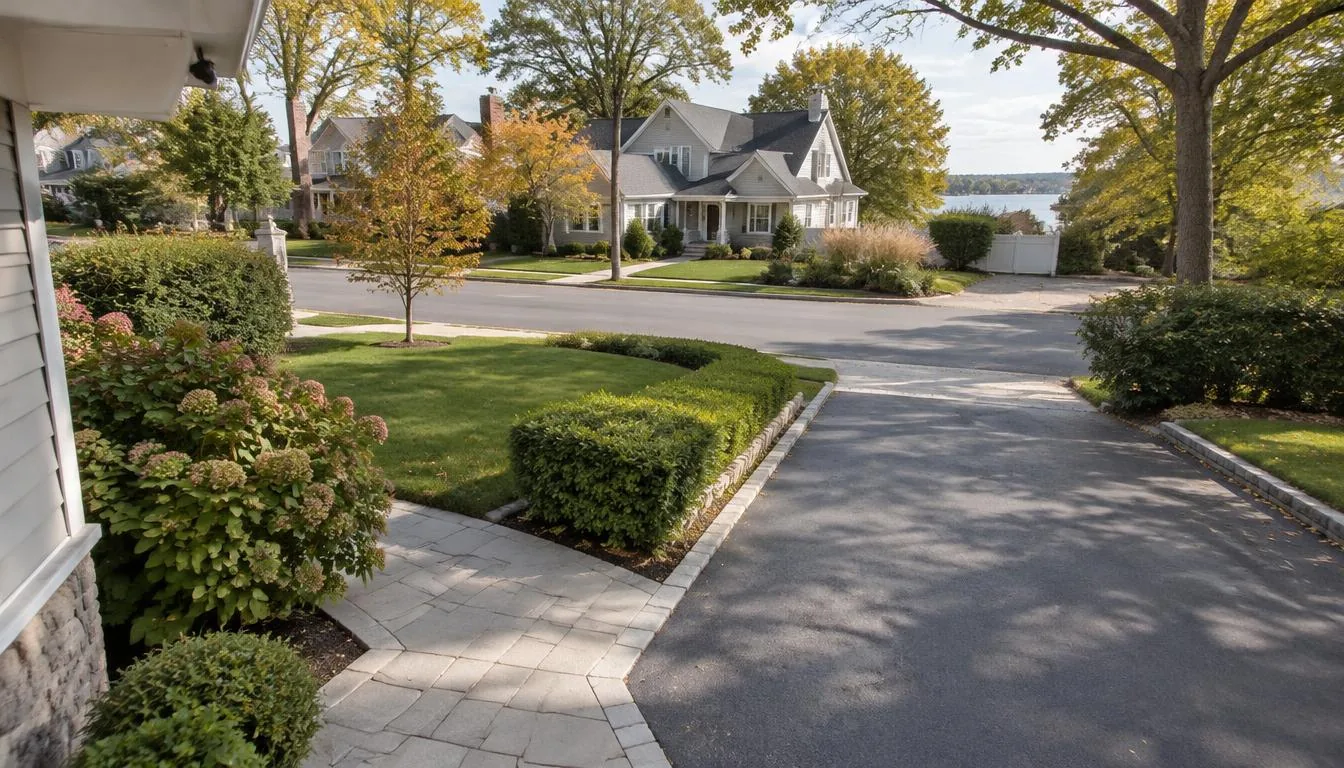
Long Island works against these cameras in specific ways. Mature oak and maple over the driveway means half the frame is in motion whenever the wind comes up, and it stays that way until the leaves drop. Deep lots and long driveways put the thing you care about at the far end of the picture, where a person is only a few pixels tall, which is the hardest case for the shape test to pass. Hedges planted for privacy sit inside the frame and move. Closer to the water, salt film builds on housings and covers faster than people expect, and salt film scatters light.
The site does that, and the site was there before the cameras. Two identical cameras, one in a cleared Smithtown back yard and one under a tree canopy near the shore, will not behave the same way and were never going to.
The sensitivity trade
Sensitivity is a threshold: how much change, across how much of the zone, before the camera calls it an event. Pulling that threshold down does stop the alerts. It stops them by raising the bar that a real event also has to clear, and the events dropped first are the quiet ones. A person walking rather than running. Dark clothing. Night. The far end of the zone. That is a tidy description of the only event anyone installed the camera for.
So the control has a shape. High, and the system is loud and you stop reading it. Low, and the system is quiet and you stop being able to trust it, usually without knowing you should. Threshold is the last thing we touch on a system that is alerting badly, and then by a small amount, because everything above it on this page is a bigger lever.
Alerts and recording are two separate switches
Confusion between these two costs people footage. Alerting is a notification rule. Recording is a storage rule. They are configured separately and they do not have to agree with each other.
Event-only recording writes to disk when detection fires. It saves space. It also means that anything detection missed was never written, and there is no going back for it. Continuous recording writes everything and marks events along the timeline, so a missed detection costs a search instead of the clip. Where there is storage for it, the configuration most houses actually want is everything recorded and almost nothing announced.
Where the footage lives, and how each kind fails
A card inside the camera leaves with the camera if somebody takes the camera, and a card in an outdoor housing lives a hard thermal life through a Long Island August and February.
A recorder in the house depends on house power and on a disk that has a service life, and disks give warning that nobody is reading if nothing is watching for it.
A cloud account depends on the upload path staying up and on somebody continuing to pay for it.
Retention is a real, knowable number. A given system keeps a given number of days before it overwrites the oldest footage. That number sits in the recorder configuration, and whoever set the system up knows what it was set to and knows whether exporting a clip is something the household can do unaided or something that takes a phone call.
What we find
Most of these jobs end without new hardware. The camera is fine. The lens is fine. What is wrong is geometry: a mount that sees a road, a soffit sitting directly above the infrared emitters, a hedge inside the frame, a long dark driveway asked to do a job it cannot do. Under that sits detection left on the shipping defaults, because the defaults are what ships.
Hardware does fail sometimes. When it does, it goes back to the manufacturer under whatever warranty it carries, and the manufacturer decides what that warranty is worth. We help with the claim. Nothing comes back to a bench here, because there is no bench here.
The pattern is consistent enough to name. Noise collects near the lens, where the light is bright and the web is close. Misses collect at the edge of the zone, where a person is small and the infrared has run out. A system tuned by somebody who only ever watched the live view at lunchtime ends up loud at the house and blind at the property line, and it has been that way since the day it went in.
FAQ
Frequently asked questions
Because nothing inside the camera knows where the property line is. It compares one frame against the next and reports change, and the road is the busiest changing thing in its picture. A detection zone takes the road out of the alert logic without cropping the recording, though on some mounts a windy night still spills enough movement across the edge of the zone to bring the street back.
No. The sensor captures the whole frame and the recorder writes the whole frame. A zone governs what gets announced, nothing else, so footage of the street is there afterward whether or not the street was inside the zone.
Usually something very close to the lens. The infrared emitters sit beside the lens, so a strand of web or an insect right at the housing is lit far brighter than the yard and sits far too close to be in focus. It registers as a bright smear or a general fog rather than as a thing, and it moves in the breeze, which is enough to count as motion.
Almost never. The usual causes are where it is mounted, what is in the frame, and detection left on the settings it shipped with. Cameras do fail, but a system that is loud rather than silent is generally working correctly and answering a question nobody meant to ask it.
Plan the camera system
For camera placement, alerts, recording and remote viewing, see Surveillance Systems. If an existing system needs its settings sorted out, including one another company installed, see Service & Troubleshooting.
Our town guides for Kings Park and Locust Valley cover cameras around detached garages and larger properties.
Talk through the problem
Call 631-656-9180, Mon–Fri 8 AM–6 PM and Sat 9 AM–1 PM, or tell us what is happening through the contact form. We serve Long Island, Manhattan and the Hamptons.