
Invisible Speakers in a Finished Room
A fully concealed loudspeaker is not one decision. It is six, and they arrive in a fixed order. First somebody stands in a room, looks at a ceiling or a wall, and decides that a visible grille cannot be there — not that it is unattractive, that it cannot be there. Second, speaker locations get committed on a drawing while the framing is still open, and from that moment they stop being adjustable. Third, the job leaves our trade and joins the drywall and plaster trade, because we mount the frame and somebody else buries it, and those two visits have to be sequenced against each other. Fourth, a thin layer of compound goes over the radiating surface and becomes part of the loudspeaker, whether anyone intended that or not. Fifth, the finish cures and access drops to near zero. Sixth, the number comes in, and it is the highest cost per speaker of any way we know to put sound into a room.
Most people stop at the first step and never find out, because the honest answer at step one is usually no — the grille is not actually unacceptable, it is just unloved. A small-aperture or paintable in-ceiling speaker, chosen well and placed well, satisfies the large majority of the people who first ask about invisible ones, at a fraction of the cost and with none of the sequencing. That is not a brush-off. It is the result we see most often when the question gets pushed on a little.
The remaining cases are real. A plaster ceiling in an older house with no place for a circle. A wall of millwork where every line was drawn on purpose. A room where the person who owns it will not accept a visible grille and is not going to change their mind. For those rooms the concealed speaker is the right call, and the rest of this is what it actually buys and what it actually costs.
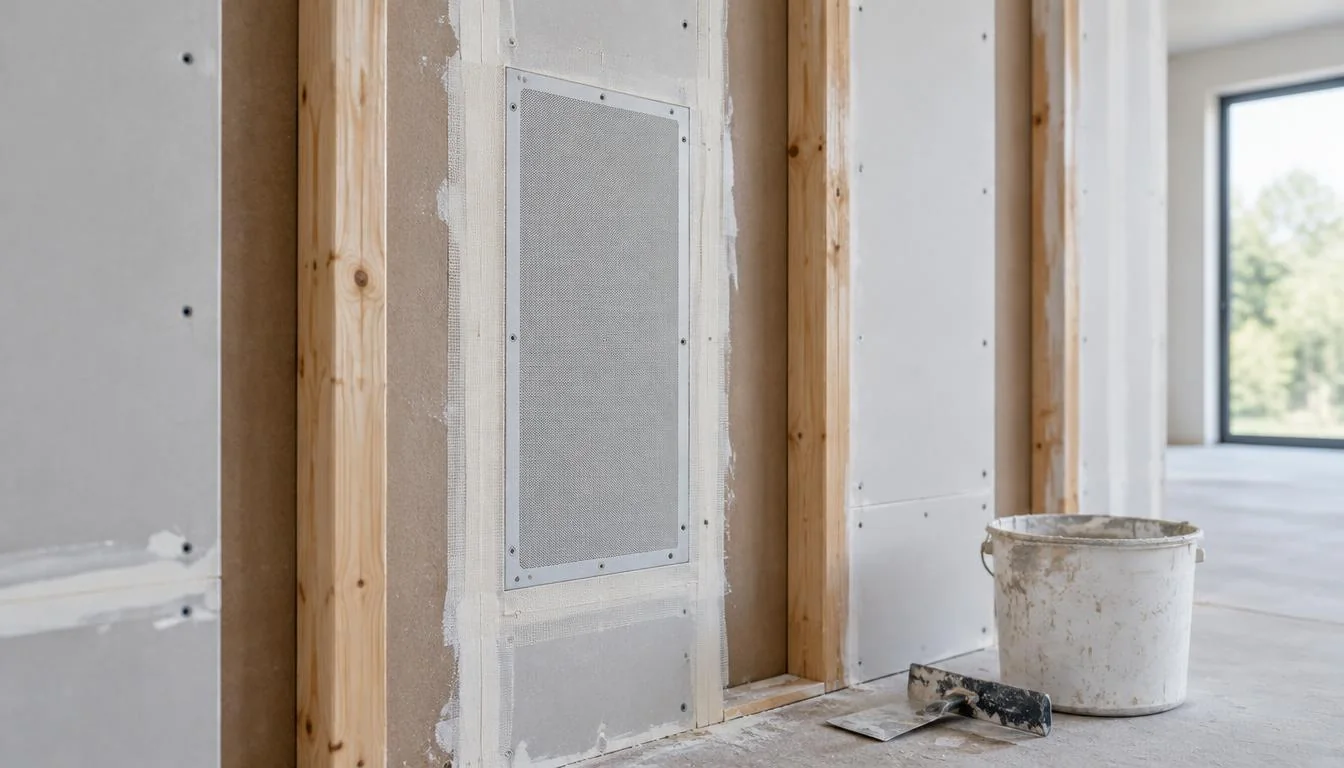
The decision leaves our trade and joins the plasterer's
A concealed speaker is a flat radiating panel in a frame that sits in the stud bay or the ceiling cavity, mounted flush with the face of the board. We install the frame and run the wire. Then the taping and plaster crew treats it like part of the wall — perimeter taped, face skimmed, edges feathered out — and the paint crew finishes the whole plane.
That hand-off is the part that goes wrong. The frame has to be set after framing and before board, which means it belongs on the general contractor's schedule and not on ours alone. The finisher has to know what is behind the compound before the trowel touches it, because the thing he is skimming over is a diaphragm, not sheetrock. Manufacturers publish a maximum finish thickness over the face for exactly this reason, and it is specific to the model rather than general to the category, so it comes off that manufacturer's own published documentation and gets handed to the finisher in writing before anyone opens a bucket. Exceed it and the speaker still plays. It just stops doing the job it was bought for.
That makes the finisher a performance variable, which is unusual in audio. The same model in two rooms in the same house can measure differently because two different people skimmed them on two different days. If you are planning this as part of a renovation, the sequencing conversation belongs in the same discussion as everything else that has to happen before the walls close — our notes on [pre-wiring during a renovation](/blog/should-you-pre-wire-during-a-renovation) cover that timing problem in general, and concealed speakers are the least forgiving item on that list.
Placement is a one-time answer
A grille can be moved. It costs a patch and a paint, and in a ceiling that already has a hole in it the second hole is cheap. A concealed speaker cannot be moved in any meaningful sense, because moving it means cutting a finished, painted, possibly plastered surface and then refinishing a whole plane so the repair does not read as a repair.
So the geometry has to be right the first time, with no revision pass. That raises the stakes on the ordinary questions — how high the speaker sits, how far off the wall, whether it is aimed at a seat or at a room — and those questions get harder when the room is still studs and nobody has settled the furniture. The usual placement logic still applies and does not change just because the speaker disappears; [where speakers sit relative to ear height](/blog/how-high-should-speakers-be) matters the same amount, it simply cannot be corrected later.
This is also where a finished house and a house under construction separate. In a house that is already done, the concealed route means opening finished surfaces on purpose, and the choice is between that and running sound through a room without opening walls at all. The [retrofit options in an older finished house](/blog/wiring-old-house-without-opening-walls) are usually a better trade than demolition in a room somebody just paid to paint.
When the concealed route is taken in a finished room anyway, the money moves almost entirely out of the speaker and into the repair. The plane has to be opened, framed to carry the enclosure, closed, taped, skimmed and repainted, and the repaint seldom stops at the patch, which means the honest scope is a whole wall or a whole ceiling rather than a hole. That is the part that surprises people. The hardware is the smaller half of the bill, and the finish trades decide what the room actually costs.
A layer of compound is a filter
Here is the physical bill for the disappearance. Sound comes off that panel because the panel moves. Adding mass to a moving surface makes it harder to move, and the penalty is not even across the spectrum — it lands hardest on the high frequencies, where the excursion is smallest and the mass matters most. Compound over a diaphragm is a low-pass filter. There is no version of this where it is not.
Good concealed speakers are engineered around that, with stiff panels, strong drive and voicing that expects the finish layer. Within the thickness the manufacturer specifies, they can sound genuinely good. Past it, the top end goes quietly away, and the symptom is not a rattle or a dropout — it is a room that sounds dull and nobody can say why. Six months later somebody blames the amplifier.
Which is why concealed speakers show up most often in distributed audio: kitchens, hallways, primary bedrooms, a dining room where music should be present and nowhere in particular. They show up least often as the front channels in a room built for movies. If dialogue intelligibility and a precise center image are the point, the [basic in-ceiling, in-wall or on-a-stand choice](/blog/in-ceiling-in-wall-or-on-a-stand) is the one to settle first, and the answer there is rarely the invisible one.
What service means once the wall is closed
Serviceability on a concealed speaker is close to zero, and it is worth being plain about what that means in practice.
If a concealed speaker fails, the work is access and replacement in the wall — a drywall crew opens the finish, the panel or frame is exchanged, and the whole plane is re-taped, skimmed and repainted. That is a drywall and paint job with an audio visit attached, not an audio job. We do no repairs in-house and nothing goes to a bench; if a unit is under warranty we assist with the manufacturer's claim, and what the manufacturer offers is what you get. The hardware may or may not be covered. The finish work never is.
The honest planning assumption, then, is that these are near-permanent and should be treated like plumbing in a slab: specified carefully, installed once, and chosen from a line that will still be supported in ten years. It also argues for keeping the amplification and the signal path accessible somewhere else in the house, because every part of the system you can still reach is a part you do not have to open a ceiling to deal with. Our [audio and video work](/services/audio-video) is organized around that idea generally, and it matters more here than anywhere else.
The cheap option, the expensive option, and which comes first
Try the cheap option first, every time, and in the room — not in a brochure.
The cheap option is a small-aperture or paintable in-ceiling speaker: a modest opening, a flush or trim-less edge, a grille that takes the ceiling color and reads as a vent or a detail rather than a loudspeaker. It is ordinary labor, one trade, one visit, and it can be moved later if the room changes. One set in the actual ceiling, in the actual paint, looked at from where people will actually sit, answers the question differently than a swatch on a counter does. A meaningful number of clients who came in certain they wanted invisible speakers look at that and stop there.
The expensive option is total concealment, and the cost is not only the hardware. It is the hardware plus added labor across two trades plus the finishing and paint of whole planes plus the schedule coordination that keeps the frames from being boarded over by a crew that did not know they were there. Project ranges for a concealed-speaker room run meaningfully above the same room done with visible speakers, and the gap is mostly finish work, which is why it widens in a house that is already done.
The expensive option is defensible when the answer at step one holds up under pressure: a visible grille is genuinely unacceptable to the person who owns the room. That is a legitimate requirement and we build to it. It is just a requirement worth testing before the walls close rather than after.
What the sequence tells you
Run the six steps in order and the decision usually declares itself before you reach the end. The people who should be buying concealed speakers are the ones who cannot be moved off step one — who look at a painted grille in their own ceiling and still say no. Everybody else finds their answer somewhere in the middle, when the sequencing, the permanence and the finish bill come into view and the small-aperture speaker in the hallway starts to look like a reasonable thing to live with.
There is one more distinction worth carrying out of this. A concealed speaker buried under too much compound still works. It passes signal, it makes sound, nothing is broken, and a service visit will find no fault. It simply is not useful for the thing it was installed to do, and because the evidence is sealed behind paint, nobody can prove it. The whole argument for getting the sequence right is that this particular failure does not announce itself.
FAQ
FAQs
Yes, and the speaker is the small part of that number. Installing in a finished room means cutting the board, setting frames, re-taping, skimming and then repainting the whole wall or ceiling plane, because a spot repair in a painted surface will read as a spot repair under raking light. In a room that was just finished, that is usually the argument for a retrofit approach that does not open walls at all.
For distributed music in a kitchen, hallway or bedroom, a good one is genuinely satisfying and most people never think about it again. For the front channels in a room built around a screen, a visible speaker of similar cost will give you more top end and a tighter image, because it is not radiating through a layer of compound. The filter is physics, not a brand problem.
Access and replacement in the wall, followed by finish work and paint. We assist with the manufacturer's warranty claim and the manufacturer sets what that covers; we do no repairs in-house and nothing goes to a bench. Plan on the finish work being the real cost of a failure, and specify a line you expect to still be supported years from now.
That is what small-aperture and paintable in-ceiling speakers are for — a large enclosure above the drywall with a small, color-matched opening below. It is one trade, ordinary labor, reversible, and in most rooms it is the version people are actually happy with.
Plan the walls
For speaker selection and placement, see Audio / Video. For the rough-in this depends on, see Smart Home Wiring & Pre-Wire.
Talk through the problem
Call 631-656-9180, Mon–Fri 8 AM–6 PM and Sat 9 AM–1 PM, or tell us what is happening through the contact form. We serve Long Island, Manhattan and the Hamptons.