
Do I Need a Receiver or an Amplifier?
Two statements on the same audio proposal look like they cancel each other out. The receiver already powers speakers. The quote still has an amplifier on it.
Both are correct, and neither one is a mistake. The two boxes do different jobs, and one is not a better version of the other. A receiver is the brain and the muscle together. An amplifier is muscle.
Start with what each one is doing, because the names hide it.
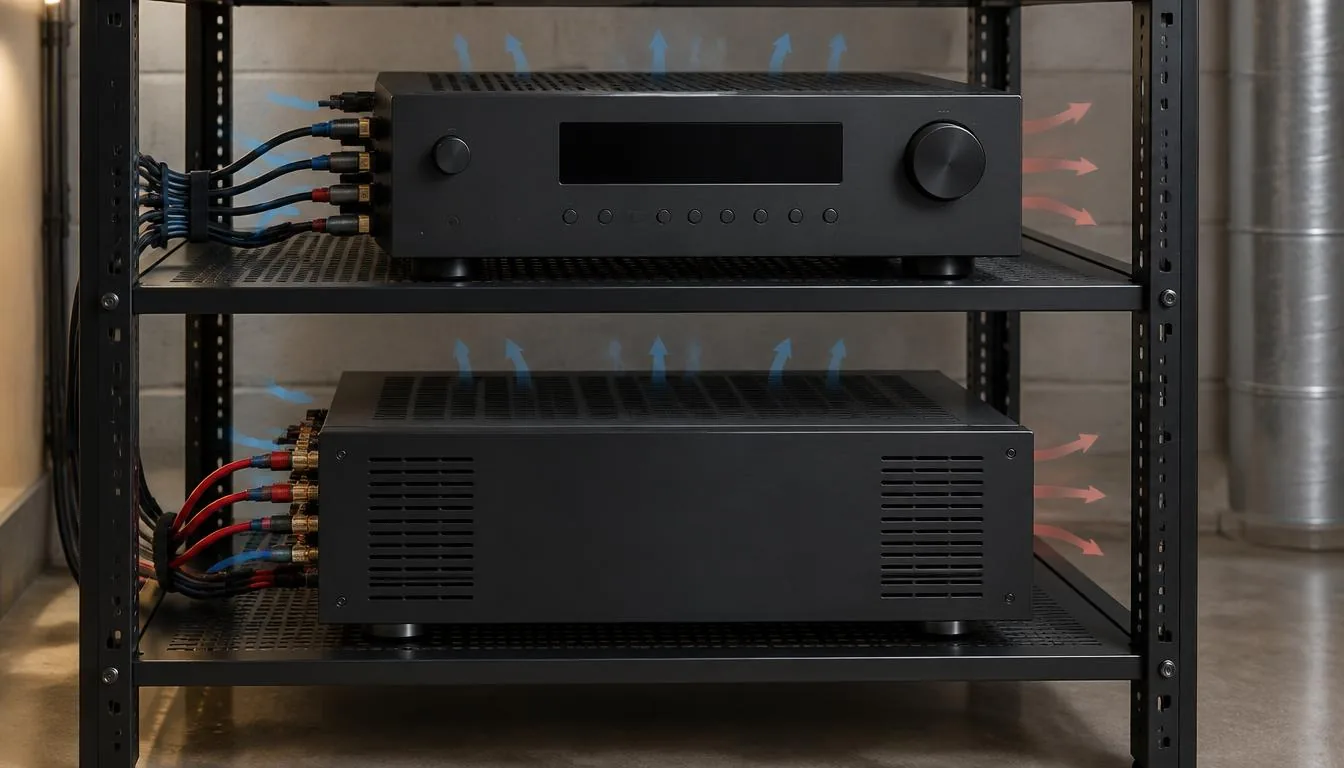
One box with three jobs, one box with one
What a receiver does that an amplifier does not.
A receiver, the box your remote talks to, takes in your sources, switches between them, decodes the soundtrack, passes video through on its way to the television, and powers a set of speakers. Decoding is the part worth naming: a surround soundtrack arrives as instructions, and the receiver is what reads those instructions and decides which speaker gets which sound.
An amplifier takes a signal that has already been switched and decoded and makes it strong enough to move a speaker. That is the entire job. No input selection in any meaningful sense, no decoding, no video, no on-screen setup. It sits downstream of the thinking and supplies power.
Picture a kitchen. The receiver takes the order, plates the food and decides where it goes. The amplifier is the arm carrying the tray. A second arm earns its keep when there are more tables than one arm can serve, and earns nothing when there is one table.
Which is why the two are rarely alternatives. The real question is almost never receiver or amplifier. It is receiver, or receiver plus amplifier.
When the receiver is the whole system
One room, one set of speakers, one place you listen.
A home theater in a single room, with a normal seating area and a speaker package the receiver was built around, is what a receiver is for. Sources in, speakers out, television on the wall, one remote. Adding an amplifier there buys very little and adds a box to power and ventilate.
The same holds for a modest surround setup in a family room. Speakers in that room, a room of ordinary size, normal listening volume: the receiver is the system, and the money does more in the speakers and the subwoofer.
This arrangement stops being enough at a specific point, and the point has little to do with sound quality. It has to do with how many rooms are involved.
What pushes a house into separate amplification
Count rooms, not speakers.
Ceiling speakers spread through the house is the most common reason. Kitchen, dining room, hallway, primary bath, back patio. That is distributed audio, meaning speakers in several separate spaces fed from one equipment location, and it is a different job from driving a surround system in one room. Each space wants its own volume, and the speakers sit far from the equipment and far from each other.
A large open room is the second reason. A great room with a two-story ceiling, hard surfaces and a wall of glass asks more of an amplifier than a closed den of the same square footage does. The goal is not more volume for its own sake. It is sound that stays composed when the volume goes up.
The third is a second zone outside. Outdoor speakers compete with wind, traffic, the pool pump and a landscaper next door, and they have no walls or ceiling helping them. Running a patio off a receiver's leftover channels is where outdoor audio disappoints people. Giving the outside its own amplification keeps it out of the theater's way.
Why a channel count is a maximum, not a promise
The number on the box describes outputs, not behavior.
Receivers list how many channels they handle, and the numbers have grown. A channel is one speaker's worth of output. The count tells you how many of those outputs exist. It does not tell you how all of them behave when every one is working hard at the same moment, because they share one power supply.
The general caution follows from that sharing. The more outputs you ask a single box to drive at once, and the harder you ask it to drive them, the more likely it is that the box, rather than the speakers, is the limiting factor. From the couch that shows up as sound that hardens or compresses as you turn it up, or as a receiver that shuts itself off in the middle of a loud scene while nobody can explain why.
There is no number to quote here, and anyone quoting one across products is generalizing. What a specific receiver can do with a specific set of speakers is in the manufacturer's current documentation for that model, and that is where we go rather than to a rule of thumb. What we will say plainly is this: if a plan has speakers in several rooms hanging off one receiver's spare channels, that is the first place to look when the system underperforms.
Heat decides where the rack lives
The hottest thing in the system is also the most hidden.
A receiver working hard puts out real heat. More channels and more amplifiers make more of it. Heat is what we most often find behind audio equipment that ages out early, and behind a system that turns flaky in August and behaves in February.
So the rack location is an airflow question before it is a cabinet question. A closed media cabinet with a solid back and no vent is a warm box that gets warmer all evening. A closet with a louvered door, or an equipment closet with a dedicated vent and a fan, is a different situation. Where a cabinet is the only spot, it needs active ventilation and it needs to be built for it, which makes it a millwork conversation with the cabinet maker, early.
Equipment in a boring place with air around it, controlled remotely, beats equipment hidden somewhere handsome and cooking. It also keeps service straightforward, because somebody can reach the back of the gear.
What a receiver swap quietly breaks
Five minutes of unplugging, then a week of small annoyances.
The box itself is easy. Everything that pointed at the box is not.
Remote programming has to be redone, because the new receiver does not answer the old commands. Input names return to generic labels, so the one that read "Apple TV" is gone and the family gets something else.
Speaker configuration resets too. Crossover settings, the dividing line deciding which speaker handles the low notes and which hands them to the subwoofer, along with distances and levels, were all set for your room. They are gone. A room correction pass is a fresh pass, not a copy of the old one. A system that was tuned to sound right in that room is no longer tuned.
The expensive version involves a distribution system that expected a particular box on a particular input. If a control system, a video distribution switch or a multi-room audio platform was configured around the old receiver, the swap can break control of things that have nothing to do with sound, and a button for the lights or the shades stops doing anything. Smart Tek is a direct dealer for Sony, Sonos and Lutron, and we handle Control4 and Crestron through integration partners, so when a swap reaches into a control system we bring in the right partner rather than guess at programming somebody else wrote.
One more thing to have straight before a box gets replaced. We do no repairs in-house and we are not a repair shop. If a receiver has failed rather than aged out, we help you work the manufacturer's warranty claim and tell you plainly what that path looks like. What the warranty provides is set by the manufacturer.
FAQ
FAQs
Often, if the receiver provides outputs intended to feed an external amplifier for the channels you want to hand off. Not every receiver does, and which channels can be handed off varies by model. That answer lives on the back panel and in the manufacturer's current documentation for that model, not in a general rule about receivers.
Those are the two usual causes and they feel identical from the couch. Heat tends to show up after the system has been running a while and improves when the cabinet is opened up. A load-related shutdown tracks with volume and with how many speakers are working. Either way the box is telling you it is at its limit, which is a troubleshooting visit rather than something to live with.
Not necessarily. Multi-room music is a different product category from home theater, and there are self-contained ways to do it. We are a direct Sonos dealer, and a music-only house is often simpler and less expensive that way than through a receiver with speakers stretched across it. Add a television with surround sound and the theater side needs its own box again.
Some headroom is reasonable, because adding two speakers later is easier than replacing the box. Buying far past what the house will ever use mostly buys heat and complexity. The same money does more as wire, since a speaker run pulled while the walls are open is the hard part to add later and the box is the easy part.
So the threshold is a count of rooms rather than a count of speakers: one room and the receiver is the whole system, four or five rooms and one box is being asked to be a theater processor and a whole-house audio system at the same time. The floor plan is what draws that line, and it is drawn there whether or not anybody looks at it before the equipment is bought.
Plan amplification and equipment placement
For room-to-room audio and video, see Audio / Video Systems. For a dedicated theater, see Media Rooms & Home Theater Service & Troubleshooting.
Our town guides for Commack and Northport cover audio/video systems and on-site troubleshooting.
Talk through the problem
Call 631-656-9180, Mon–Fri 8 AM–6 PM and Sat 9 AM–1 PM, or tell us what is happening through the contact form. We serve Long Island, Manhattan and the Hamptons.