
What Does the Center Speaker Actually Do?
Two people on the same couch rarely agree about this one. One of them wants the volume up to catch a line of dialogue. The other says it is already too loud, flinches when the next scene arrives, and takes it back down. Then the line after that gets missed. Both of them are reporting the room accurately, and neither complaint gets settled by the control they are fighting over.
That is a dialogue problem rather than a volume problem, and in a room with a surround system it points at one speaker. Taken in the order these turn up in the field, here is what is usually wrong with it.
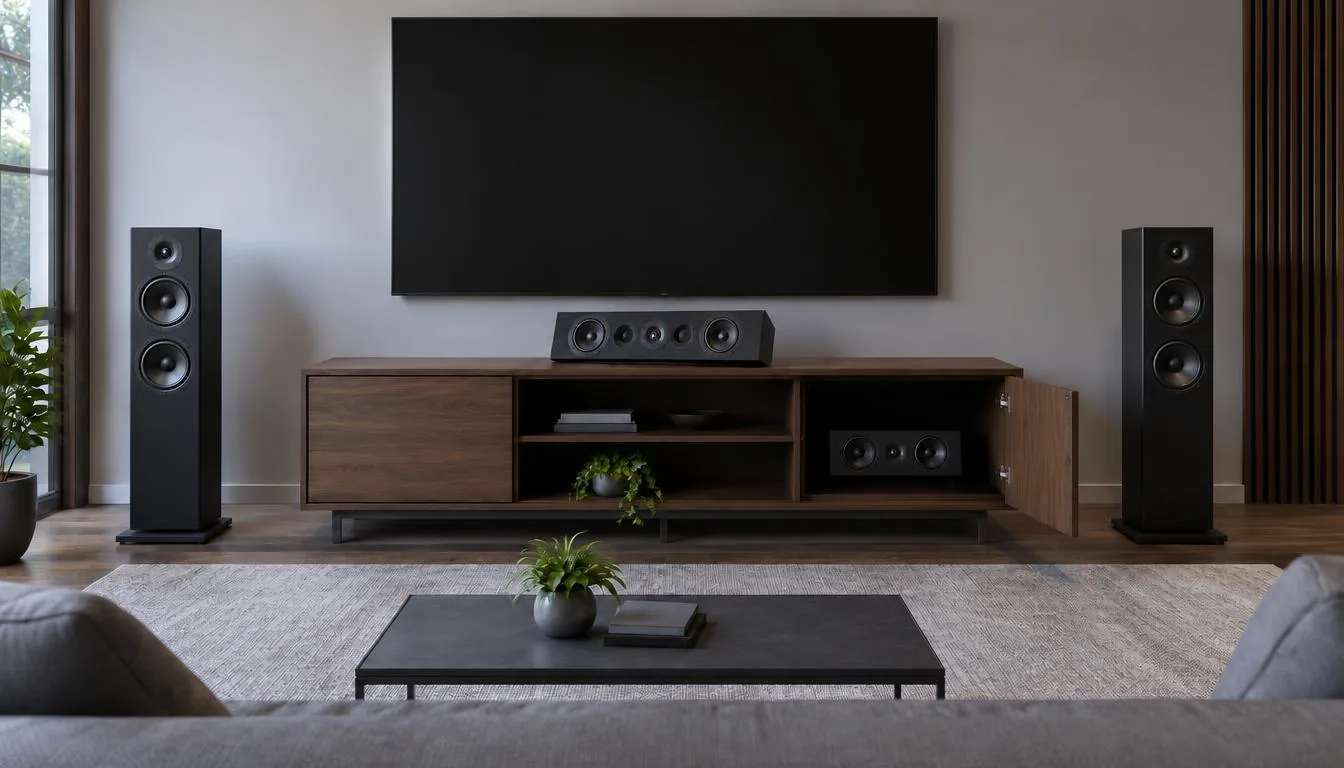
What the center channel is carrying
Most of the dialogue, most of the time.
In a surround mix the voices are sent deliberately to the center channel. Effects move around the room, music spreads wide, and dialogue stays locked to the middle of the screen where the people talking are.
That makes the center the speaker that decides whether the house can follow a movie. Modest surrounds are tolerable. Not understanding the words is not.
Which sets a standard rather than a preference. A center speaker that produces sound is working. A center speaker that keeps dialogue intelligible from every seat in use is useful. Those are two different tests, and the second one is the one that matters.
First: the cabinet
The most common finding, and the cheapest to confirm.
A center speaker inside a media cabinet with the doors closed is the finding that comes up most often. A wooden box in front of a speaker muffles it and adds resonance of its own, so voices thicken while the rest of the system sounds normal. Volume does not correct it. Louder mud is mud.
The mechanism is physical and it is not subtle. Sound leaving a driver has to get through whatever sits in front of it, and a wooden panel passes very little; what does arrive comes late, and it arrives carrying the panel's own resonance and the air trapped in the box behind it. That coloration lands in the range speech lives in, which is why voices go thick while music and effects, arriving from speakers out in the open, stay clean.
The expensive fix is the cabinet itself, built with that speaker accounted for, which is a millwork decision made before the cabinet is built. In a finished room the closed door accounts for more of the complaint than anything else on this list, which is why it gets looked at before any purchase is discussed.
Second: height and aim
A center on a low shelf is aimed at your shins.
The next finding is geometry. A center speaker on a low shelf under the television points at the front of the couch, not at the heads on it. High frequencies are directional, and they carry the detail that separates one consonant from another, so that detail goes into the floor and the upholstery.
Tilting the speaker up toward the seats recovers a fair amount of it. Aim is what decides where that directional energy lands, and volume is not a substitute for it.
The standard here is not level. The standard is aimed at ear height in the seats people use.
Third: a center that does not match the pair beside it
The one nobody checks.
A center from a different family than the left and right has a different tonal character. Different drivers, different cabinet, different voicing. In a room that reads as a change in the quality of a sound as it crosses the front of the room.
Voices expose it before anything else does, because everyone has spent a lifetime listening to speech. Music panning left to right can hide a mismatch. A character walking across a room while talking cannot: the voice thins or thickens as it passes the middle, and people who cannot name the problem will say the dialogue sounds strange.
This one gets skipped because nothing is broken. Every speaker plays. The system passes a channel test. It fails the standard anyway. The practical rule is to buy the front three together, from the same line, and keep them as close to identical as the room allows. Matching the fronts matters more than matching the surrounds.
Fourth: level and setup
Set once, then never looked at again.
A center channel level set low in the system setup produces the same complaint as a muffled cabinet. So does a distance figure entered wrong, or a setup run before the furniture arrived and never run again.
This is a no-cost check, which is why it belongs ahead of any purchase. It is also the one most likely to have drifted, because a receiver swap, a firmware update or a factory reset clears those figures and nothing on screen announces that they are gone.
Mounting: above, below, in-wall, on-wall
Permanent and tidy, or movable and visible.
Below the screen is the usual position and a good one, provided the speaker is tilted up toward the seats rather than firing level across the floor. Above the screen works where below is not available, with the same requirement reversed: aimed down at the listeners.
In-wall is the cleaner install and it carries commitments. The location is fixed, the stud bay has to fall in the right place, and a change of mind later means patching drywall. On-wall or on a shelf keeps the position adjustable and leaves a visible box. Neither is wrong. One is permanent, the other is movable.
The fireplace is its own case. A television above a firebox puts the screen high, which puts the center either well above the seats or down on the mantel with masonry around it. Both produce the same result: voices arrive from somewhere other than the faces, off a hard surface on the way. Aim, mounting and system setup improve it. None of them undoes a screen at that height. In a room being built or renovated the position of the television is still open, and that is the moment to discuss it.
Where a soundbar stands in
Some have a center section. Some produce a center image.
A soundbar sits under the television in roughly the right place, which puts it ahead of a left-and-right pair with nothing in the middle. Some include a dedicated center section with its own drivers, and the voice then has a real source in the middle.
Others produce a center image from their left and right sections. That is the same effect a stereo pair makes, in a smaller package: convincing in the seat directly in front, less so as you move off to the side. Which approach a given bar takes is a property of that product, and the manufacturer's current documentation for it is where that is settled.
A bar is a reasonable answer in a bedroom, a kitchen or a secondary television, and in a family room where in-wall work is not happening. In a room built for movies, a placed and matched center speaker is doing a job a bar is not attempting.
Why a left-and-right pair alone lets voices drift
Two speakers can produce a middle. One seat gets it.
With a left and a right speaker and nothing between them, dialogue has to be produced by both at once, and your ears construct a voice that appears to come from the space between them. The effect is real from one seat.
Off that seat it comes apart. Sitting closer to the left speaker means sound from the left arrives sooner and louder, so the voice slides toward that speaker and away from the mouth on the screen. The further off center the seat, the further the voice detaches from the picture. The chaise end of a sectional is normally the worst seat in the room for it.
A center channel replaces that effect with a source. The voice comes from the middle because something in the middle produces it, and that holds from the end of the couch, from the kitchen doorway, and from the floor where the kids sit.
FAQ
FAQs
Usually, if the receiver has a center channel output and a way to record that a speaker is now there. The speaker then needs a position and an aim, and the setup has to be re-run so levels and distances account for it. On an existing surround system it is one of the more noticeable changes available.
That pattern points at the center channel. Music and effects reach you through the other speakers normally, while dialogue passes through whatever is wrong in the middle: a closed cabinet, a speaker aimed at the floor, a level set low. The physical situation accounts for more of these than the settings do.
Same line matters more than same brand. Two models from different families by one manufacturer can be voiced differently. The test is whether a voice crossing the front of the room changes character, and buying the front three as a set is the surest way to pass it.
Below, tilted up at the seats, is the common choice and the easier one. Above works when below is not available, aimed down. What matters more than above or below is that it is aimed at ear height in the main seats and not blocked by a cabinet door, a mantel or a row of game consoles.
Four findings, and three of them are not the speaker at all: the box built around it, the direction it points, and whether it was bought with the two beside it. Dialogue faults cluster in the middle of the front three because that is the one position in a surround system where the cabinetmaker, the furniture height and the purchase order all get a vote.
Check dialogue and speaker placement
For speaker placement and system setup, see Audio / Video Systems and Media Rooms & Home Theater. For an existing system with unclear dialogue, see Service & Troubleshooting.
Our town guides for Commack and Sea Cliff cover audio/video and media-room work.
Talk through the problem
Call 631-656-9180, Mon–Fri 8 AM–6 PM and Sat 9 AM–1 PM, or tell us what is happening through the contact form. We serve Long Island, Manhattan and the Hamptons.