
The smallest opening in the ceiling
A ceiling is the only surface in a room that holds nothing. Walls take art and casework and a paint color somebody argued about. Floors take rugs, furniture, traffic. The ceiling takes nothing, which is exactly why the eye goes there, and why every circle cut into it counts for more than it should. Downlights at a spacing, a smoke detector, a sprinkler head, a register where the duct comes through — a ceiling that reads as calm is almost always a ceiling where somebody already fought about where those things land.
Then the drawings come back with speakers on them, and the new circles are larger than anything else in the field.
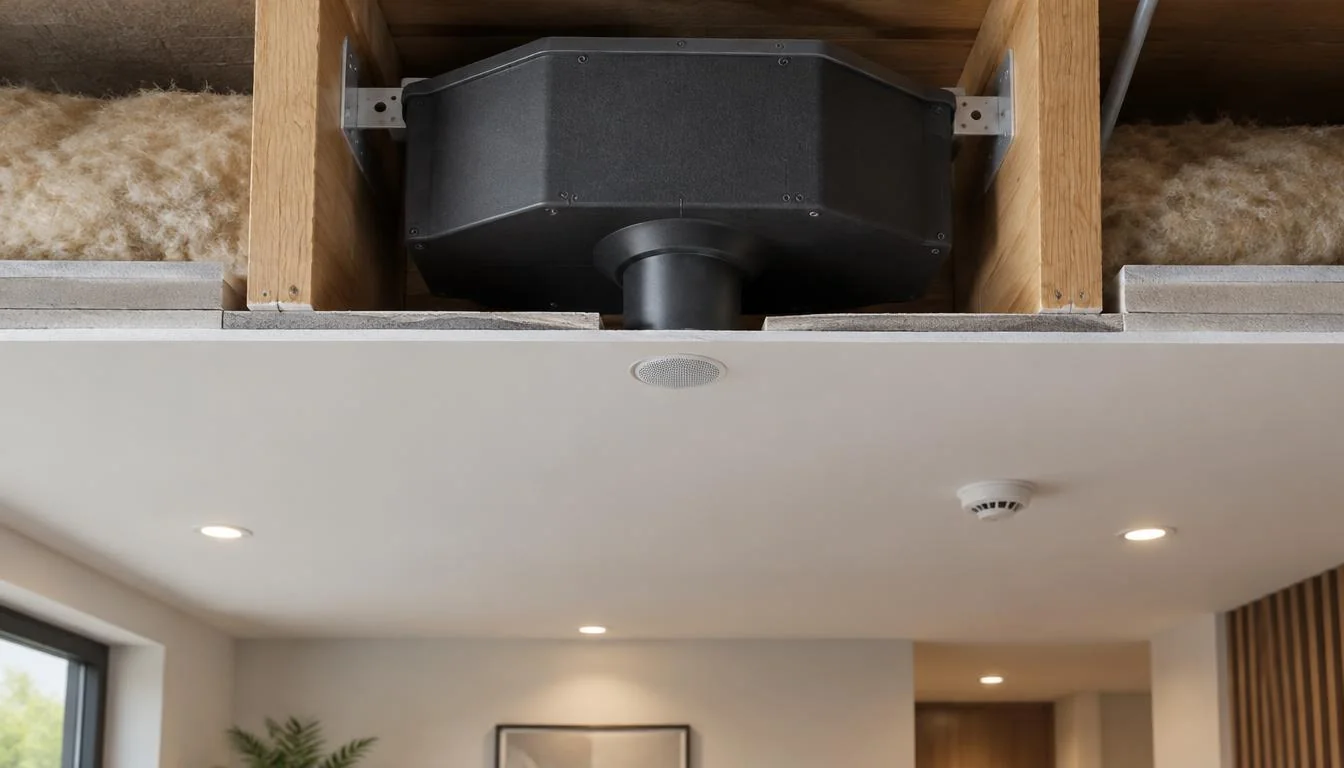
That is the problem small-aperture in-ceiling speakers exist to answer. A large enclosure goes up into the ceiling cavity before the sheetrock, the rock closes around it, and what is left in the finished plane is a square or a circle three or four inches across — closer to the size of a trim ring on a downlight than to the size of a speaker. The sound comes out of that. Architects and designers tend to like them on sight, for the obvious reason: the ceiling stays almost unbroken.
Why the box is the speaker
The part that surprises people is that a cone moving in open air is not really a loudspeaker. It pushes air forward on one stroke and pulls it back on the other, and where the front and back of the cone can reach each other, those two motions cancel. Low frequencies cancel worst, because their wavelengths are long and the air has time to travel around the edge and meet itself. What stops that from happening is the enclosure: a wall between front and back.
The enclosure does a second job. The air sealed behind the cone acts like a spring, and the stiffness of that spring — set by how much air is trapped and how rigid the box around it is — helps decide how low the driver can usefully play and how controlled it stays when it gets there. A different volume of air behind the same driver is a different instrument, not merely a different housing.
A conventional in-ceiling speaker, the round kind with the grille, usually has no enclosure of its own. It has a frame, a baffle, a driver, and behind that, whatever happens to be up there: a tight joist bay, a corner of an attic, the cavity between two floors. The speaker is borrowing a box from the house. That is why the same model in two ceilings in the same house does not always sound like the same model — one is sealed into a shallow bay with a floor above it, the other opens into a cavity the size of a garage.
Back boxes exist for conventional speakers, and on careful jobs they get specified. The small-aperture design takes the same idea and stops treating it as an accessory. The enclosure is the product: sized, sealed, braced, with the driver mounted inside it rather than at the ceiling line.
The opening is not the driver
On a conventional in-ceiling speaker, the visible circle is roughly the driver. The cone fires straight down through the opening, so the opening has to be about as wide as the cone is. What reads as a cover over the speaker is more accurately the speaker's face.
Moving the driver off the ceiling line breaks that relationship. The woofer sits inside the buried enclosure and fires into a volume and a tapered path that ends at the small opening. The displacement work — the actual shoving of air back and forth, which is all low frequency really is — happens up inside the ceiling, where there is room for it. What arrives in the room is that same air movement squeezed through a much smaller area, moving faster through it.
Wavelength is what makes this physics rather than a trick. Low frequencies are physically long; a bass wave is measured in feet, not in inches. An opening a few inches across is so much smaller than the wave coming through it that the wave hardly registers it as a restriction at all. It loads through and radiates into the room from that point. High frequencies are the opposite case: short waves care a great deal about the geometry they emerge from, which is why these designs place a dedicated small radiator at or near the aperture rather than asking a buried woofer to deliver treble up a pipe.
Then there is the side effect nobody expects to like. A small opening behaves like a point in space. A large cone aimed at the floor beams — it throws its highest frequencies in a narrowing cone directly beneath itself, which is why walking under a row of conventional ceiling speakers can feel like walking through a series of bright spots with dull stretches between them. A few inches of aperture spreads far more broadly. In a hallway, in a kitchen with no fixed seating, in an open plan where people are always moving, that evenness is worth as much as the hidden hardware is.
The taper and the geometry of the opening are also why this is not something to improvise on site. Air moving quickly through a small passage is air that can be made to whistle or hiss if the path is wrong, and the path is the engineering.
What the ceiling gets in exchange
Seen as geometry, a ceiling is a field of small points at intervals — lights, a detector, a register, maybe a vent. Add two large circles and the field now contains two objects, and the eye sorts objects into equipment. Brought down to the same order of size as the downlights, the same speakers stop being objects and rejoin the pattern.
Many of these are available with square or round trims and a paintable face, which means the aperture can be matched to the trim already specified for the lighting. On a drawing set where somebody has aligned the downlights to the cabinetry and the cabinetry to the window mullions, that is not a cosmetic detail. It is the difference between a ceiling that holds its order and a ceiling with audio equipment introduced into it late.
Where the extra money goes
This is a materially more expensive way to put sound into a ceiling, and it arrives on a proposal as a different tier of project rather than as an upgrade line. Part of that is the speaker, which now includes a built enclosure instead of a trim ring. The rest is the work around it: coordination before the framing closes, depth and clearance in the bay, staying out of the way of ducts, sprinkler lines, structural members and the lighting layout, and finish trades closing sheetrock around a box that has to end up flush and square with a plane nobody has built yet.
It is worth being plain about what that buys. The extra cost does not buy more sound than a well-chosen conventional in-ceiling speaker with a proper back box behind it. It buys a ceiling that does not show where the sound is coming from. Where visible hardware is acceptable to everyone who will live in the room, a conventional speaker in that same ceiling is a fraction of the cost and can be genuinely good. The reason to spend the difference is that somebody wants the sound and will not accept the hardware in view.
Sonance builds a small-aperture architectural line, and James Loudspeaker builds small-aperture models of its own. Those are products that exist and that we install, and the model is the smaller half of the decision — the amplification and electronics live in a rack somewhere else in the house, which carries its own set of questions about [where equipment goes and how it breathes](/blog/where-should-equipment-go).
The sequence this has to live in
Everything above depends on one condition: the ceiling is still open. The enclosure needs to be hung in the cavity, wired, braced and positioned while the framing is exposed, and then the rock goes on around it. There is no version of this that arrives after the ceiling is taped and painted, because the enclosure is bigger than its own opening. That is the whole premise.
Which puts it in the same part of the schedule as the rough electric and the duct runs, being argued about with the people who own those ceilings on the drawings. A speaker decision made during framing is cheap in every sense. The same decision made after the finish coat is a different job with a different name, and often a different answer: a [speaker that plasters into a finished surface](/blog/in-ceiling-in-wall-or-on-a-stand) solves the hardware problem a second way, by a different mechanism, with its own set of things to give up.
FAQ
FAQs
Not the way people assume. Output comes from the driver and the enclosure, and the aperture is the coupling between that and the room rather than the bottleneck. What a particular model actually delivers is set by its own design rather than by the width of the hole, and that figure lives in the manufacturer's documentation.
Usually, and that is a large part of the appeal — the goal is a small element that reads like the lighting trim rather than like a speaker. What finishes a given manufacturer permits on its own trim is set by that manufacturer, and on most jobs the answer lands while the finish schedule is still being written.
Routinely, and it is usually the sensible way to spend the money. The rooms where the ceiling is part of the architecture get the small aperture; a laundry room, a back hallway, a garage gets the round grille nobody will look at twice. The one place it needs thought is a single zone that spans both, because two different radiating designs playing the same music in the same open space will not have quite the same character.
Rarely, and not in the way the question hopes. Opening a finished ceiling to hang enclosures turns a speaker decision into a sheetrock and paint project. A renovation already taking a ceiling apart is the natural moment; a finished room is where the invisible panel and the conventional speaker both start to look reasonable again. What is still decidable while a ceiling is framed and open is nearly everything: which plane, how many, where they sit relative to the lighting grid, whether the trim is square or round, and whether the room is getting background music or something that has to hold up at volume. Those are design choices, and they are cheap while the bays are visible. What closed is narrower, and it closes quietly. The moment the rock went up and the tape went on, the ceiling answered the question for the house: the hardware shows, or the room gets a different solution. Nobody holds a meeting about that. It is decided by a trade that was never in the conversation.
Plan the ceiling
For speaker selection and placement, see Audio / Video. For the rough-in this depends on, see Smart Home Wiring & Pre-Wire.
Talk through the problem
Call 631-656-9180, Mon–Fri 8 AM–6 PM and Sat 9 AM–1 PM, or tell us what is happening through the contact form. We serve Long Island, Manhattan and the Hamptons.