
Why Does My 4K Movie Look Soft?
The picture looks soft, so the television must not be good enough. No.
The television is almost never the problem. A picture passes through six or seven things before it reaches your eyes, and it is only as good as the weakest of them. Soft is the chain telling you where it is being squeezed.
Replacing the last link does nothing about a pinch at the first one. That is the whole argument, and it is why a new television is the answer most often sold for this complaint and the one least likely to fix it.
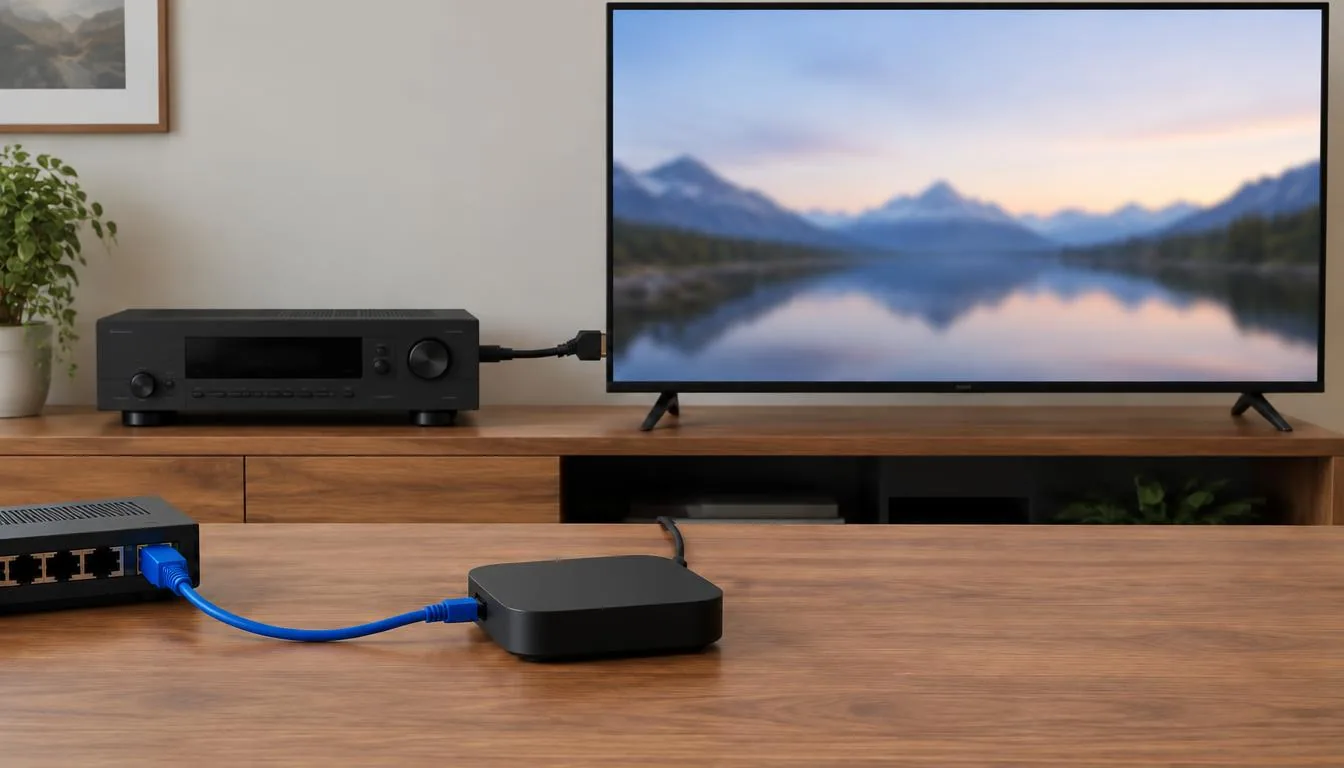
The chain, top to bottom
Internet, app, streaming device, HDMI run, receiver, television.
Your internet connection delivers the data. The app decides how much of that data it will use and how hard to compress it. The streaming device or the disc player decodes it. The HDMI run carries it. A receiver or a switch in the middle passes it along. The television displays it.
Any one of those can throttle the picture. None of the ones downstream can undo it. A television cannot add detail that never arrived. A receiver cannot restore what an app decided not to send.
The answer usually sits in the first two or three links, before anybody buys hardware. Replacing the television is working the chain from the bottom, and it leaves the soft picture exactly where it was.
Streaming and disc are not the same movie
Same title, same screen, different amount of data.
A disc carries far more data for a given movie than a stream does, because it does not have to cross your internet connection in real time. The difference shows up where compression struggles: dark scenes, smoke, fog, water, film grain, slow pans across detailed backgrounds. Blocky shadows and mushy dark scenes are a compression signature, not a panel signature.
It also explains something people assume they are imagining. The same movie looks different on two services, on the same television, on the same evening. Each service encodes its own version, chooses its own data rate, and makes its own decisions when your connection wavers.
That makes a disc or a local file the most useful diagnostic in the house, whether or not you watch discs. It takes the internet and the app out of the chain.
The network is the usual culprit
Where the streaming box sits decides what the app sends.
Most soft-picture calls end up being network calls. A streaming box or a smart television sitting far from the access point, through a floor and two walls, works with whatever signal survives the trip. It does not fail. It downshifts, and the app sends a lower-quality stream to keep playing without buffering. You get a watchable picture that is not the picture you paid for.
Band selection is next. Many televisions and streaming devices will hold onto a slower, longer-reaching band when a faster one is available, and once connected they tend to stay there. A device a few feet from an access point can be on the wrong band, and nothing on screen says so.
Then there is time of day. Fine at two in the afternoon, soft at eight at night. That is not the television. That is the whole house online at once, and the neighborhood doing the same. Evening softness that clears overnight is a network answer every time.
A bigger plan from the provider is the thing most often sold against this and the thing least often needed. If the data gets stuck after it enters the house, paying more every month changes nothing. Placement and wiring change it. An access point in the right place, or a wire to the main television, takes the variable out, and a wired streaming device does not care how many people are home.
The middle of the path
One older link, newer equipment on both ends of it.
The signal usually passes through something between the source and the screen: a receiver, a matrix switch, a splitter, a wall plate. If one of those is older than the equipment around it, it can hand a reduced version of the signal to the television while everything appears to work. No error message. A picture that looks acceptable and not as good as it should.
Long passive HDMI runs are the other frequent one, and they are frequent because they are invisible. A cable that was fine for an older television and an older source can go marginal when both ends get upgraded. A marginal HDMI connection does not always fail outright. It can drop to a lower mode, flicker, lose handshake now and then, or sparkle. No maximum length holds across products, so a long run through a wall gets tested rather than assumed.
Settings nobody changed
Out of the box is a showroom setting.
Televisions ship in a picture mode chosen to stand out on a sales floor, and plenty of them are never changed. Showroom settings push brightness and sharpness in ways that do strange things at home. Over-applied sharpening makes an image look harsh and less detailed at the same time, with halos on edges.
Motion processing is the second. The feature that smooths motion makes film look like video. People describe the result as cheap or oddly fluid rather than soft, and it changes the character of everything on the screen. It is usually on by default.
The third is the input. On many televisions an HDMI input has to be set to its full-bandwidth mode before it will accept the highest-quality signal, and until it is, the source and the television quietly settle for something lesser. What that setting is called, where it lives, and whether a given television has it at all is a property of the model and often of the individual input, which is why we check the television in front of us instead of describing a menu we have not seen.
When it is the television
It happens, and it looks different.
A failing backlight, a bad zone, a defect that shows on a uniform bright field. Those are real. They look unlike a soft picture: uneven brightness, a dim patch, a tint across part of the screen, something visible on a plain white image.
On that, plainly. Smart Tek does no repairs in-house and is not a repair shop. We do not take televisions, receivers or speakers to a bench. We help you work the manufacturer's warranty claim, document what we found and get the right information to the right place. What the manufacturer provides is what you get, and we will tell you up front what that path tends to look like rather than promise an outcome we do not control.
More often the television is fine and the chain in front of it is not.
FAQ
FAQs
Each service encodes its own version and chooses its own data rate and compression. Those choices differ, and they shift with what your connection can sustain at that moment. Two services on the same television on the same night are sending you different pictures.
Often no. If the bottleneck is inside the house, a streaming box far from the access point, a device on the slow band, or a network that bogs down in the evening, more bandwidth at the curb changes nothing, because the data gets stuck after it arrives. A bigger plan is a legitimate purchase when the connection is genuinely undersized. It is not a fix for this problem.
For a main television, yes, where it is practical. A wire removes band selection, distance, interference and evening congestion in one move. For televisions in rooms where a wire means opening walls, a well-placed access point is the better trade.
No, not in the way the packaging implies. A connection either carries the signal reliably or it does not. The question that matters is whether a particular cable handles what your equipment is sending over the distance it has to travel, which comes down to length, routing and cable type. Price does not answer it.
A new television buys a new television. It does not buy back the detail an app, a network or a tired link in the middle already threw away, because nothing at the end of a chain restores what something upstream of it discarded.
Check the picture path and the network
For the connection inside the house, see Networking & Wi-Fi. For source, display and control setup, see Audio / Video Systems. For an existing system with a picture problem, see Service & Troubleshooting.
Talk through the problem
Call 631-656-9180, Mon–Fri 8 AM–6 PM and Sat 9 AM–1 PM, or tell us what is happening through the contact form. We serve Long Island, Manhattan and the Hamptons.